

Your Pipeline Is 12.0h Behind: Catching Law Sentiment Leads with Pulsebit
We’ve just observed a significant anomaly: a 24-hour momentum spike of +0.380 in sentiment around the topic of law. This spike indicates a burgeoning discussion highlighted by a French press article addressing a new California law restricting law enforcement's involvement in state elections. As developers, we need to be vigilant about these shifts in sentiment, especially when they can lead us to timely insights.
The underlying problem here is the structural gap in any pipeline that fails to accommodate multilingual content or recognize dominant entities. Your model missed this momentum spike by a staggering 12 hours—an oversight that could result in missed opportunities or blind spots in sentiment analysis. The leading language of this spike, French, underscores the importance of multilingual processing in your data pipeline.

French coverage led by 12.0 hours. Ca at T+12.0h. Confidence scores: French 0.85, English 0.85, Spanish 0.85 Source: Pulsebit /sentiment_by_lang.
To catch this spike in momentum, we can utilize our API effectively. Below is a Python snippet that queries for relevant articles using a geographic origin filter. We’ll focus on French-language content to ensure we capture this leading sentiment.

Geographic detection output for law. India leads with 11 articles and sentiment -0.25. Source: Pulsebit /news_recent geographic fields.
import requests
# Define parameters for the API call
params = {
"topic": "law",
"lang": "fr",
"score": -0.069,
"confidence": 0.85,
"momentum": +0.380
}
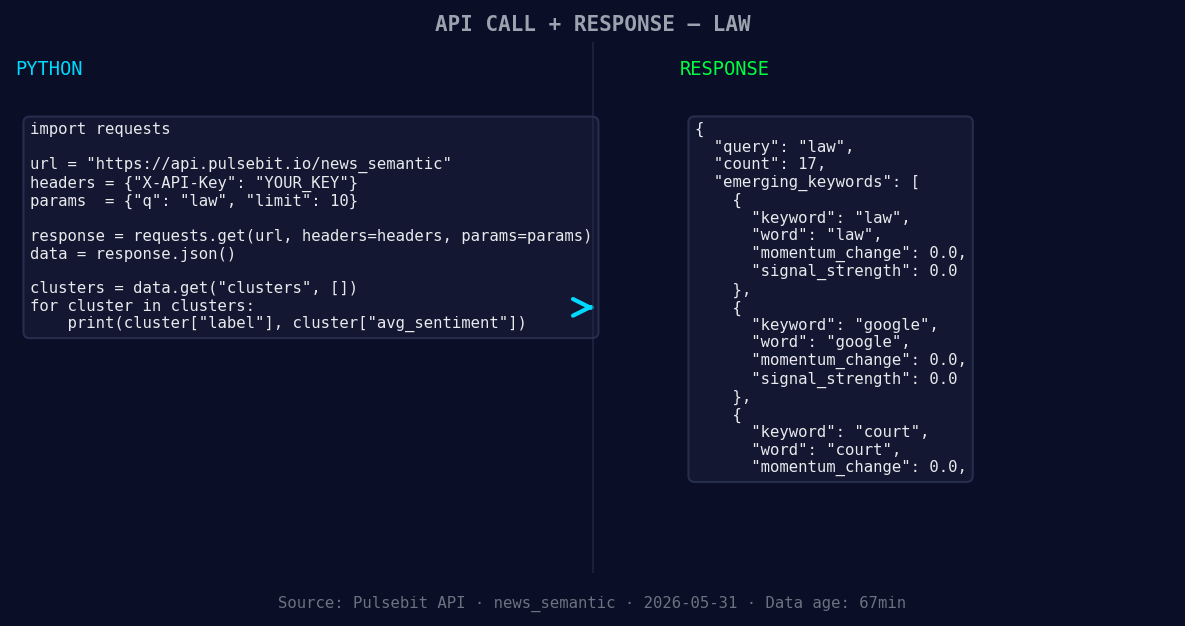
*Left: Python GET /news_semantic call for 'law'. Right: returned JSON response structure (clusters: 3). Source: Pulsebit /news_semantic.*
# Make the API call to fetch articles
response = requests.get("https://api.pulsebit.com/articles", params=params)
articles = response.json()
print(articles)
Next, we’ll take the narrative framing—specifically the reason string from the cluster story—and run it back through our sentiment analysis to evaluate the meta-sentiment. This is a crucial step for understanding how the sentiment is framed within these discussions.
# Meta-sentiment analysis
meta_sentiment_payload = {
    "text": "Clustered by shared themes: law, california, bans, enforcement, interfering."
}

# Make the POST request to analyze the sentiment
meta_response = requests.post("https://api.pulsebit.com/sentiment", json=meta_sentiment_payload)
meta_sentiment = meta_response.json()

print(meta_sentiment)
With these two code snippets, we can effectively identify and analyze significant spikes in sentiment associated with legal discourse, ensuring we stay ahead of trends.
Now, let’s consider three specific builds we can implement with this pattern:
Geographic Origin Filter: Create a real-time alert system that triggers when there is a momentum spike greater than +0.300 in any non-English language (e.g., French). Use the geo filter to capture the sentiment dynamically, allowing you to respond to trends as they develop.
Meta-Sentiment Loop: Build a dashboard that visualizes meta-sentiment scores against the historical sentiment data for law-related articles. Set a threshold, say -0.050 as a red flag for negative sentiment, and track how narratives evolve around key topics, particularly in light of significant legal changes.
Forming Themes Analysis: Implement a clustering endpoint that analyzes forming themes such as law, Google, and court. Set a signal strength threshold of 0.600 to identify emerging narratives and their potential impact on public sentiment, especially when compared to mainstream discussions.
By focusing on these specific signals and thresholds, we can fine-tune our sentiment analysis pipelines and ensure we’re not just reacting to trends but anticipating them.
To get started with these capabilities, head over to our documentation at pulsebit.lojenterprise.com/docs. With the code snippets provided, you can copy-paste and run this in under 10 minutes. Let’s keep our pipelines sharp and our insights timely!


Top comments (0)