

Your Pipeline Is 20.7h Behind: Catching Stock Market Sentiment Leads with Pulsebit
We recently uncovered a compelling anomaly: a 24h momentum spike of +0.637 related to stock market sentiment. This spike is noteworthy not just for its magnitude but for the implications it has on our understanding of sentiment dynamics—especially considering that the English press has been leading the conversation by an impressive 20.7 hours. This is a clear signal that something significant is brewing in the stock market narrative.
But what does this mean for you? If your current pipeline fails to account for multilingual origins or entity dominance, your model missed this momentum spike by over 20 hours. With the leading language being English, the implications are clear: your model isn't capturing the full spectrum of sentiment across languages. This makes it increasingly difficult to stay ahead of market movements and risks leaving you behind when it comes to timely decision-making.

English coverage led by 20.7 hours. Nl at T+20.7h. Confidence scores: English 0.85, Spanish 0.85, French 0.85 Source: Pulsebit /sentiment_by_lang.
Let’s dive into the code that can help you catch these insights in real-time. We can filter sentiment by language and also evaluate the meta-sentiment of the narrative. First, here's how to query our API for sentiment data in English:
import requests
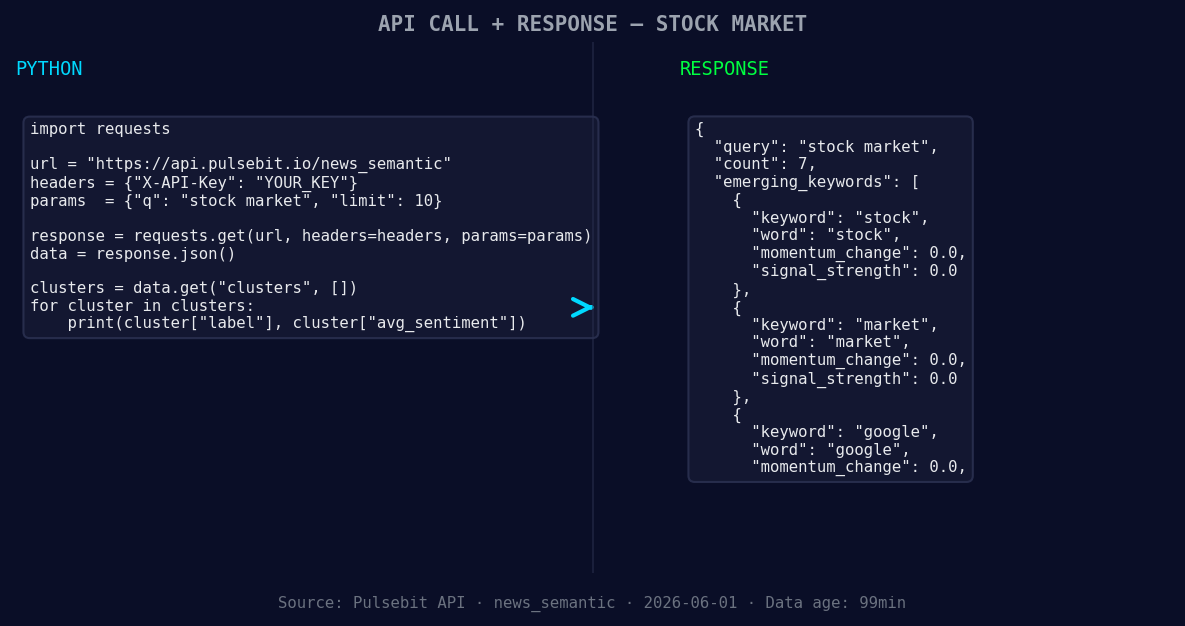
*Left: Python GET /news_semantic call for 'stock market'. Right: returned JSON response structure (clusters: 3). Source: Pulsebit /news_semantic.*
url = "https://api.pulsebit.com/sentiment"
params = {
"topic": "stock market",
"lang": "en"
}
response = requests.get(url, params=params)
data = response.json()
# Example output
print(data) # Check the response for the sentiment data
Once you have the sentiment data, we can also run a meta-sentiment analysis on the cluster reason string. This is crucial for understanding the framing of the narrative itself. Here’s how to do that:
meta_sentiment_payload = {
    "text": "Clustered by shared themes: stock, market, may, about, break."
}
meta_sentiment_response = requests.post(url, json=meta_sentiment_payload)
meta_sentiment_data = meta_sentiment_response.json()

# Check the meta sentiment score
print(meta_sentiment_data)
In this case, we’ve leveraged our API to analyze the clusters around terms like “stock” and “market” which are trending positively. This dual approach allows us to refine our understanding of sentiment and its implications.
Now, let's consider three specific builds around this pattern.
Geo-Filtered Alert: Set up an alert mechanism that triggers when the sentiment score for the stock market topic exceeds +0.557 in English. Use the geo filter to ensure you’re only capturing relevant data from English-speaking regions.
Meta-Sentiment Dashboard: Create a dashboard that visualizes the meta-sentiment of clustered narratives. For instance, run the meta-sentiment on clusters like “stock,” “market,” and “google” and set thresholds for alerts if the score goes above +0.6.
Forming Themes Tracker: Develop a tracker that logs forming themes in real-time. For instance, monitor the sentiment scores of the forming themes: “stock(+0.00), market(+0.00), google(+0.00)” against the mainstream narrative. This can help you identify when emerging themes start to gain traction.
If you want to get started with all of this, check out our documentation at pulsebit.lojenterprise.com/docs. You can copy, paste, and run the above code in under 10 minutes. By doing so, you'll be equipped to catch sentiment leads that might otherwise slip through the cracks.

Geographic detection output for stock market. India leads with 6 articles and sentiment +0.05. Source: Pulsebit /news_recent geographic fields.


Top comments (0)