

Your Pipeline Is 25.7h Behind: Catching Energy Sentiment Leads with Pulsebit
We just stumbled upon a striking anomaly: a 24h momentum spike of +0.600 in energy-related sentiment. This isn't just a random blip; it’s a signal that something significant is brewing. The leading language in this spike is English, with a notable 25.7-hour lead over Italian. If your pipeline isn't designed to capture multilingual contexts or prioritize dominant entities, you could be missing crucial insights, like this one.

English coverage led by 25.7 hours. Italian at T+25.7h. Confidence scores: English 0.85, Spanish 0.85, French 0.85 Source: Pulsebit /sentiment_by_lang.
This gap highlights a critical flaw in many sentiment analysis pipelines: they often lack the capability to handle multilingual dynamics effectively. Imagine your model, stuck in the past, missing this energy sentiment lead by a staggering 25.7 hours. It’s as if you’re watching others profit from insights while your system lags behind, anchored to a single language or narrow entity focus. This is a wake-up call.
Here’s how we can catch this momentum spike using our API in Python. First, we need to filter our query by language and country, focusing on English:

Geographic detection output for energy. India leads with 2 articles and sentiment +0.05. Source: Pulsebit /news_recent geographic fields.
import requests
# Define parameters for the API call
params = {
"topic": "energy",
"lang": "en",
"momentum": "+0.600"
}
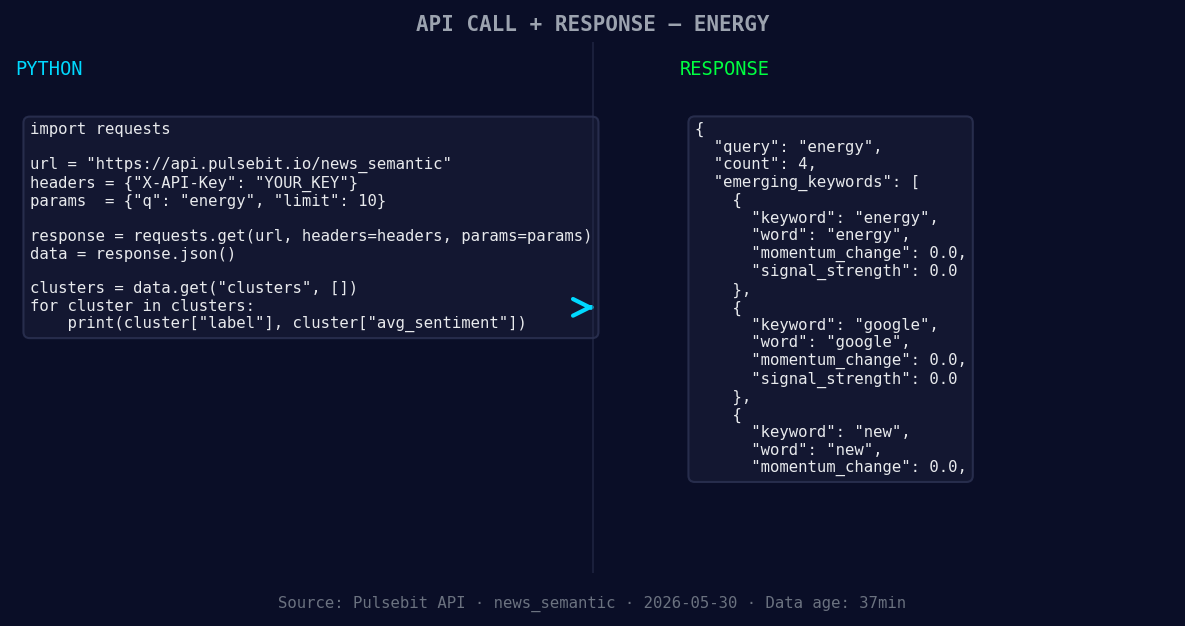
*Left: Python GET /news_semantic call for 'energy'. Right: returned JSON response structure (clusters: 3). Source: Pulsebit /news_semantic.*
# Make the API call to get the sentiment data
response = requests.get("https://api.pulsebit.com/v1/sentiment", params=params)
# Check the response
data = response.json()
print(data)
Now that we have the data, we need to run a meta-sentiment moment. We’ll take the cluster reason string and send it back through our sentiment scoring endpoint to evaluate the narrative framing:
# Define the narrative for meta-sentiment scoring
narrative = "Clustered by shared themes: how, michigan, can, enter, age."

# Make the API call to score the narrative
meta_response = requests.post("https://api.pulsebit.com/v1/sentiment", json={"text": narrative})

# Check the response
meta_data = meta_response.json()
print(meta_data)
With this in place, we’re primed to make some powerful builds around this anomaly. Here are three specific builds we can implement based on the emerging themes:
Geo-Sentiment Signal: Set a signal threshold of +0.600 for energy in English. Create a webhook that triggers when sentiment exceeds this threshold in the U.S., allowing you to react in real-time to surges in energy sentiment.
Meta-Sentiment Loop: Use the meta-sentiment scoring from our narrative loop to adjust your communication strategy. When the sentiment about "how Michigan can enter the energy age" scores above +0.500, initiate a content campaign targeting energy innovations in Michigan.
Forming Themes Alert: Monitor for forming themes such as "new energy" and "Google" alongside "how, Michigan, can." Set a threshold that alerts you when these themes cluster with a sentiment score above +0.400, ensuring you’re always ahead of the curve.
These builds leverage the data we’ve uncovered, allowing you to turn insights into action. By refining your models to handle multi-language inputs and utilizing meta-sentiment, you can close the gap and capitalize on emerging trends before they become mainstream.
To get started, check out our documentation at pulsebit.lojenterprise.com/docs. You can copy-paste the code snippets above and run them in under 10 minutes. Let’s catch those leads together!


Top comments (0)