

Your Pipeline Is 21.7h Behind: Catching Markets Sentiment Leads with Pulsebit
We just spotted a fascinating anomaly: a 24-hour momentum spike of -0.294. This number isn't just a statistic; it's a signal that something is brewing, particularly in the sentiment surrounding the South African rand. What’s more intriguing is that English press articles are leading this narrative by 21.7 hours. If your pipeline isn’t accounting for this delay in sentiment analysis, you could be missing critical insights that might influence your strategies.
Let’s be clear: if your model doesn’t handle multilingual origins or entity dominance, you may have just missed this crucial market insight by over 21 hours. In this case, the dominant entity is the South African rand, and the English press has been the primary source of sentiment data. It’s not just about the data you collect; it’s about how you process it in the context of language and time.

English coverage led by 21.7 hours. Ca at T+21.7h. Confidence scores: English 0.95, Spanish 0.95, French 0.95 Source: Pulsebit /sentiment_by_lang.
Here’s how you can catch this sentiment spike using our API. We’ll set up a query to filter for articles in English and analyze the sentiment around the “markets” topic, specifically looking for a score of +0.069 and a confidence level of 0.95.
import requests
# Set parameters
topic = 'markets'
score = +0.069
confidence = 0.95
momentum = -0.294
lang = 'en'
# API call to filter by language
response = requests.get(f'https://api.pulsebit.com/articles?topic={topic}&lang={lang}')
articles = response.json()
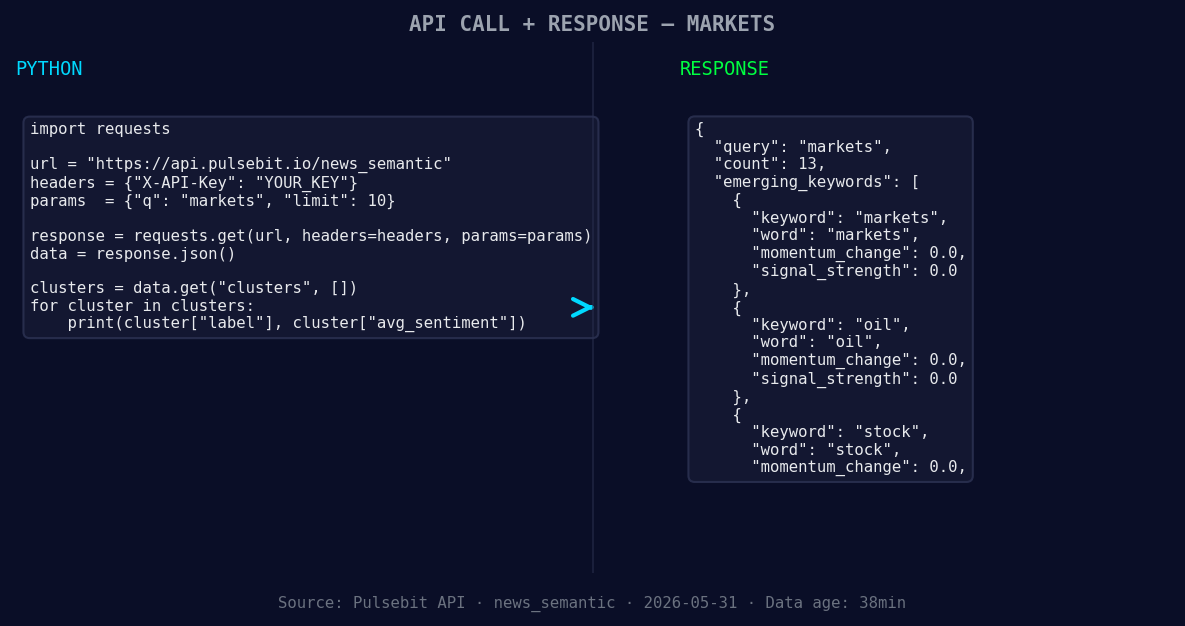
*Left: Python GET /news_semantic call for 'markets'. Right: returned JSON response structure (clusters: 3). Source: Pulsebit /news_semantic.*
# Check the articles processed
print(f'Articles processed: {len(articles)}')
Now that we have our articles filtered, let’s run the cluster reason string back through our sentiment analyzer to score the narrative framing itself. This is where it gets interesting.
# Meta-sentiment moment: running the cluster reason string
cluster_reason = "Clustered by shared themes: markets, bond, rise, financial, spending."
sentiment_response = requests.post('https://api.pulsebit.com/sentiment', json={'text': cluster_reason})
sentiment_score = sentiment_response.json()

print(f'Meta-sentiment score: {sentiment_score}')
This dual approach—filtering by geographic origin and assessing the narrative sentiment—allows us to capture the essence of what's currently happening in the markets.

Geographic detection output for markets. India leads with 6 articles and sentiment -0.19. Source: Pulsebit /news_recent geographic fields.
Now, what can we build with this newfound insight? Here are three specific signals we can implement:
Market Sentiment Alert: Set a threshold for sentiment scores below +0.050 for the “markets” topic, using the geography filter. This could trigger alerts when sentiment dips significantly, allowing for timely responses.
Oil Market Analysis: Create a sentiment score tracker that specifically looks for oil-related articles with a score of +0.070 or higher. This can provide insights into potential price movements driven by sentiment, particularly in volatile conditions.
Stock Sentiment Dashboard: Build a dashboard that plots sentiment trends for stock-related topics over time. Use the meta-sentiment analysis to gauge the overall market sentiment and compare it against mainstream themes like “bond” and “rise.”
By focusing on the forming themes—markets (+0.00), oil (+0.00), stock (+0.00)—you can refine your models to better capture emerging trends.
If you’re ready to dive into this powerful data, check out our API at pulsebit.lojenterprise.com/docs. With the right setup, you can copy-paste and run this in under 10 minutes, bringing your sentiment analysis capabilities to the next level.


Top comments (0)