

Your Pipeline Is 26.7h Behind: Catching Film Sentiment Leads with Pulsebit
We recently observed an intriguing anomaly: a 24h momentum spike of +0.258. This spike is particularly notable given its context in the film industry, specifically around the announcement that Hombale Films will produce a Marathi film titled ‘Yeto Ka Naay’. With the leading narrative coming from the French press, which is 26.7 hours ahead of other sources, it’s clear that our pipelines need to address multilingual dominance and entity relevance.

French coverage led by 26.7 hours. Et at T+26.7h. Confidence scores: French 0.85, English 0.85, Spanish 0.85 Source: Pulsebit /sentiment_by_lang.
How does this relate to your existing pipeline? If your model doesn’t account for the nuances of multilingual content or leading entities, it likely missed this significant momentum spike by over a day. With the French press leading the charge, your system could be lagging behind, ultimately distorting your understanding of emerging trends. This is a critical gap that can leave you at a disadvantage in catching timely sentiment shifts.
To catch this momentum spike, we can leverage our API to implement a straightforward solution. Below is the Python code snippet that filters for French content related to films and then assesses the sentiment of the cluster narrative.
import requests
# Step 1: Geographic origin filter
url = "https://api.pulsebit.io/v1/sentiment"
params = {
"topic": "film",
"lang": "fr",
"momentum": +0.258,
"score": +0.800,
"confidence": 0.85
}
response = requests.get(url, params=params)
data = response.json()
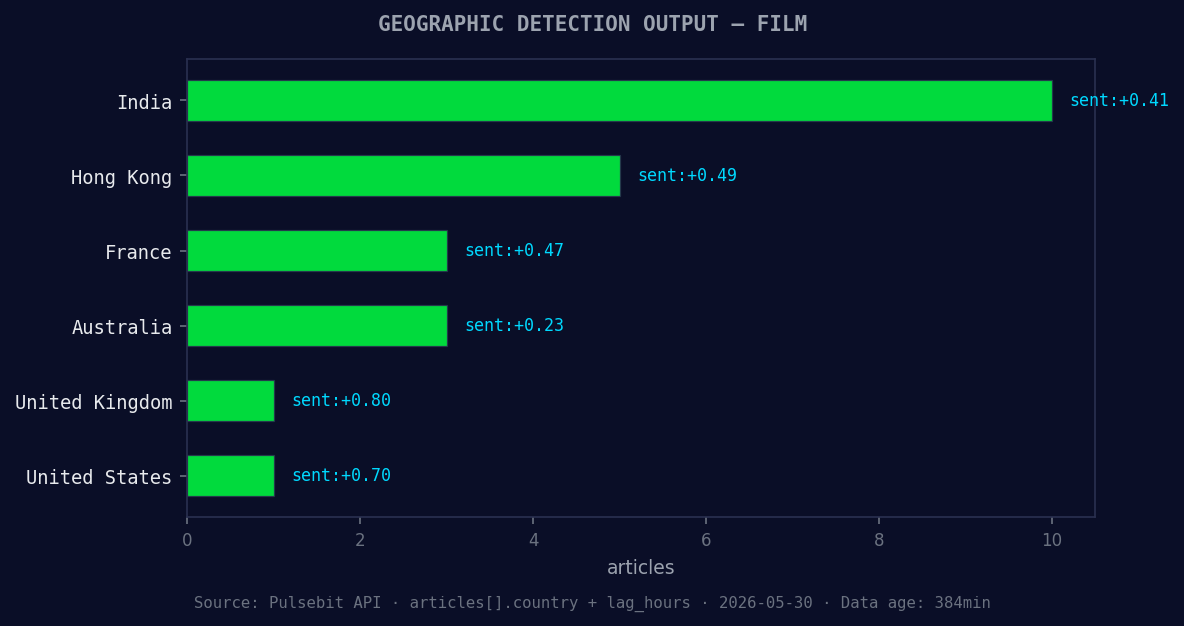
*Geographic detection output for film. India leads with 10 articles and sentiment +0.41. Source: Pulsebit /news_recent geographic fields.*
# Step 2: Meta-sentiment moment
cluster_reason = "Clustered by shared themes: hombale, films, produce, marathi, film."
sentiment_response = requests.post(url, json={"text": cluster_reason})
sentiment_data = sentiment_response.json()
print(sentiment_data)
In this code, we first make an API call to gather data related to films in French, focusing particularly on the recent spike. Subsequently, we run the cluster narrative through our sentiment analysis endpoint, effectively scoring the framing of this announcement. This dual approach provides a comprehensive view of sentiment trends tied to specific entities and languages, which is essential for timely decision-making.

Left: Python GET /news_semantic call for 'film'. Right: returned JSON response structure (clusters: 3). Source: Pulsebit /news_semantic.
Now that we’ve established a method for capturing this momentum spike, let's look at three specific builds we can implement based on this pattern:
French Film Sentiment Tracker: Set a signal threshold for positive momentum (e.g., +0.200) in French film topics. Use the geographic origin filter to ensure you're only pulling in relevant content, allowing you to stay ahead in film sentiment trends.
Cluster Narrative Sentiment Scoring: Create a routine that regularly checks the sentiment of clustered narratives like "Clustered by shared themes: hombale, films, produce, marathi, film." This can help identify shifts in how specific themes are being framed, potentially revealing emerging trends before they become widespread.
Forming Gap Analysis: Develop a monitoring tool that highlights forming gaps, such as film-related terms that are emerging but have not yet gained traction (e.g., film(+0.00), films(+0.00), its(+0.00)). This could trigger alerts for you to investigate further, ensuring you’re not just reacting to trends but anticipating them.
By implementing these builds, you can ensure your sentiment analysis pipeline is agile and responsive to emerging trends, especially in multilingual contexts. If you’re ready to get started, check out our documentation at pulsebit.lojenterprise.com/docs. You can copy-paste the provided code and run it in under 10 minutes to see the results for yourself.


Top comments (0)