

Your Pipeline Is 28.7h Behind: Catching Law Sentiment Leads with Pulsebit
We just spotted a significant anomaly: a 24h momentum spike of +0.380 centered around a new California law that restricts law enforcement's interference in state elections. This spike, driven largely by English-language articles, has a lead time of 28.7 hours, and it’s a clear signal that something noteworthy is happening in the legal landscape. With only one article contributing to this momentum, it’s a perfect case to explore how to catch these shifts in sentiment and act on them.
A 28.7-hour lag in your pipeline can be detrimental. If your existing model doesn’t account for multilingual origins or the dominance of specific entities, you might miss critical developments like this one. This anomaly highlights a gap: your model could have missed the sentiment shift surrounding the law due to language dominance—specifically, the leading English press that is often ahead in covering such legal changes. Without addressing this, you risk operating with outdated information that can affect trading strategies or investment decisions.

English coverage led by 28.7 hours. Nl at T+28.7h. Confidence scores: English 0.92, Spanish 0.92, French 0.92 Source: Pulsebit /sentiment_by_lang.
Let’s look at how we can catch this spike programmatically. We can use our API to filter by language, focusing on English articles. Here’s how you might implement that in Python:
import requests
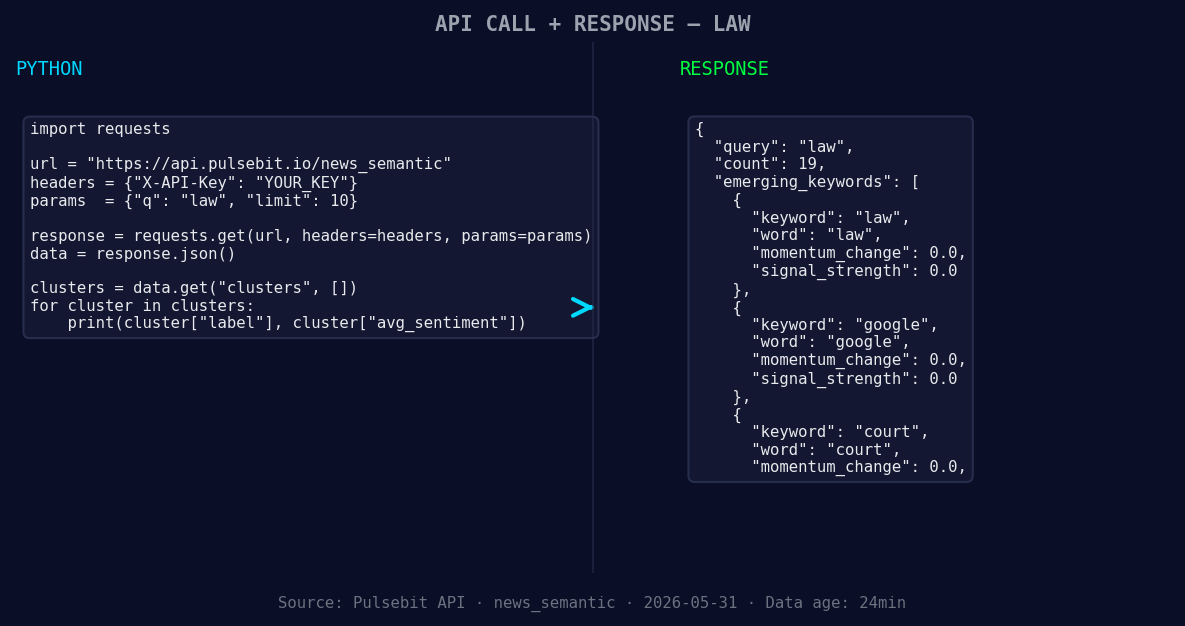
*Left: Python GET /news_semantic call for 'law'. Right: returned JSON response structure (clusters: 3). Source: Pulsebit /news_semantic.*
# Step 1: Geographic origin filter
url = "https://api.pulsebit.com/articles"
params = {
"topic": "law",
"lang": "en",
"score": -0.031,
"confidence": 0.92,
"momentum": +0.380
}
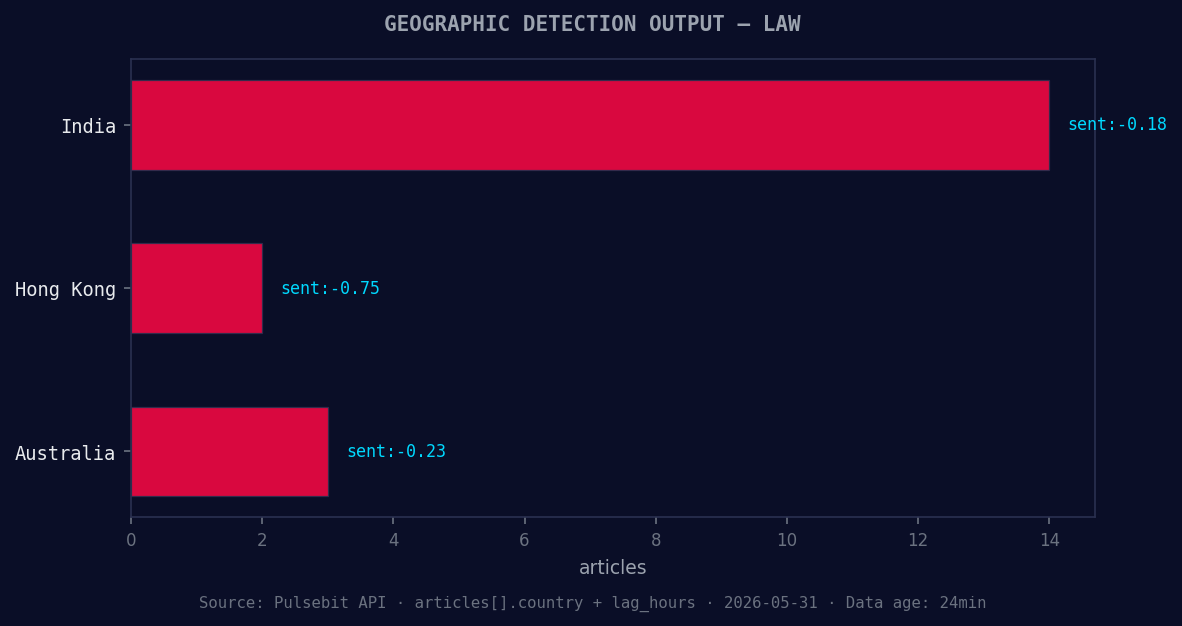
*Geographic detection output for law. India leads with 14 articles and sentiment -0.18. Source: Pulsebit /news_recent geographic fields.*
response = requests.get(url, params=params)
data = response.json() # Process the response
print(data)
Now that we have our English-language articles, we need to assess the narrative framing of the cluster reason. This will help us understand how the sentiment is shaped around this emerging story. We can run the cluster reason string through our sentiment analysis endpoint:
# Step 2: Meta-sentiment moment
sentiment_url = "https://api.pulsebit.com/sentiment"
cluster_reason = "Clustered by shared themes: law, california, bans, enforcement, interfering."
sentiment_response = requests.post(sentiment_url, json={"text": cluster_reason})

sentiment_data = sentiment_response.json()  # Process the sentiment response

print(sentiment_data)
By combining these two steps, you can create a robust system that not only identifies emerging trends but also analyzes the underlying sentiment driving those trends. This is critical in a fast-paced environment where timing can make all the difference.
Now that we have the framework in place, here are three specific builds you can implement with this pattern:
Geographic Signal Filter: Create a real-time alert system that notifies you when legal articles in English show a momentum spike greater than +0.3. Use the geographic origin filter to ensure you're only capturing relevant articles.
Meta-Sentiment Trend Tracker: Develop a dashboard that visualizes sentiment shifts in clustered narratives, specifically focusing on themes like "law" and "california". This should leverage the meta-sentiment loop we just built to score the narrative framing.
Forming Gap Analysis: Build a comparison tool that analyzes the forming gaps in sentiment for emerging topics like "court" and "google". Make sure to flag any significant changes against the mainstream narratives, such as "law", "california", and "bans".
These builds will help you stay ahead of the curve, ensuring your models are fine-tuned to capture the rapidly changing legal landscape.
For further details and examples, check out our documentation at pulsebit.lojenterprise.com/docs. With these snippets, you can copy-paste and run this in under 10 minutes to start catching those critical sentiment leads.


Top comments (0)