

Your Pipeline Is 18.5h Behind: Catching Cybersecurity Sentiment Leads with Pulsebit
We recently discovered a striking anomaly: a 24h momentum spike of +0.203 in the cybersecurity domain. This spike signals a significant shift in sentiment, predominantly driven by English-language press coverage, which led by 18.5 hours with no lag compared to German sources. It’s a clear indicator that something important is happening in the cybersecurity landscape that you need to pay attention to.
The structural gap here is glaring. If your data pipeline isn’t equipped to handle multilingual sources or the dominance of specific entities, you might have missed this spike by a staggering 18.5 hours. The leading language being English and the dominant narrative revolving around the needs expressed by industry leaders, particularly the CIO. This lag can leave your models outdated, failing to capture crucial shifts in sentiment that could inform timely decisions.

English coverage led by 18.5 hours. German at T+18.5h. Confidence scores: English 0.85, French 0.85, Spanish 0.85 Source: Pulsebit /sentiment_by_lang.
Here’s how we can catch this momentum spike using our API. First, we’ll filter the news articles by language and country to focus on the English press. We’ll use the following Python code to make this happen:

Geographic detection output for cybersecurity. United States leads with 2 articles and sentiment +0.85. Source: Pulsebit /news_recent geographic fields.
import requests
# Define the parameters for the API call
params = {
"topic": "cybersecurity",
"lang": "en",
"momentum": "+0.203",
}
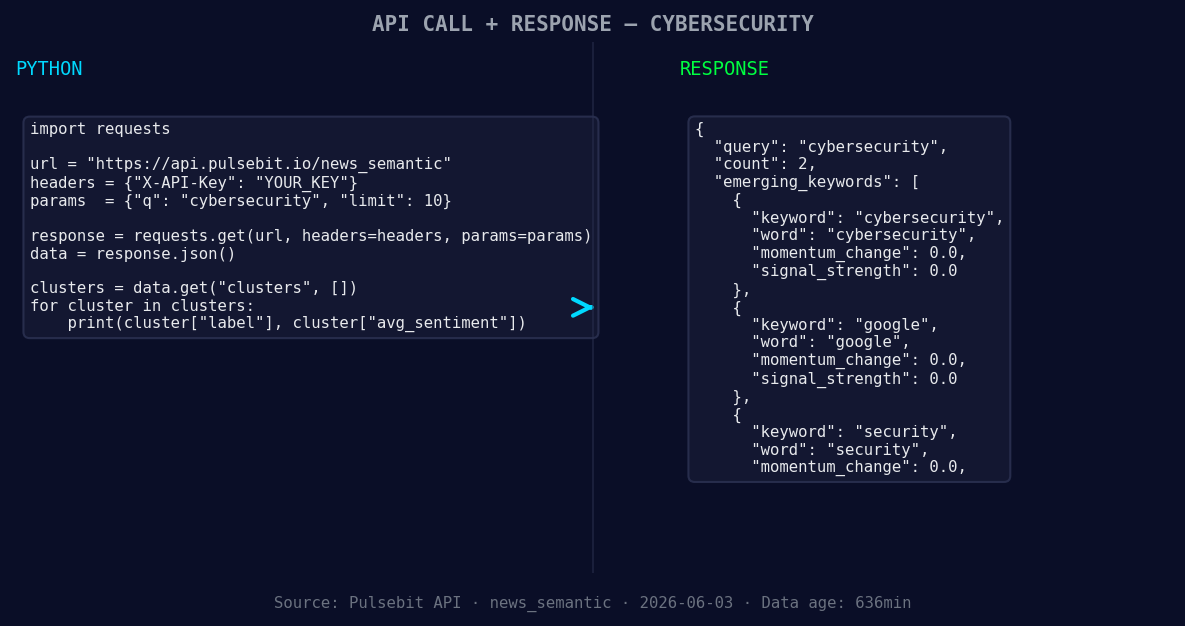
*Left: Python GET /news_semantic call for 'cybersecurity'. Right: returned JSON response structure (clusters: 3). Source: Pulsebit /news_semantic.*
# API endpoint to fetch articles
response = requests.get("https://api.pulsebit.com/v1/articles", params=params)
# Process the response
articles = response.json()
print(articles)
Next, we want to analyze the narrative surrounding this spike to ensure we’re framing it accurately. We can run the cluster reason string through our sentiment scoring endpoint. This helps us understand the framing better, so we’ll send the following POST request:
# Cluster reason to score the narrative
cluster_reason = "Clustered by shared themes: cio, implores, industry, put, greater."
sentiment_response = requests.post("https://api.pulsebit.com/v1/sentiment", json={"text": cluster_reason})

# Process the sentiment response
sentiment_data = sentiment_response.json()
print(sentiment_data)
This combination of techniques allows us to not only identify emerging trends but also to understand the context in which they arise.
Now, let’s talk about three specific things you can build using this pattern:
Sentiment Tracking Dashboard: Create a real-time dashboard that pulls data using the geographic origin filter. Set a threshold for sentiment scores above +0.525. This can help you visualize spikes in sentiment tied to specific events, particularly in cybersecurity.
Meta-Sentiment Alerts: Develop a notification system that triggers when the meta-sentiment score for narratives like our example exceeds a predefined threshold (e.g., +0.500). This will keep you informed about significant shifts in sentiment framing around critical topics like cybersecurity.
Article Clustering Tool: Build a tool that clusters articles based on shared themes and sentiment scores. Use the endpoint for sentiment scoring and ensure it tracks not only topics like "cybersecurity" but also related terms like "google" (+0.00) and "security" (+0.00). This will provide a more holistic view of the landscape.
With these insights and tools, you can ensure that your pipeline is aligned with the latest developments in cybersecurity sentiment.
To get started, check out our documentation at pulsebit.lojenterprise.com/docs. You can copy-paste the above code snippets and run them in under 10 minutes, enabling you to catch these critical shifts in sentiment without missing a beat.


Top comments (0)