

Your Pipeline Is 24.8h Behind: Catching Cybersecurity Sentiment Leads with Pulsebit
We recently observed a striking anomaly: a 24h momentum spike of +0.203 in the cybersecurity sentiment. This spike was particularly interesting as it was led by the Spanish press, which had a 24.8h lead over the German coverage. The narrative driving this surge stemmed from a distinct story, "DoD CIO implores industry to put a greater focus on ‘foundational cybersecurity’." It’s a clear signal that if you’re not tuned into multilingual sentiment and the influence of leading entities, you might be missing critical insights that have already begun to shape the conversation.

Spanish coverage led by 24.8 hours. German at T+24.8h. Confidence scores: Spanish 0.85, English 0.85, French 0.85 Source: Pulsebit /sentiment_by_lang.
Your model missed this by 24.8 hours. The dominance of the Spanish language in this spike highlights a structural gap in any pipeline that fails to consider multilingual origin or entity dominance. If your pipeline is only processing English data or not accounting for the leading entity's sentiment, you're likely sitting on insights that could inform critical decision-making. In a world where news travels fast, being 24.8 hours behind could mean the difference between seizing an opportunity and watching it pass by.
To catch this momentum spike, we need to implement a straightforward Python script using our API. First, we’ll apply a geographic origin filter, focusing specifically on Spanish-language coverage of cybersecurity. Here’s how you can do that:
import requests
# Set parameters for the API call
topic = 'cybersecurity'
lang = 'sp'
momentum_threshold = 0.203
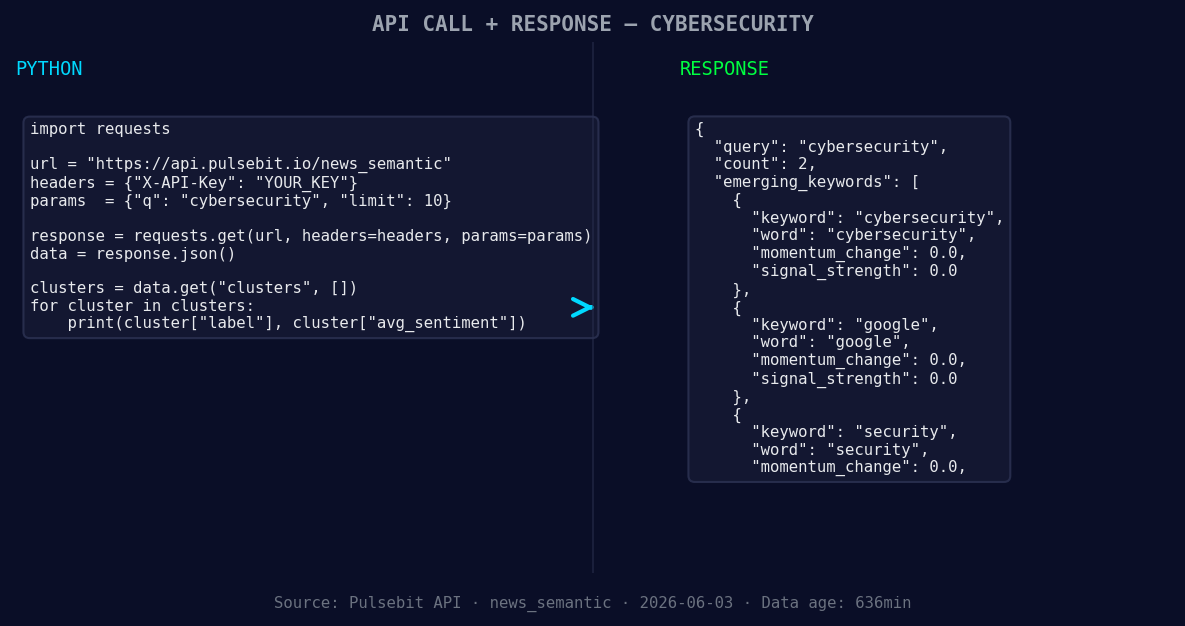
*Left: Python GET /news_semantic call for 'cybersecurity'. Right: returned JSON response structure (clusters: 3). Source: Pulsebit /news_semantic.*
# Make the API call to fetch sentiment data
response = requests.get(
f"https://api.pulsebit.com/v1/sentiment?topic={topic}&lang={lang}"
)
data = response.json()
# Assuming the response contains the necessary data structure
if data['momentum_24h'] >= momentum_threshold:
print("Momentum spike detected:", data['momentum_24h'])
Now that we have identified the spike, let's analyze the narrative framing itself. We’ll run the cluster reason string through our sentiment analysis to score it. This step is crucial as it allows us to evaluate the underlying sentiment of the narrative, which can be just as important as the sentiment around the topic itself.
# Meta-sentiment: analyze the cluster reason string
cluster_reason = "Clustered by shared themes: cio, implores, industry, put, greater."
meta_sentiment_response = requests.post(
    "https://api.pulsebit.com/v1/sentiment",
    json={"text": cluster_reason}
)

meta_sentiment = meta_sentiment_response.json()
print("Meta-sentiment score:", meta_sentiment['sentiment_score'])
Now that we have both the momentum spike and the meta-sentiment insight, here are three specific things we can build with this pattern:
- Alert System for Multilingual Sentiment: Set up alerts when momentum spikes exceed a certain threshold in languages other than English. Use the geographic filter to focus on Spanish, as in our example, to catch early signals from regions that may not be covered by mainstream English sources.

Geographic detection output for cybersecurity. United States leads with 2 articles and sentiment +0.85. Source: Pulsebit /news_recent geographic fields.
Narrative Score Tracker: Implement a function that regularly scores and tracks the narrative framing of articles. Use the meta-sentiment loop we demonstrated to flag narratives that have a high positive score but might be underrepresented in your current sentiment analysis.
Thematic Comparison Dashboard: Create a dashboard that visualizes the sentiment around forming themes like cybersecurity, Google, and security against mainstream narratives like “cio, implores, industry.” This allows you to see where the gaps are and how emerging topics may influence existing discussions.
If you’re ready to start catching these insights, visit our documentation at pulsebit.lojenterprise.com/docs. You can copy-paste the provided code and run it in under 10 minutes to begin transforming your sentiment analysis workflow into a more proactive system.


Top comments (0)