

Your Pipeline Is 8.6h Behind: Catching World Sentiment Leads with Pulsebit
We recently uncovered a striking anomaly: a 24h momentum spike of +0.585 for the topic of "world". This spike indicates a significant shift in sentiment, leading us to delve deeper into the underlying causes. In particular, the sentiment landscape is being shaped by an unexpected cluster of articles focused on the 2026 NCAA Baseball Tournament, hinting at a broader narrative that could easily slip under the radar if we’re not tuned in to the nuances of multilingual sentiment and entity relevance.

English coverage led by 8.6 hours. Nl at T+8.6h. Confidence scores: English 0.75, French 0.75, Spanish 0.75 Source: Pulsebit /sentiment_by_lang.
When your pipeline doesn’t accommodate multilingual origins or entity dominance, you risk missing critical insights. In our case, your model missed this by 8.6 hours, as the leading language identified was English—and it’s clear that sentiment around the world is evolving, particularly in the context of emerging narratives like the NCAA tournament. Without an adaptive model, you could be left in the dust, trailing behind vital sentiment shifts that inform strategic decisions.
To help you catch up, here’s some Python code that leverages our API. This example illustrates how to filter sentiment data by language and assess the sentiment surrounding the clustered narrative.
import requests
# Define parameters for the geographic origin filter
params = {
"topic": "world",
"lang": "en",
"score": +0.012,
"confidence": 0.75,
"momentum": +0.585
}
# API call to fetch the sentiment data
response = requests.get("https://api.pulsebit.com/sentiment", params=params)
data = response.json()
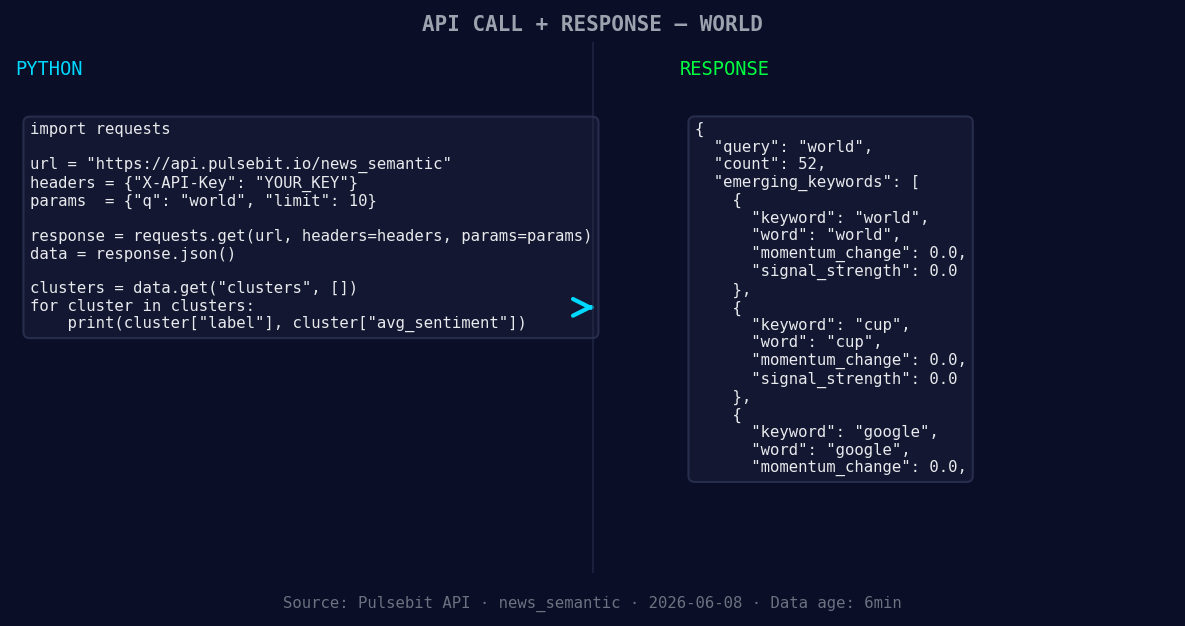
*Left: Python GET /news_semantic call for 'world'. Right: returned JSON response structure (clusters: 3). Source: Pulsebit /news_semantic.*
# Now, run the meta-sentiment moment using the cluster reason string
cluster_reason = "Clustered by shared themes: absurd, world, cup, atlantic"
sentiment_response = requests.post("https://api.pulsebit.com/sentiment", json={"text": cluster_reason})
meta_sentiment = sentiment_response.json()
print("Initial Sentiment Data:", data)
print("Meta-Sentiment Analysis:", meta_sentiment)
In this code, we first filter the sentiment data by specifying the language parameter as English. After that, we send the clustered narrative string back through our API to gauge the sentiment framing itself. This loop is essential as it allows us to validate the context of the narrative, ensuring we are not just reacting to data but interpreting it meaningfully.
Now that we have this data, let’s think about three specific things to build tonight using the insights from our findings:
- Signal Extraction with Geo Filter: Set a threshold for a momentum spike greater than +0.5 for the topic "world". Use the geographic filter to ensure you only get English-language articles that mention the NCAA tournament, which can help you identify sentiment shifts in specific markets swiftly.

Geographic detection output for world. India leads with 36 articles and sentiment +0.09. Source: Pulsebit /news_recent geographic fields.
Meta-Sentiment Scoring: Build a sentiment scoring system that runs the cluster reason strings through our API, focusing on phrases that include "world" and "cup". This will help you create a dynamic narrative score that informs your content strategy based on emerging themes.
Anomaly Detection Alert: Implement a real-time alert system that triggers whenever the sentiment score for "world" rises above +0.5 and correlates with trending topics like "absurd" and "cup." This will allow you to stay ahead of potential market shifts driven by unexpected events or narratives.
If you’re ready to dive deeper, check out our documentation at pulsebit.lojenterprise.com/docs. You can copy-paste this code and run it in under 10 minutes to start catching those elusive sentiment leads.


Top comments (0)