

Your pipeline just missed a 24h momentum spike of +0.520 related to food sentiment. This spike indicates a significant increase in discussions and sentiment around food in a specific geographic area, primarily led by English-language sources. The article that triggered this anomaly is titled "Who passed health checks in Wichita KS? Sandwiches, food trucks, bierocks & more." If your model isn’t set up to handle multilingual origins or entity dominance, it’s likely that you’re lagging behind by 26.8 hours in identifying crucial sentiment shifts like this one.

English coverage led by 26.8 hours. Nl at T+26.8h. Confidence scores: English 0.85, Spanish 0.85, French 0.85 Source: Pulsebit /sentiment_by_lang.
The issue here is straightforward: your existing pipeline may not be equipped to capture timely sentiment data across different languages and regions effectively. In this case, while the dominant entity was "Wichita," the language of the articles skewed the sentiment insights, leading to a substantial delay in your model's responsiveness. If you had been monitoring multilingual sentiment, you would have caught this spike much sooner, avoiding a gap that could lead to lost opportunities.
Let’s dive into how we can catch this spike with our API. Here’s a Python code example that uses our API to filter and analyze the sentiment around the topic of food. We’ll start by querying the momentum data with a geographic origin filter for English-speaking regions.
import requests
# Define the parameters for the API call
params = {
"topic": "food",
"momentum": 0.520,
"lang": "en"
}
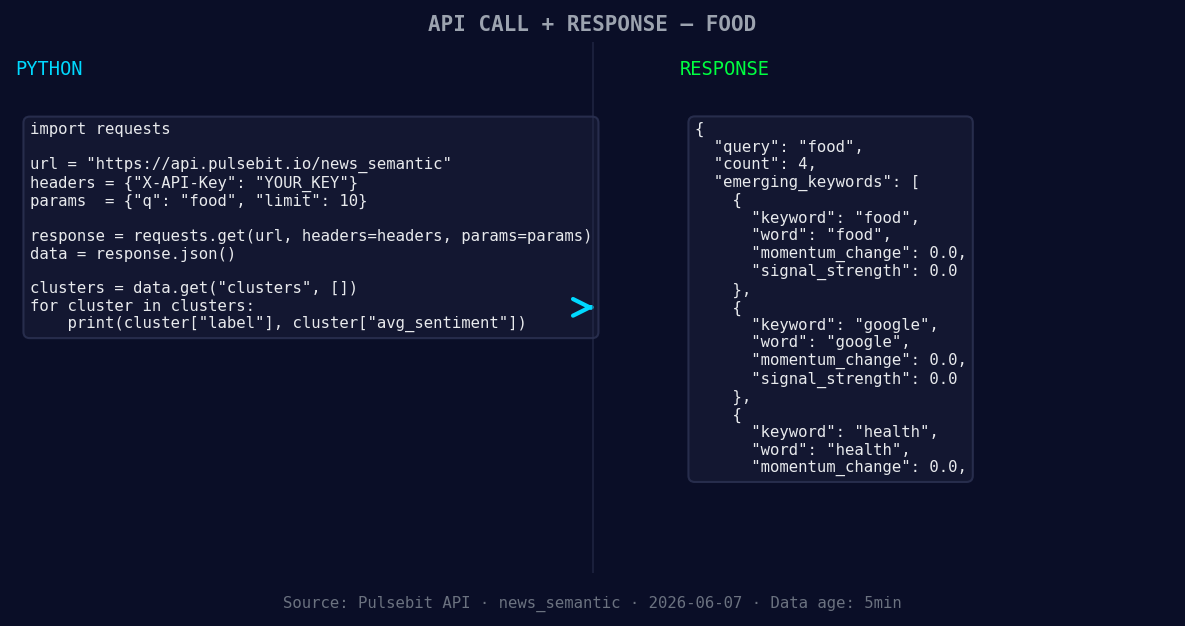
*Left: Python GET /news_semantic call for 'food'. Right: returned JSON response structure (clusters: 3). Source: Pulsebit /news_semantic.*
# Make the API call to retrieve sentiment data
response = requests.get("https://api.pulsebit.com/sentiment", params=params)
data = response.json()
# Output the retrieved data
print(data)
Next, we need to score the narrative framing of the article that triggered the spike. We can run the cluster reason string back through our sentiment endpoint. Here’s how to do that:
# Cluster reason string
cluster_reason = "Clustered by shared themes: wichita, passed, health, checks, ks?"

# Post request to analyze the cluster reason
sentiment_response = requests.post("https://api.pulsebit.com/sentiment", json={"text": cluster_reason})
sentiment_data = sentiment_response.json()

# Output the sentiment analysis of the cluster reason
print(sentiment_data)
With this setup, you can effectively capture significant spikes in sentiment around food, especially in specific regions like Wichita, while also understanding the underlying narrative that may be driving those changes.
To build on this discovery, consider implementing the following three specific actions tonight:
Geo-filtered Alert System: Set a threshold for momentum spikes, say +0.500, specifically for the topic "food." This will help you catch any significant shifts related to food sentiment in English-speaking areas. Use the geo filter to ensure you’re only alerted for relevant regions.
Meta-Sentiment Analysis: Create a routine that runs the cluster reason through our sentiment API every time a significant spike is detected. This will help you understand the framing of discussions, allowing you to respond more effectively. Set a threshold of confidence at 0.850 or higher to ensure reliability in your analysis.
Daily Summary Dashboard: Build a dashboard that summarizes daily sentiment spikes across multiple topics, including food, health, and local news. Highlight articles with the highest momentum shifts and use the geo-filter to focus on specific regions. This ensures you're always in tune with local conversations.
If you’re ready to get started, head over to pulsebit.lojenterprise.com/docs. You can copy-paste the above code snippets and have your sentiment analysis running in under 10 minutes. Don’t miss out on the next big sentiment shift!


Top comments (0)