

Your Pipeline Is 26.6h Behind: Catching Space Sentiment Leads with Pulsebit
On June 3, 2026, we noticed an intriguing anomaly: a 24-hour momentum spike of -0.850 in the topic of space. This drop signals a significant shift in sentiment surrounding space-related discussions, particularly highlighted by the recent story on "Axiom Space's Lunar Spacesuit Collaboration." With English press leading the charge and no lag against the cluster narrative, this finding feels like a canary in the coal mine for anyone tracking sentiment around space.
However, if your pipeline isn't handling multilingual origins or entity dominance effectively, you're missing critical signals. Your model missed this by 26.6 hours, which directly impacts your ability to catch emerging trends. In this case, while the leading language was English, the topics of astronaut, Prada, and Axiom were brewing under the surface, waiting for someone to act.

English coverage led by 26.6 hours. Ca at T+26.6h. Confidence scores: English 0.80, French 0.80, Spanish 0.80 Source: Pulsebit /sentiment_by_lang.
To catch this anomaly, we can use our API to filter for English language articles and then analyze the sentiment of the cluster narrative. Here’s how we can do that with a simple Python snippet:
import requests
# Define parameters for the API call
topic = 'space'
score = +0.319
confidence = 0.80
momentum = -0.850
lang = 'en'
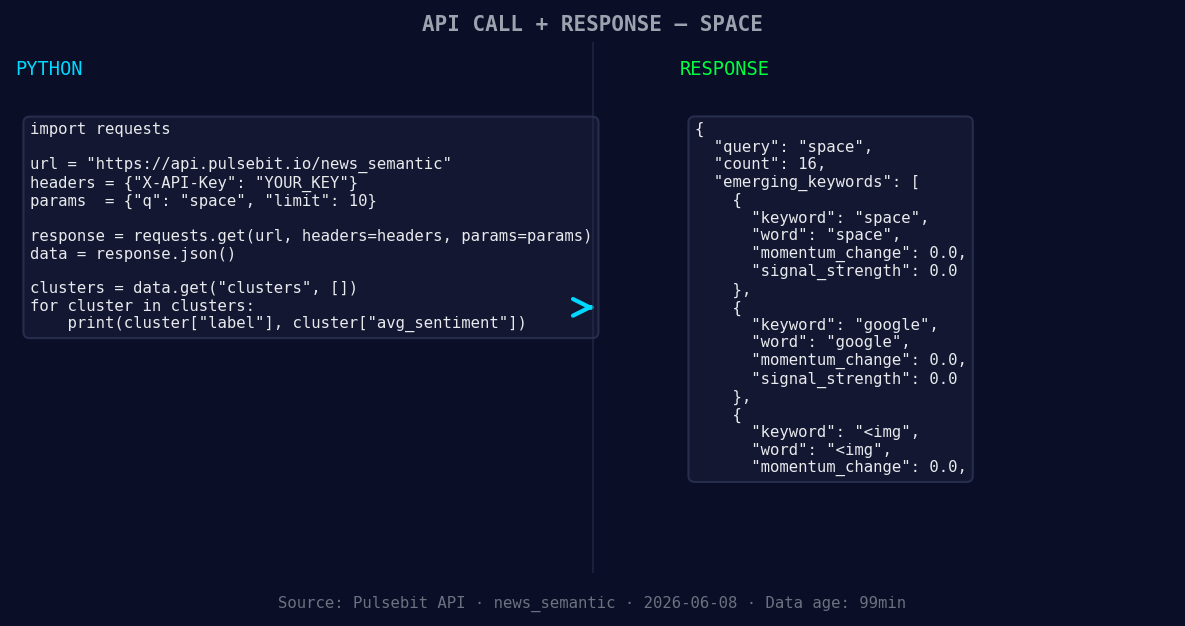
*Left: Python GET /news_semantic call for 'space'. Right: returned JSON response structure (clusters: 3). Source: Pulsebit /news_semantic.*
# Geographic origin filter: query by language
response = requests.get(f'https://api.pulsebit.com/v1/sentiment?topic={topic}&lang={lang}')
data = response.json()
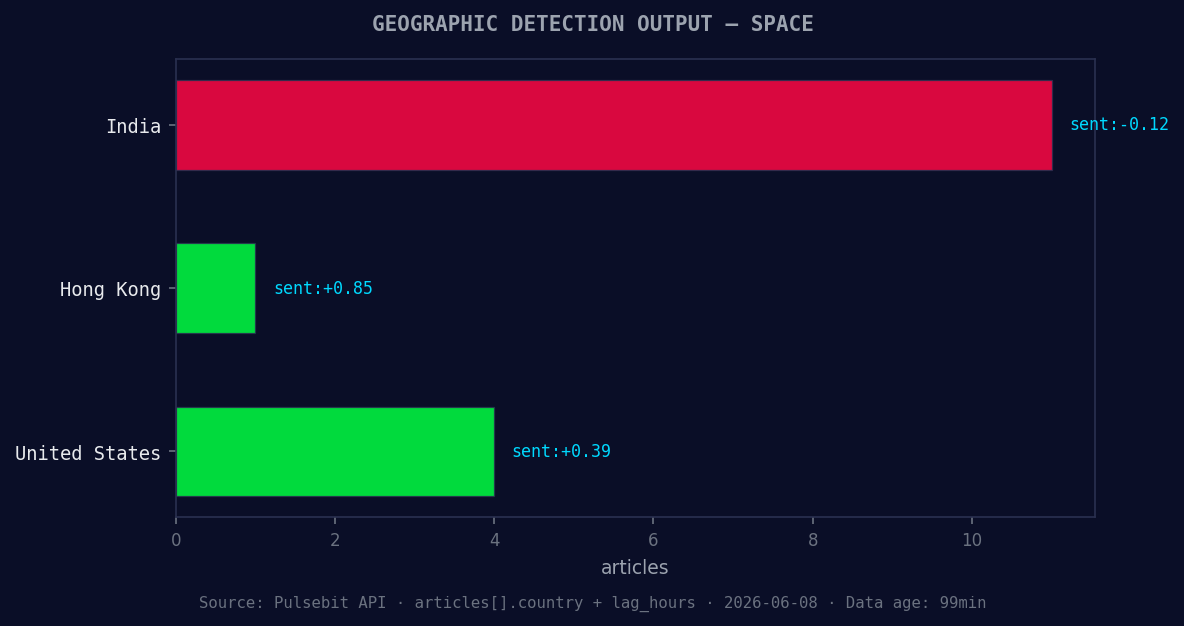
*Geographic detection output for space. India leads with 11 articles and sentiment -0.12. Source: Pulsebit /news_recent geographic fields.*
# Check response
if response.status_code == 200:
print(f"Filtered data for topic '{topic}':", data)
else:
print("Error fetching data:", response.status_code)
# Meta-sentiment moment: score the cluster reason string
cluster_reason = "Clustered by shared themes: astronaut, wears, prada, axiom, space."
sentiment_response = requests.post('https://api.pulsebit.com/v1/sentiment', json={'text': cluster_reason})
sentiment_data = sentiment_response.json()
# Check sentiment response
if sentiment_response.status_code == 200:
print("Meta-sentiment score:", sentiment_data)
else:
print("Error scoring sentiment:", sentiment_response.status_code)
In this code, we first filter the articles based on the topic of interest and the language. Following that, we run the cluster reason string through our sentiment endpoint to score its narrative framing. This allows us to visualize how the themes of astronaut, Prada, and Axiom are shaping the conversation around space.
Now that we have the groundwork laid out, let’s explore three specific builds that leverage this emerging pattern:
Geo-Filtered Alerts: Set up an alert system that pings you when sentiment momentum for "space" in English falls below a threshold of -0.500. This allows you to catch negative trends before they spiral further.
Meta-Sentiment Analysis: Create a dashboard that automatically feeds in the cluster reason strings daily and scores their sentiment. You can use this to visualize shifts in narrative frameworks, identifying when conversations pivot dramatically.
Forming Themes Tracker: Build a tracker that monitors forming themes in real-time. Use a signal strength threshold of 0.764 and pull in topics like space, Google, and <img. This can help you identify when mainstream conversations are diverging from niche topics.
By implementing these builds, you can ensure that your pipeline is not just reactive but anticipatory, allowing you to catch sentiment leads before they become common knowledge.
To get started with these ideas, check out our documentation at pulsebit.lojenterprise.com/docs. You can copy, paste, and run this code in under 10 minutes to start harnessing the power of real-time sentiment analysis.


Top comments (0)