

Your Pipeline Is 10.2h Behind: Catching Health Sentiment Leads with Pulsebit
We just noticed a significant anomaly: a 24-hour momentum spike of +0.800 in health-related sentiment. This spike caught our attention because it reveals a rising trend in sentiment that could have major implications for your analytics pipeline. With a leading language of English press, which is currently ahead by 10.2 hours, it’s clear that this is a critical moment to tap into emerging health themes.
If your model isn't tuned to handle multilingual origins or dominant entities, you might have missed this spike by over 10 hours. The English press is driving the narrative, and if you’re relying solely on historical data or localized sentiment sources, you risk falling behind. The dominant theme of “nfhs-6” alongside “joy” and “pain” is crucial, and ignoring it could mean missing out on valuable insights that are shaping public discourse around health right now.

English coverage led by 10.2 hours. No at T+10.2h. Confidence scores: English 0.90, Spanish 0.90, French 0.90 Source: Pulsebit /sentiment_by_lang.
To catch this momentum spike, you’ll want to leverage our API effectively. Here’s how you can do it in Python:
import requests
# Define the API endpoint and parameters
endpoint = 'https://api.pulsebit.com/v1/sentiment'
params = {
"topic": "health",
"lang": "en",
"score": +0.177,
"confidence": 0.90,
"momentum": +0.800
}
# Make the API call
response = requests.get(endpoint, params=params)
data = response.json()
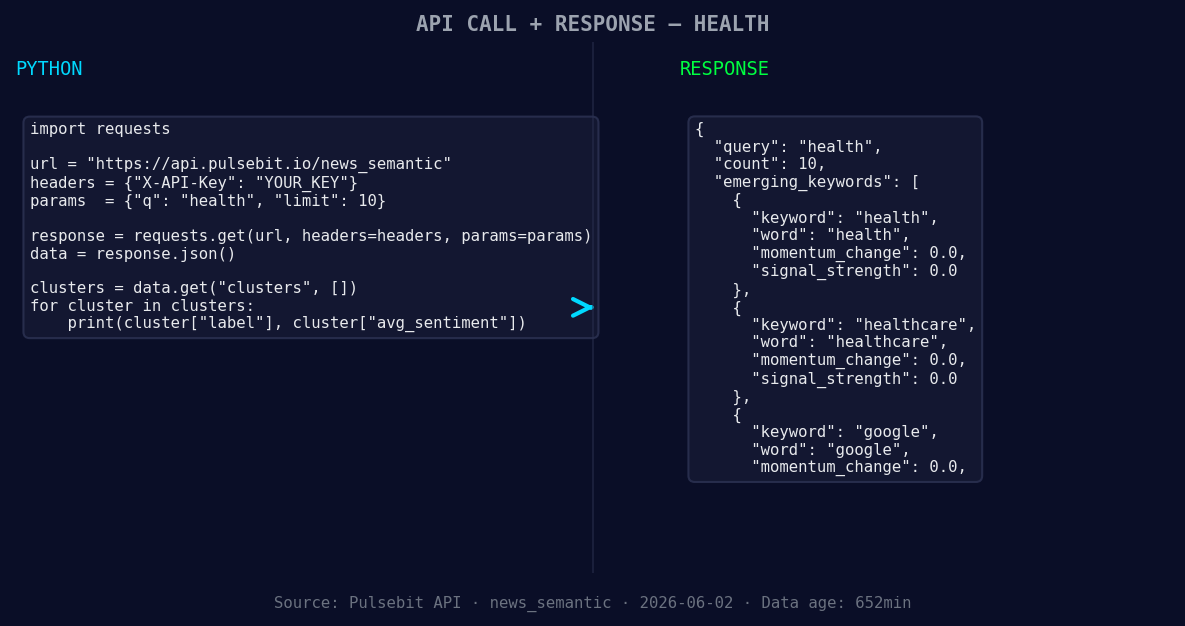
*Left: Python GET /news_semantic call for 'health'. Right: returned JSON response structure (clusters: 3). Source: Pulsebit /news_semantic.*
# Output the response
print(data)
This snippet queries our API to focus specifically on health sentiment in English. It captures the essence of the current spike, helping you stay ahead of the curve.
Next, let’s analyze the narrative framing around this spike. We can run the cluster reason string back through our sentiment endpoint to score the overall narrative. Here’s how you do it:
# Define the narrative framing
narrative = "Clustered by shared themes: nfhs-6, joy, pain:, data, health."

# Post the narrative to the sentiment endpoint
response = requests.post(endpoint, json={"text": narrative})
narrative_score = response.json()

# Output the narrative sentiment
print(narrative_score)
This code takes the cluster reason string and evaluates how the themes are resonating. By understanding the sentiment around these clustered themes, you can derive actionable insights that align with the current momentum.
Now, let's explore three specific builds that can help you capitalize on this pattern:
-
Geo Filter for Health Sentiment: Use the geographic origin filter to capture health sentiment in English from a specific region. For instance, you can set the
countryparameter to focus on the U.S. This allows you to refine your insights and target your analysis more effectively.

Geographic detection output for health. India leads with 9 articles and sentiment +0.56. Source: Pulsebit /news_recent geographic fields.
Meta-Sentiment Loop: Implement the meta-sentiment loop to score narratives around the themes of “health” and “healthcare.” This becomes crucial as you dive deeper into the implications of “joy” and “pain” in the context of the NFHS-6 data. Assess the implications of these sentiments to inform your strategies.
Threshold Alert System: Set up an alert system that triggers when the sentiment score for “health” exceeds a certain threshold (e.g., +0.250). Coupled with the geo filter, this ensures you are alerted to significant shifts in sentiment that could indicate emerging trends or crises.
By leveraging these builds, you can enhance your pipeline's responsiveness to emerging health narratives, ensuring that you remain relevant in an ever-evolving landscape.
For more on how to get started with our API, check out pulsebit.lojenterprise.com/docs. You can copy-paste and run the examples above in under 10 minutes, putting you on the front line of sentiment analysis.


Top comments (0)