

Your Pipeline Is 28.2h Behind: Catching Finance Sentiment Leads with Pulsebit
We recently discovered a striking anomaly: a 24h momentum spike of +1.300 in the finance sector. This spike indicates an unexpected surge in sentiment around financial themes, specifically highlighted by a single article discussing the "Mismatch in 16th Union Finance Commission allocation for Kerala’s urban population." The leading language for this spike is English, with a noteworthy 28.2-hour lead time. If you’re not capturing this data effectively, your pipeline is lagging behind by 28.2 hours, potentially causing you to miss critical insights.
When your model doesn’t account for multilingual origins or the dominance of certain entities, it can lead to significant blind spots. In this case, while the English press drove the narrative, any pipeline that only focuses on a single language or lacks entity recognition would completely overlook this emerging sentiment. You could be missing out on valuable insights that could inform your strategies. This isn't just a minor oversight; it's a structural gap that could cost you precious time and relevance in decision-making.

English coverage led by 28.2 hours. Et at T+28.2h. Confidence scores: English 0.75, Spanish 0.75, So 0.75 Source: Pulsebit /sentiment_by_lang.
To help you catch this sentiment spike, here’s a Python snippet that leverages our API to effectively gather and analyze the relevant data:
import requests
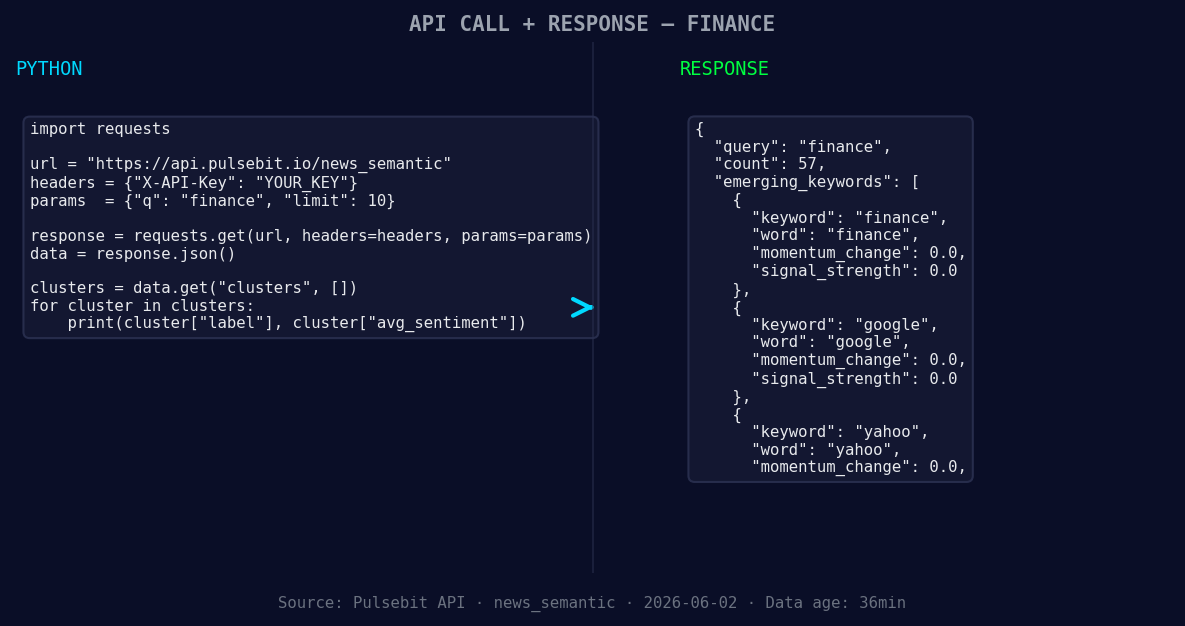
*Left: Python GET /news_semantic call for 'finance'. Right: returned JSON response structure (clusters: 3). Source: Pulsebit /news_semantic.*
# Step 1: Geographic origin filter for English content
url = "https://api.pulsebit.com/v1/sentiment"
params = {
"topic": "finance",
"lang": "en",
"momentum": 1.300,
"score": 0.004,
"confidence": 0.75
}
response = requests.get(url, params=params)
data = response.json()
print(data)
# Step 2: Meta-sentiment moment
cluster_reason = "Clustered by shared themes: finance, commission, mismatch, 16th, union."
meta_sentiment_url = "https://api.pulsebit.com/v1/sentiment"
meta_params = {
"text": cluster_reason
}
meta_response = requests.post(meta_sentiment_url, json=meta_params)
meta_data = meta_response.json()
print(meta_data)
In this code, we first filter for English content about finance, capturing the sentiment spike directly related to the recent developments. Then, we send the cluster reason string through our sentiment endpoint to score the narrative itself. This approach not only identifies the spike but also provides context around it, allowing for deeper analysis.
Here are three specific things we can build using this momentum spike data:
Signal Monitoring: Set up a cron job to monitor the
momentumthreshold at +1.300 for the finance topic and alert if it crosses this threshold again in the next 24 hours. This will help you react quickly to emerging trends.Geographic Filtered Alerts: Create a notification system that triggers alerts when articles in English about finance exceed a certain score (like +0.004). This way, you can stay informed about critical developments without manually sifting through content.

Geographic detection output for finance. France leads with 3 articles and sentiment +0.23. Source: Pulsebit /news_recent geographic fields.
- Meta-Sentiment Analysis Dashboard: Build a dashboard that visualizes sentiment scores for clustered narratives. For instance, you can compare the sentiment of the current spike in finance with other themes like technology or healthcare, enhancing your ability to detect shifts in public sentiment.
You can dive into building these insights right away. Check out our documentation at pulsebit.lojenterprise.com/docs, and you can easily copy-paste and run the provided code in under 10 minutes. The insights from this anomaly can be crucial for staying ahead in the finance landscape, so don’t let your pipeline lag behind.


Top comments (0)