

Your Pipeline Is 22.4h Behind: Catching Governance Sentiment Leads with Pulsebit
We recently stumbled upon a notable anomaly: a 24-hour momentum spike of +0.252 in sentiment surrounding governance topics. This spike reflects an urgent call for Africa to strengthen governance reforms, particularly under Agenda 2063, as highlighted by Channel Africa. With only one article contributing to this spike, it’s clear that even small shifts can indicate significant underlying trends.
But let’s be real: if your pipeline doesn’t account for multilingual origins or the dominance of certain entities, you might be missing crucial insights. Your model missed this by 22.4 hours, while the leading conversation unfolded in English. When it comes to governance, timely recognition of sentiment trends is essential for making informed decisions. Whether you are analyzing public sentiment or planning strategic responses, this delay can be detrimental.

English coverage led by 22.4 hours. Et at T+22.4h. Confidence scores: English 0.90, French 0.90, Spanish 0.90 Source: Pulsebit /sentiment_by_lang.
To catch this momentum spike effectively, we need to filter our data. Here’s the Python code that accomplishes this, specifically targeting English-language articles about governance:
import requests
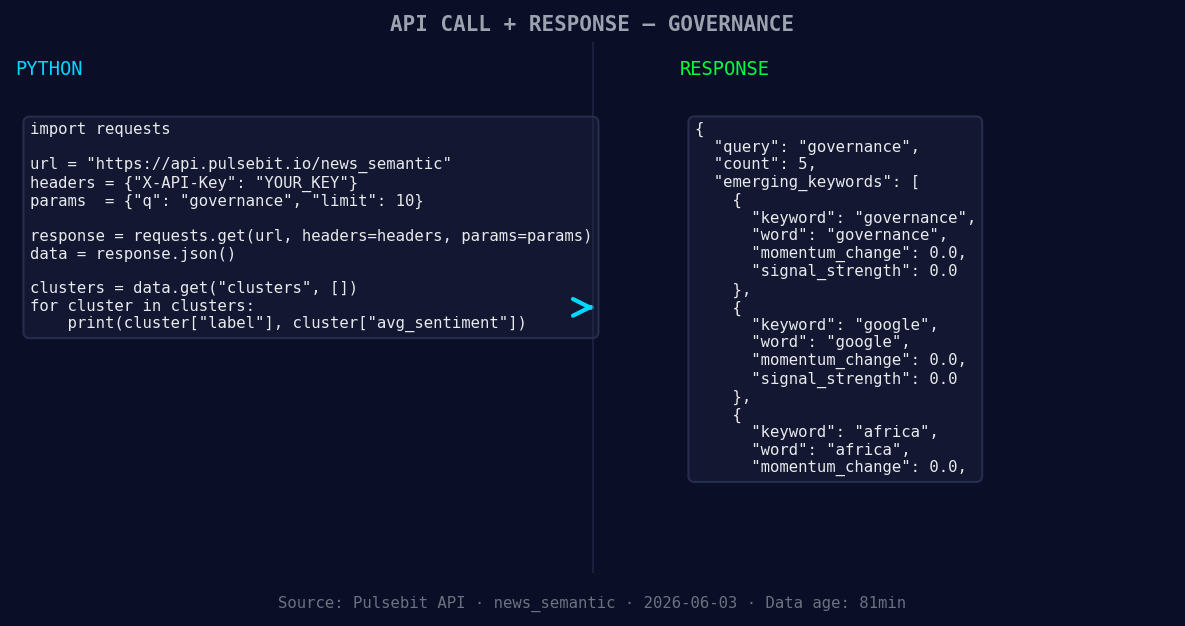
*Left: Python GET /news_semantic call for 'governance'. Right: returned JSON response structure (clusters: 3). Source: Pulsebit /news_semantic.*
# Step 1: Geographic origin filter
url = "https://api.pulsebit.com/v1/articles"
params = {
"topic": "governance",
"lang": "en",
"score": 0.117,
"confidence": 0.90,
"momentum": 0.252
}
response = requests.get(url, params=params)
data = response.json()
# Display the received data
print(data)
Now that we have filtered our data, we need to assess the narrative framing surrounding this momentum spike. We’ll run the cluster reason string back through our sentiment scoring API to evaluate how the narrative is being shaped. Here’s how we can do that:
# Step 2: Meta-sentiment moment
sentiment_url = "https://api.pulsebit.com/v1/sentiment"
meta_input = "Clustered by shared themes: africa, urged, strengthen, governance, reforms."
meta_response = requests.post(sentiment_url, json={"text": meta_input})
meta_sentiment = meta_response.json()

# Display the meta sentiment score
print(meta_sentiment)
By leveraging the geographic filter and the meta-sentiment loop, we can build a more robust understanding of governance sentiment trends. Here are three specific builds we can implement with this pattern:

Geographic detection output for governance. India leads with 5 articles and sentiment -0.25. Source: Pulsebit /news_recent geographic fields.
Governance Signal Tracker: Create a real-time monitoring script that triggers alerts when the momentum for governance exceeds a threshold of +0.25. This can be achieved by regularly querying our API with the geographic filter set to "en".
Meta-Sentiment Analyzer: Build an analytical dashboard that visualizes the sentiment around narratives related to governance. Use the meta-sentiment loop to score incoming narratives, allowing you to identify shifts and emerging themes in real-time.
Cluster Comparison Tool: Develop a tool that compares clusters of articles on governance against mainstream sentiment. Use the forming themes—like governance, google, and africa—to identify discrepancies between niche discussions and broader public sentiment, highlighting potential areas of concern or opportunity.
These builds will not only enhance your analysis but also ensure you’re responding to sentiment shifts promptly and effectively. For more information on how to get started with our API, check out our documentation at pulsebit.lojenterprise.com/docs. You can copy-paste and run this in under 10 minutes, so there’s no excuse to miss out on critical insights!


Top comments (0)