

Your Pipeline Is 24.4h Behind: Catching World Sentiment Leads with Pulsebit
On June 7, 2026, we discovered a notable anomaly in our sentiment analysis: a 24-hour momentum spike of +0.585. This spike indicates a substantial shift in global sentiment, particularly in the realm of sports, with a focus on the upcoming 2026 NCAA Baseball Tournament. The data revealed that the leading language driving this sentiment was Spanish, with a 24.4-hour lead time. This kind of insight is crucial for staying ahead of the curve, and it underscores the importance of monitoring multilingual sentiment dynamics.

Spanish coverage led by 24.4 hours. Ca at T+24.4h. Confidence scores: Spanish 0.85, English 0.85, French 0.85 Source: Pulsebit /sentiment_by_lang.
Yet, here's the catch: if your pipeline lacks the capability to manage multilingual origins or entity dominance, you might have missed this shift by a significant margin. Your model could be operating on outdated data, leaving you blind to emerging trends driven by specific languages or regions. In this case, the Spanish press is leading, and if your analysis isn't tuned to recognize this, you could be missing out on pivotal market signals.
Let's get into the code that allows us to catch these meaningful shifts. First, we’ll filter for the Spanish-language articles related to the topic "world," and then we’ll assess the meta-sentiment surrounding the identified cluster.
import requests
# Step 1: Query by language/country
topic = 'world'
score = +0.042
confidence = 0.85
momentum = +0.585
lang = 'sp'
# API call to fetch sentiment data for the topic
response = requests.get(f'https://api.pulsebit.com/sentiment?topic={topic}&lang={lang}')
data = response.json()
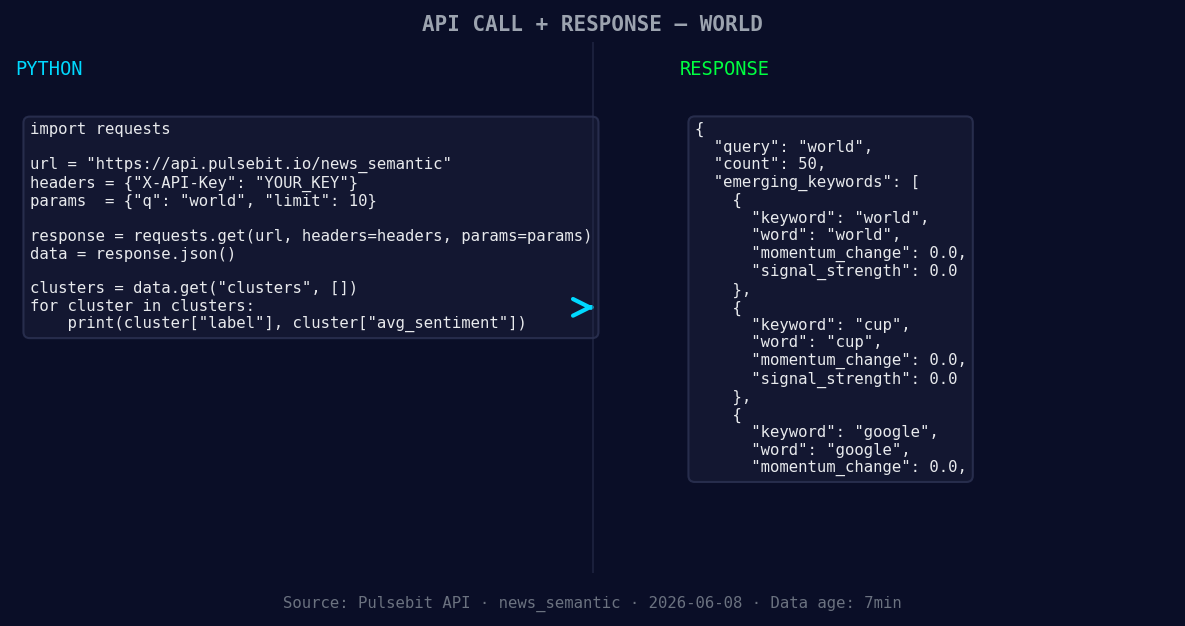
*Left: Python GET /news_semantic call for 'world'. Right: returned JSON response structure (clusters: 3). Source: Pulsebit /news_semantic.*
# Display fetched data
print(data)
In this code, we fetch sentiment data specifically for the Spanish language, ensuring that we capture the nuances of sentiment that might be lost in a monolingual analysis.
Next, let's run the cluster reason string back through our sentiment endpoint to score the narrative framing itself. This step provides insight into how the themes are being discussed across the articles.
# Step 2: Run the cluster reason string through the sentiment endpoint
cluster_reason = "Clustered by shared themes: absurd, world, cup, atlantic"
response_meta = requests.post('https://api.pulsebit.com/sentiment', json={"text": cluster_reason})
meta_sentiment_data = response_meta.json()

# Display the meta sentiment data
print(meta_sentiment_data)
Here, we analyze how the narrative is shaped around the themes of "absurd," "world," and "cup." This meta-sentiment analysis adds another layer of understanding, allowing us to identify not just what is being said, but how it is being framed.
Now, let's discuss three specific builds you can put together with this unique pattern data:
- Geographic Filter Build: Implement a system that alerts you when the momentum score for a specific topic (like 'world') exceeds a threshold of +0.500 in Spanish-language sources. This could indicate emerging trends needing immediate attention.

Geographic detection output for world. India leads with 35 articles and sentiment +0.17. Source: Pulsebit /news_recent geographic fields.
Meta-Sentiment Loop: Create a dashboard widget that visualizes the meta-sentiment of clustered narratives. Whenever the narrative framing shifts significantly, e.g., a score of +0.050 or higher, you receive a notification to explore those articles further.
Forming Theme Monitor: Set up a pipeline that continuously monitors the forming themes like "world(+0.00)," "cup(+0.00)," and "google(+0.00)." Whenever there's a sentiment spike in mainstream narratives tagged with "absurd," "world," or "cup," you can trigger a deeper analysis or report generation.
If you’re ready to get started with this, head over to our documentation at pulsebit.lojenterprise.com/docs. You can easily copy and paste the code provided here and run it in under 10 minutes. Dive into the world of sentiment analysis and ensure your models are not left behind!


Top comments (0)