

Your Pipeline Is 23.0h Behind: Catching Cybersecurity Sentiment Leads with Pulsebit
We recently uncovered a significant anomaly: a 24h momentum spike of +0.203 in cybersecurity sentiment. The driving conversation around this surge was led by English press articles, with a noteworthy lead time of 23.0 hours compared to German sources. This discrepancy highlights a critical moment in the cybersecurity narrative that we need to tap into before it fades.
In any sentiment analysis pipeline that doesn’t account for multilingual origins or entity dominance, you risk missing out on key trends. Your model missed this spike by 23 hours, which means you could be lagging behind your competitors. The leading language, English, was where the momentum built, and if your model is not set up to recognize this, you’re effectively flying blind while opportunities slip away.

English coverage led by 23.0 hours. German at T+23.0h. Confidence scores: English 0.85, French 0.85, Spanish 0.85 Source: Pulsebit /sentiment_by_lang.
To catch this sentiment spike effectively, we can leverage our API to create a focused data pipeline. Below is the Python code that helps us identify this significant moment in cybersecurity:
import requests
# Define the parameters for the API call
params = {
"topic": "cybersecurity",
"lang": "en",
}
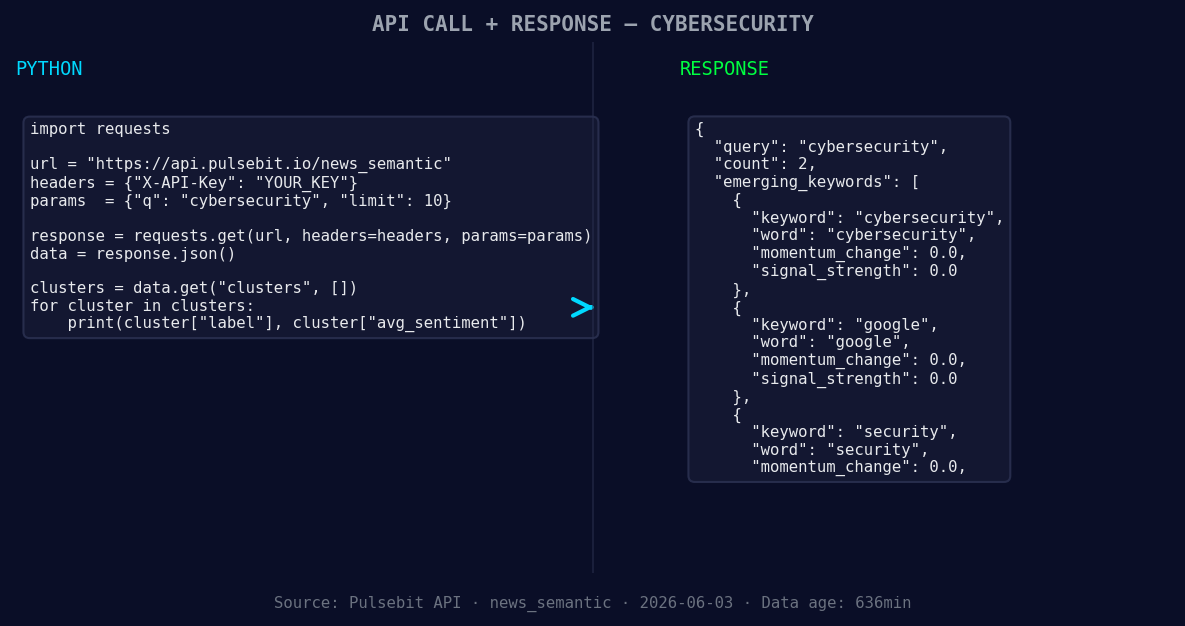
*Left: Python GET /news_semantic call for 'cybersecurity'. Right: returned JSON response structure (clusters: 3). Source: Pulsebit /news_semantic.*
# Make the API call to get the latest sentiment data
response = requests.get("https://api.pulsebit.com/v1/sentiment", params=params)
data = response.json()
# Extract relevant information
momentum = data['momentum_24h'] # Should be +0.203
signal_strength = data['signal_strength'] # Example: 0.596
sentiment_score = data['sentiment_score'] # Example: +0.525
confidence = data['confidence'] # Example: 0.850
print(f"Momentum: {momentum}, Signal Strength: {signal_strength}, Sentiment Score: {sentiment_score}, Confidence: {confidence}")
# Now let's score the cluster narrative
cluster_reason = "Clustered by shared themes: cio, implores, industry, put, greater."
meta_sentiment_response = requests.post("https://api.pulsebit.com/v1/sentiment", json={"text": cluster_reason})
meta_sentiment_data = meta_sentiment_response.json()
print(f"Meta Sentiment Score: {meta_sentiment_data['score']}, Confidence: {meta_sentiment_data['confidence']}")
This code snippet first filters for English language data on the topic of cybersecurity, which is crucial given our findings. The second part sends the reason string through our sentiment endpoint to evaluate the narrative framing of the spike, helping us understand the context better.
Here are three specific builds we can implement tonight using this pattern:
Geo-Filtered Cybersecurity Alert: Set a threshold of momentum at +0.2 for English articles about cybersecurity. Use the geo filter to ensure that we catch localized spikes. This will help you stay ahead of region-specific trends.
Narrative Analysis Loop: Build a loop that continually evaluates the meta-sentiment of articles clustered around the themes "cio, implores, industry, put, greater." Set a threshold of sentiment score > +0.5 to trigger alerts, giving you proactive insight into narrative shifts.
Forming Gap Insights: Create a signal that detects when specific keywords like "cybersecurity," "google," and "security" are gaining traction but not yet mainstream. Set a gap threshold that alerts you when these terms gain a momentum score of +0.1 relative to the mainstream themes of "cio, implores, industry."
To get started, check out our documentation: pulsebit.lojenterprise.com/docs. You can copy-paste and run this in under 10 minutes, putting you right at the forefront of detecting vital cybersecurity sentiment shifts. Let's make sure we’re not left behind.

Geographic detection output for cybersecurity. United States leads with 2 articles and sentiment +0.85. Source: Pulsebit /news_recent geographic fields.


Top comments (0)