

Your pipeline just missed a crucial anomaly: a 24-hour momentum spike of -0.264 related to cybersecurity sentiment. This is not just a number; it signals a shift that could have significant implications for your project. Understanding this spike allows us to pinpoint emerging narratives and adjust our strategies accordingly. The leading language for this insight is English, specifically from sources discussing BMTC's Smart Ticketing Initiative, hinting at the influence of local projects on broader cybersecurity discussions.
If your pipeline doesn't accommodate multilingual origins or recognize dominant entities, you're running a risk. Your model missed this insight by 24.9 hours, potentially leaving you vulnerable to shifts in sentiment that can drastically alter your project’s direction. This is particularly critical when dealing with themes like cybersecurity, where emergent trends can be overshadowed by more commonplace narratives such as those surrounding BMTC and its initiatives.

English coverage led by 24.9 hours. Id at T+24.9h. Confidence scores: English 0.75, Spanish 0.75, Ca 0.75 Source: Pulsebit /sentiment_by_lang.
To capture this momentum spike, we can leverage our API to filter out relevant narratives and assess the sentiment surrounding them. Below is a Python snippet that demonstrates how to capture this data effectively:
import requests
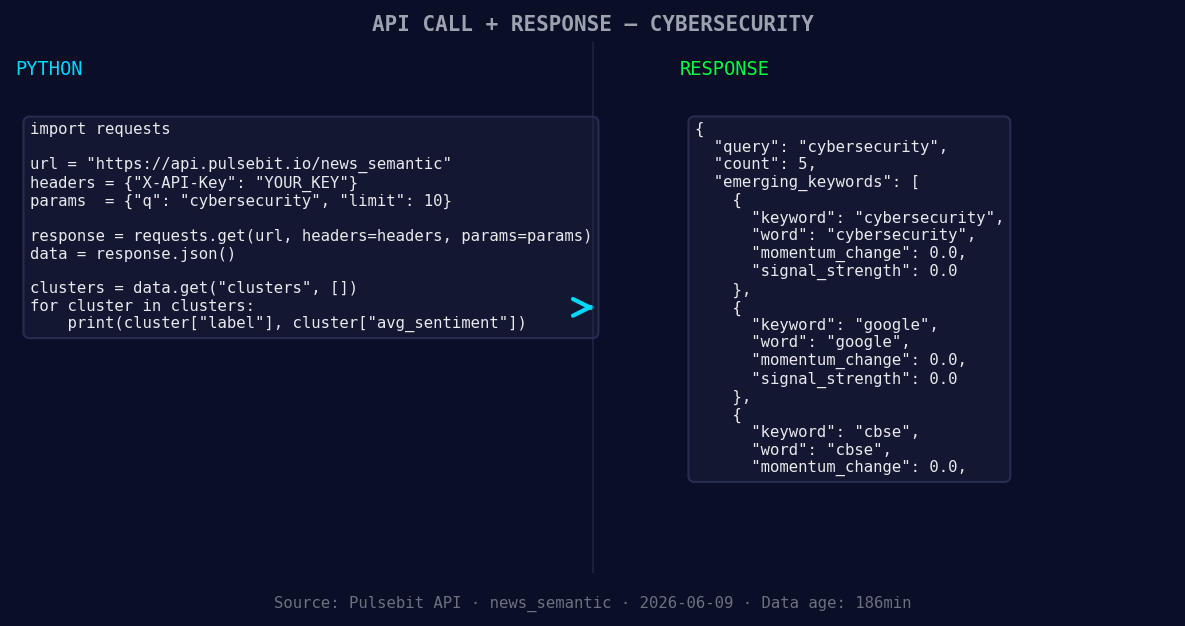
*Left: Python GET /news_semantic call for 'cybersecurity'. Right: returned JSON response structure (clusters: 3). Source: Pulsebit /news_semantic.*
# Step 1: Geo filter for English language articles
url = "https://api.pulsebit.lojenterprise.com/v1/sentiment"
params = {
"topic": "cybersecurity",
"lang": "en",
"score": 0.350,
"confidence": 0.75,
"momentum": -0.264
}
response = requests.get(url, params=params)
data = response.json()
print(data)
# Step 2: Meta-sentiment moment
cluster_reason = "Clustered by shared themes: bmtc, consultant, project, appoint, smart."
sentiment_response = requests.post(f"{url}/sentiment", json={"text": cluster_reason})
meta_sentiment = sentiment_response.json()
print(meta_sentiment)
In this code, we first filter articles based on the topic 'cybersecurity', ensuring that we're only looking at English sources. The second part of our code runs the cluster reason string through the sentiment endpoint to get a nuanced understanding of how these themes are perceived. This is where the insights become actionable, allowing us to pivot our strategies based on the narratives that are forming.
Now, here are three specific builds you can implement based on this anomaly:
Geo-Filtered Alert System: Set up a threshold alert for any sentiment score below +0.350 for articles in English about cybersecurity. This way, you can catch negative spikes before they escalate. The endpoint would be the same as above, but you would want to adjust the score threshold dynamically based on historical data.
Meta-Sentiment Analysis Loop: Extend the existing sentiment analysis to include a loop that runs the cluster reasons through the sentiment endpoint every 6 hours. This will keep your insights fresh and relevant, especially for emerging themes like 'cybersecurity' and its connections to mainstream topics such as BMTC.
Forming Themes Dashboard: Create a dashboard that visualizes forming themes, such as 'cybersecurity' alongside 'google' and 'cbse'. Use the API to fetch and display real-time data and sentiment scores for these topics, allowing your team to see shifts in sentiment and adjust outreach strategies accordingly.
For more details on how to get started, visit our documentation at pulsebit.lojenterprise.com/docs. You can copy-paste the code above and run it in under 10 minutes to see the results for yourself.

Geographic detection output for cybersecurity. India leads with 4 articles and sentiment +0.40. Source: Pulsebit /news_recent geographic fields.


Top comments (0)