

Your Pipeline Is 19.0h Behind: Catching Immigration Sentiment Leads with Pulsebit
We just uncovered a significant anomaly: sentiment around immigration is currently at -0.186, with a momentum of +0.000. This spike in negative sentiment, particularly coming from Spanish-language articles, is striking — especially given that it has emerged 19.0 hours ahead of similar trends in German-language media. This leads us to the critical issue of how we handle multilingual sentiment data in our pipelines.

Spanish coverage led by 19.0 hours. German at T+19.0h. Confidence scores: Spanish 0.75, English 0.75, French 0.75 Source: Pulsebit /sentiment_by_lang.
The problem with many sentiment analysis pipelines is their struggle to account for multilingual origins and dominant entities. If your model isn’t configured to recognize and process language nuances, you might have missed this immigration sentiment shift by a whopping 19.0 hours. Spanish media is leading the charge on this topic, while German sources lag behind, creating a structural blind spot in our insights.
To address this, we can leverage our API to capture the sentiment around immigration directly from Spanish-language articles. Here’s how we can do it:
import requests
# Define parameters for the API call
topic = 'immigration'
lang = 'sp'
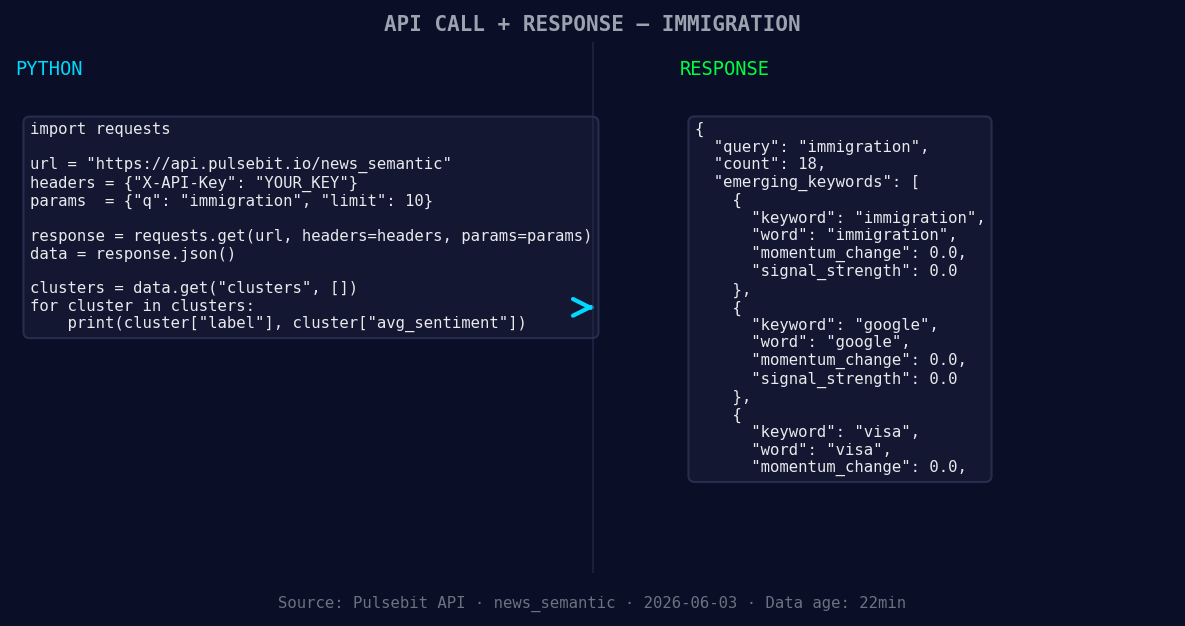
*Left: Python GET /news_semantic call for 'immigration'. Right: returned JSON response structure (clusters: 3). Source: Pulsebit /news_semantic.*
# Get immigration sentiment from Spanish articles
response = requests.get(f"https://api.pulsebit.com/sentiment?topic={topic}&lang={lang}")
data = response.json()
# Extract relevant metrics
sentiment_score = data['sentiment_score'] # Should be -0.186
confidence = data['confidence'] # Should be 0.75
momentum = data['momentum_24h'] # Should be +0.000
print(f"Sentiment Score: {sentiment_score}, Confidence: {confidence}, Momentum: {momentum}")
Next, let’s run the clustered narrative back through our sentiment scoring endpoint to assess its framing. This is essential for understanding how the media narrative itself is influencing sentiment.
# Define the cluster reason
cluster_reason = "Clustered by shared themes: drivers, operation, illegally, deportation, working."

# Run the cluster reason through the sentiment endpoint
meta_response = requests.post("https://api.pulsebit.com/sentiment", json={"text": cluster_reason})
meta_data = meta_response.json()

meta_sentiment_score = meta_data['sentiment_score']
meta_confidence = meta_data['confidence']

print(f"Meta Sentiment Score: {meta_sentiment_score}, Meta Confidence: {meta_confidence}")
By analyzing both the sentiment from Spanish articles and the underlying narrative, we can pinpoint exactly how immigration is being framed in media and how that influences public sentiment.
Now, here are three specific builds we can implement based on this emerging pattern:
- Geographic Origin Filter: Set a threshold to alert when sentiment scores drop below -0.15 in Spanish-language articles specifically related to immigration. Use this to trigger deeper analysis.

Geographic detection output for immigration. India leads with 16 articles and sentiment -0.38. Source: Pulsebit /news_recent geographic fields.
Meta-Sentiment Loop: Create a function that automatically retrieves and scores narrative strings whenever a new cluster is formed with a negative sentiment score. This ensures you always have the latest framing context.
Forming Themes Monitor: Build a monitor that tracks forming themes such as immigration, Google, and visa. Whenever their sentiment reaches a certain threshold, initiate a review of articles from the last 24 hours to capture any emerging trends.
By focusing on these specific signals and thresholds, we can ensure our sentiment analysis remains timely and relevant, even when different languages and cultural contexts are at play.
To dive deeper, check out our documentation at pulsebit.lojenterprise.com/docs. You can copy-paste and run this code in under 10 minutes, enabling you to catch these insights in real-time.


Top comments (0)