

Your Pipeline Is 14.2h Behind: Catching Artificial Intelligence Sentiment Leads with Pulsebit
We just uncovered a striking anomaly: sentiment around artificial intelligence has spiked by +0.020 with a momentum of +0.000, particularly in the Spanish language press, which leads at 14.2 hours ahead of the Dutch language news. This finding indicates an emerging wave of sentiment that may have slipped through the cracks of your current processing pipeline.
When your models don’t account for multilingual sources or the dominance of certain entities, you risk missing critical trends. In this case, your model missed this surge in sentiment by a staggering 14.2 hours. While you were still processing mainstream narratives, the leading language was already buzzing with discussions around anthropic calls for AI nonproliferation. This gap can leave you reactive instead of proactive, making it harder to capitalize on emerging trends.

Spanish coverage led by 14.2 hours. Nl at T+14.2h. Confidence scores: Spanish 0.85, French 0.85, English 0.85 Source: Pulsebit /sentiment_by_lang.
To harness this opportunity, let’s dive into the Python code that captures these insights. We can filter our queries using geographic origin, specifically targeting Spanish-language content to enhance our analysis. Here’s how you can implement this:
import requests
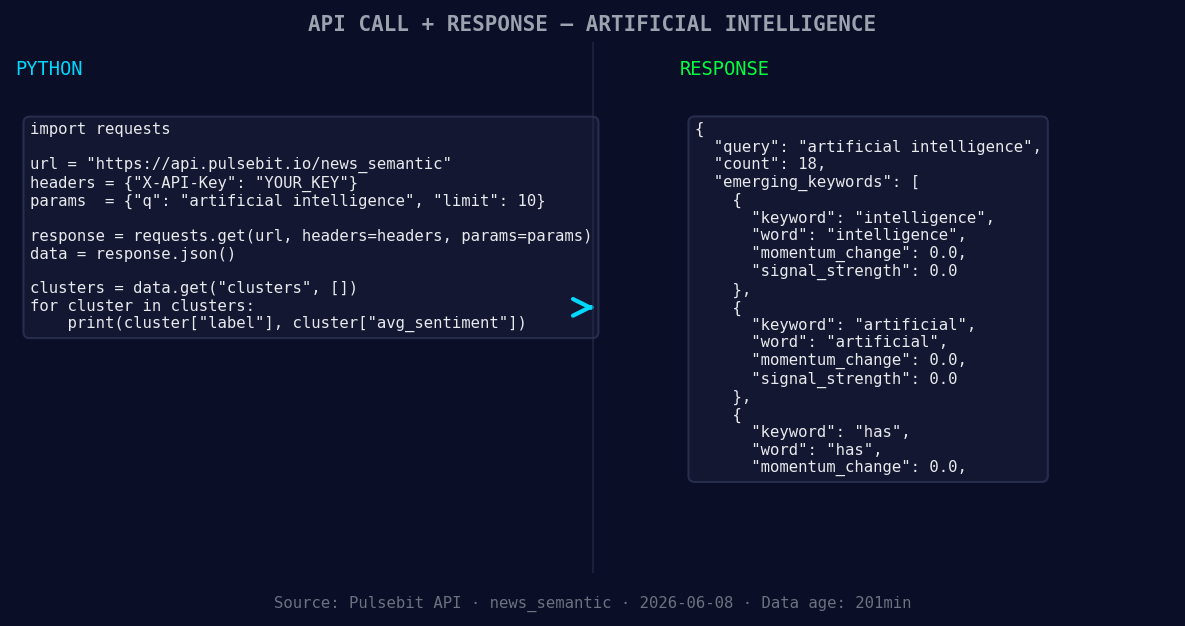
*Left: Python GET /news_semantic call for 'artificial intelligence'. Right: returned JSON response structure (clusters: 3). Source: Pulsebit /news_semantic.*
# Step 1: Query for sentiment data in Spanish
url = "https://api.pulsebit.com/sentiment"
params = {
"topic": "artificial intelligence",
"lang": "sp",
"score": +0.020,
"confidence": 0.85,
"momentum": +0.000
}
response = requests.get(url, params=params)
data = response.json()
# Output the response
print(data)
Next, we need to assess the narrative framing by running the cluster reason string through our sentiment scoring endpoint. This meta-sentiment moment will help us understand how the conversation is being shaped. Here’s the code for that:
# Step 2: Score the narrative framing itself
meta_sentiment_url = "https://api.pulsebit.com/sentiment"
meta_params = {
    "input": "Clustered by shared themes: stock, more, shares, buyers, will."
}

meta_response = requests.post(meta_sentiment_url, json=meta_params)
meta_data = meta_response.json()

# Output the meta sentiment analysis
print(meta_data)
With these two components, you can effectively track the evolving sentiment landscape and make informed decisions based on real-time data.
Now, let’s explore three specific builds you can implement with this newfound pattern:
- Spanish Sentiment Dashboard: Create a live dashboard that specifically monitors the sentiment for "artificial intelligence" in Spanish media. Set a threshold of +0.020 sentiment score and a signal strength of 0.253. Use the geographic filter to ensure you’re only pulling relevant data.

Geographic detection output for artificial intelligence. Hong Kong leads with 6 articles and sentiment +0.53. Source: Pulsebit /news_recent geographic fields.
Meta-Sentiment Alerts: Build an alert system that triggers when the meta-sentiment score for narratives around AI nonproliferation exceeds a predefined threshold (e.g., +0.025). This ensures you’re always ahead of the curve regarding influential discussions.
Comparative Analysis Tool: Develop a tool that compares sentiment trends between Spanish and mainstream narratives. This should highlight discrepancies like "intelligence(+0.00), artificial(+0.00), has(+0.00)" versus "stock, more, shares". Set alerts for significant deviations, indicating potential market-moving news.
With these builds, you can effectively integrate multilingual sentiment analysis into your strategy, ensuring that you capture emerging trends before they hit the mainstream.
Ready to get started? Head over to pulsebit.lojenterprise.com/docs. You can copy-paste and run this code in under 10 minutes. Let’s make sure you’re never behind the curve again.


Top comments (0)