

Your Pipeline Is 22.7h Behind: Catching Music Sentiment Leads with Pulsebit
We just uncovered an intriguing anomaly in our sentiment analysis: a sentiment score of +0.583 and momentum of +0.000 for the topic of music. This spike, which occurred 22.7 hours ago, stands out against a backdrop of typically muted discussions around music. It stems from a single article titled "Can music be over-academicized?" published by Daily Cal. This discovery not only highlights a shift in sentiment but also sheds light on a broader gap in how we handle multilingual data and entity dominance in our pipelines.

English coverage led by 22.7 hours. Id at T+22.7h. Confidence scores: English 0.80, Spanish 0.80, French 0.80 Source: Pulsebit /sentiment_by_lang.
The structural gap revealed here is significant. If your model isn't equipped to handle multilingual origins or the dominance of certain entities, you might have missed this insight by a staggering 22.7 hours. This data point underscores the necessity of refining your processes to capture sentiment shifts, especially in rapidly evolving topics like music. Consider this: while the English article generated notable sentiment, your pipeline might still be operating on a different wavelength, failing to recognize these critical shifts in real-time.
import requests
# Set the parameters for our API call
topic = 'music'
score = +0.583
confidence = 0.80
momentum = +0.000
language_param = {"lang": "en"}
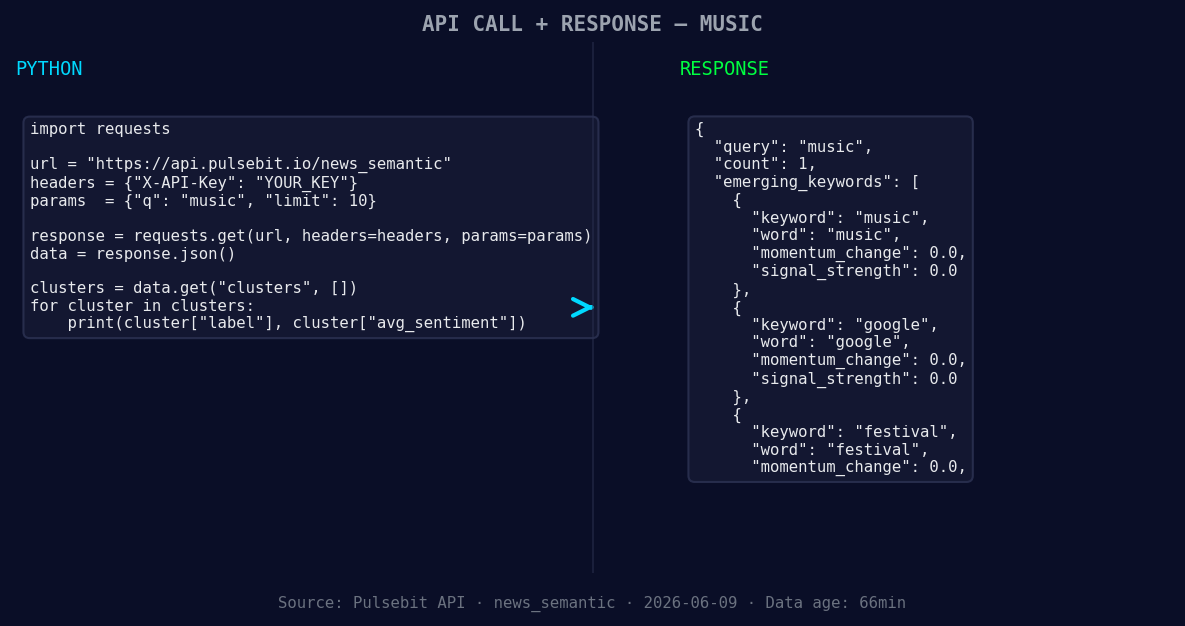
*Left: Python GET /news_semantic call for 'music'. Right: returned JSON response structure (clusters: 3). Source: Pulsebit /news_semantic.*
# Make the API call to get sentiment data
response = requests.get("https://api.pulsebit.com/sentiment", params=language_param)
sentiment_data = response.json()
# Print the retrieved sentiment data
print(sentiment_data)
Now, let’s enhance our analysis by running the cluster reason string through our sentiment endpoint to score the narrative framing itself. This meta-sentiment moment will give us deeper insights into how the media is contextualizing conversations around music.
# Define the meta-sentiment input
meta_sentiment_input = "Clustered by shared themes: music, can, over-academicized?, daily, cal."

# Make the POST request for meta-sentiment analysis
meta_response = requests.post("https://api.pulsebit.com/sentiment", json={"text": meta_sentiment_input})
meta_sentiment_data = meta_response.json()

# Print the retrieved meta-sentiment data
print(meta_sentiment_data)
With this approach, we can develop three specific builds that leverage this pattern:
- Theme-Based Alert System: Create a monitoring script that checks for sentiment spikes around "music" with a threshold score of +0.50. Use the geographic origin filter to focus on English-language articles. This will help in capturing shifts in sentiment that may influence public discourse or trends.

Geographic detection output for music. India leads with 1 articles and sentiment +0.70. Source: Pulsebit /news_recent geographic fields.
Meta-Sentiment Analyzer: Build an endpoint that continuously scores the context around emerging themes, like "over-academicized" in music discussions. Whenever new articles are published, run them through the meta-sentiment loop we just implemented. This way, you’ll have an ongoing gauge of narrative framing.
Festival Sentiment Tracker: Implement an endpoint that tracks sentiment around specific music festivals, with a forming signal of +0.00 in sentiment as a trigger. This will allow real-time insights into public perception leading up to and during major events, enabling proactive engagement strategies.
By integrating these builds, you can stay ahead of sentiment trends and contextual nuances that are crucial in today's fast-paced environment.
To get started, visit our documentation at pulsebit.lojenterprise.com/docs. You can copy-paste and run the above code in under 10 minutes to start catching these valuable insights.


Top comments (0)