

Your Pipeline Is 28.5h Behind: Catching Health Sentiment Leads with Pulsebit
We stumbled upon a compelling anomaly: a 24h momentum spike of +0.800 in health sentiment. This spike indicates something significant brewing in the health narrative, particularly with the leading English press that is lagging by 28.5 hours. The spike signifies an urgent need for our systems to adapt and catch up with the evolving sentiment landscape.
If your pipeline isn’t designed to handle the nuances of multilingual origins or entity dominance, it’s likely that you missed this crucial insight by nearly a day. The leading language here is English, but the relevant themes—the joy and pain associated with the NFHS-6 data—indicate that there’s a deeper narrative in the air. Your model’s inability to capture this sentiment in real-time could mean losing out on critical insights that affect decision-making.

English coverage led by 28.5 hours. Et at T+28.5h. Confidence scores: English 0.85, French 0.85, Spanish 0.85 Source: Pulsebit /sentiment_by_lang.
Here’s how we can catch this momentum spike using our API. First, we need to filter the data by geographic origin to focus on English-speaking audiences. The following Python code snippet demonstrates how to query the API for sentiment data related to health:
import requests
# Define the parameters for the API call
params = {
"topic": "health",
"score": 0.700,
"confidence": 0.85,
"momentum": 0.800,
"lang": "en" # Filter by English language
}
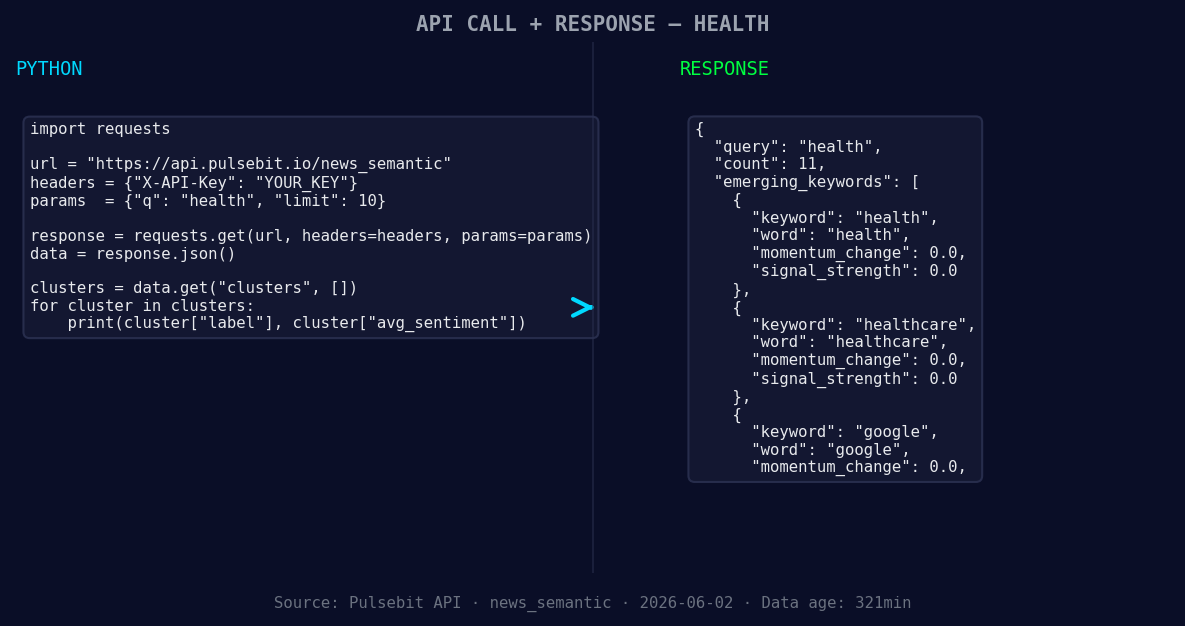
*Left: Python GET /news_semantic call for 'health'. Right: returned JSON response structure (clusters: 3). Source: Pulsebit /news_semantic.*
# Make the API call
response = requests.get("https://api.pulsebit.com/sentiment", params=params)
data = response.json()
Next, we need to examine the cluster reason string to assess the narrative framing. This helps us understand how the themes of joy, pain, and health are interacting. We can utilize the POST endpoint to score this narrative:
# Cluster reason string
cluster_reason = "Clustered by shared themes: nfhs-6, joy, pain:, data, health."

# Make the POST request to score the narrative framing
response = requests.post("https://api.pulsebit.com/sentiment", json={"text": cluster_reason})
meta_sentiment_data = response.json()
By connecting these two pieces, we’re not just identifying a spike; we’re contextualizing it within the larger narrative framework.
Now, let’s talk about three specific builds we can create based on this momentum spike.
- Geographic Filter for Health Trends: Use the geo filter to create a dashboard that tracks health sentiment trends specifically in English-speaking regions. Set a threshold of momentum > +0.500 to trigger alerts for any significant shifts.

Geographic detection output for health. India leads with 9 articles and sentiment +0.56. Source: Pulsebit /news_recent geographic fields.
Meta-Sentiment Analyzer: Build a tool that continuously feeds the cluster reason strings through our sentiment scoring endpoint. Use the threshold of sentiment score > +0.600 to highlight narratives that are gaining traction, particularly around forming topics like healthcare and joy.
Anomaly Detector for Healthcare: Create a monitoring system that checks for health-related keywords in real-time. Set up alerts for when momentum spikes above +0.800, indicating a need for immediate analysis and reporting, especially in relation to mainstream conversations surrounding NFHS-6 data.
These builds will not only enhance your sentiment analysis capabilities but also ensure that your models are responsive to the fast-paced changes in public discourse surrounding health.
For a deep dive into implementing these insights, check out our documentation at pulsebit.lojenterprise.com/docs. You can copy-paste these examples and have them running in under 10 minutes. Don’t let your pipeline lag behind—catch up with the pulse of health sentiment today!


Top comments (0)