

Your pipeline just missed a significant 24h momentum spike: +0.185. This isn't just a minor oversight; it reveals a critical gap in how we process multilingual data and entity dominance in sentiment analysis. The leading language here is English, with a press coverage lag of 14.4 hours. If your model isn't tuned to capture this nuance, it means you’re behind the curve, missing timely insights that can inform decisions. In this case, the world of education is buzzing with relevant news, but your pipeline is still catching up, potentially leading to missed opportunities.

English coverage led by 14.4 hours. Ro at T+14.4h. Confidence scores: English 0.75, French 0.75, Spanish 0.75 Source: Pulsebit /sentiment_by_lang.
Many pipelines struggle with multilingual origin and entity relevance. If your model isn't equipped to handle these factors, you're potentially missing out on valuable sentiment shifts. You just let a leading story slip by, delayed by 14.4 hours, and that's a gap that can cost you. A nuanced understanding of the source language and the dominant narrative is essential for timely insights. Without it, you risk acting on stale information while others capitalize on emerging trends.
import requests
# Set up parameters for the API call
topic = 'world'
score = +0.024
confidence = 0.75
momentum = +0.185
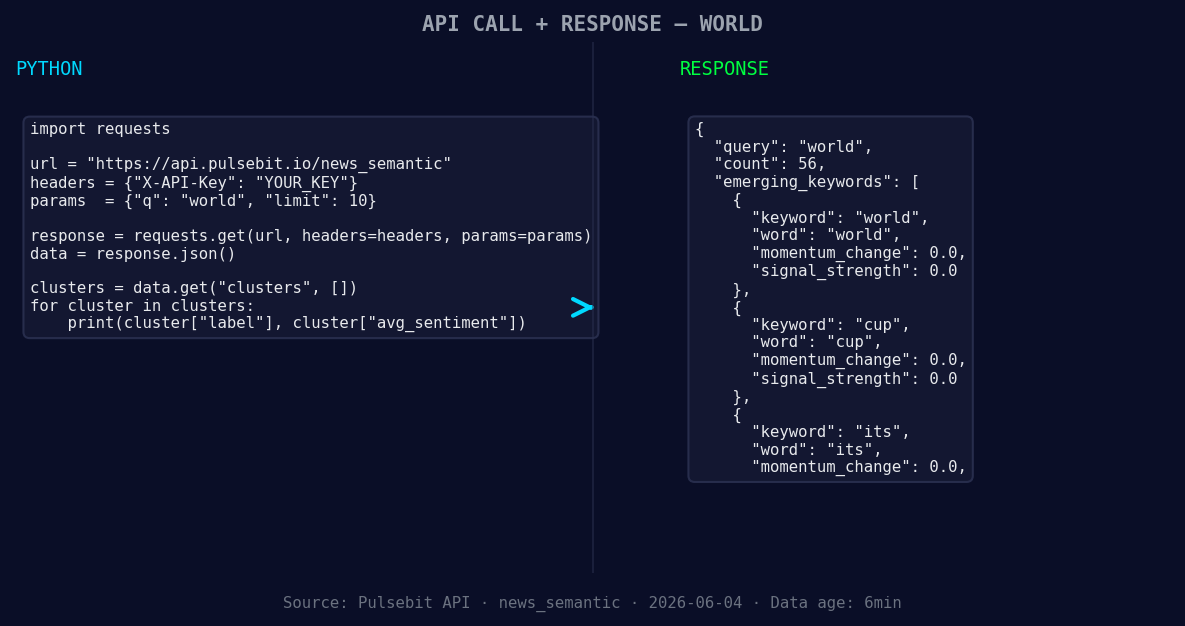
*Left: Python GET /news_semantic call for 'world'. Right: returned JSON response structure (clusters: 3). Source: Pulsebit /news_semantic.*
# Geographic origin filter: query by language
url = "https://api.pulsebit.com/v1/sentiment"
params = {
"topic": topic,
"score": score,
"confidence": confidence,
"momentum": momentum,
"lang": "en" # Filter for English articles
}
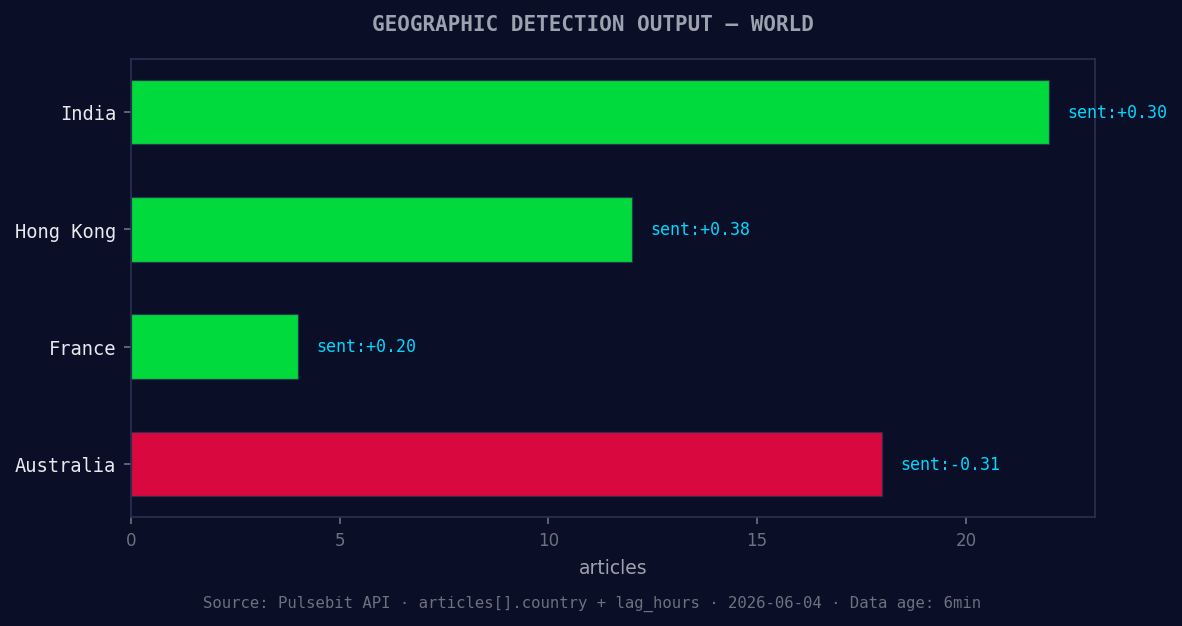
*Geographic detection output for world. India leads with 22 articles and sentiment +0.30. Source: Pulsebit /news_recent geographic fields.*
# Make the API call
response = requests.get(url, params=params)
data = response.json()
print(data)
# Now, let's analyze the meta-sentiment around our clustered themes
cluster_reason = "Clustered by shared themes: news, world, education:, june, 2026."
meta_sentiment_url = "https://api.pulsebit.com/v1/sentiment"
meta_response = requests.post(meta_sentiment_url, json={"text": cluster_reason})
meta_sentiment_data = meta_response.json()
print(meta_sentiment_data)
With this code, you can filter for sentiment data in English and then assess the narrative framing of clustered themes. The cluster reason string is crucial; it gives us insight into how the story is being framed across multiple articles. By running this through our sentiment analysis endpoint, we can gauge how the news is being interpreted and whether it's aligned with the momentum spike we observed.
Here are three specific things you can build using this pattern:
Geo Filter for Domain-Specific Trends: Set a signal threshold for world-related topics with momentum spikes over +0.1. This lets you catch significant sentiment changes specifically within English-language articles, like those related to education, to ensure you're not missing critical updates.
Meta-Sentiment Loop for Contextual Analysis: Build a monitoring function that runs the cluster reason string against the POST /sentiment endpoint every 24 hours. If the sentiment score drops below +0.01, trigger an alert, allowing you to react to shifts in narrative framing before they become mainstream.
Real-Time Dashboard for Forming Themes: Create a dashboard that visualizes forming themes like 'world(+0.00)', 'cup(+0.00)', and 'its(+0.00)'. Use sentiment scores to identify when these themes start diverging from mainstream topics. If the world-related sentiment starts to trend negatively while education is positive, that’s a signal to dig deeper.
If you're ready to dive in, visit pulsebit.lojenterprise.com/docs. You can copy-paste this code and get it running in under 10 minutes. Don’t let your pipeline lag behind; catch those crucial sentiment shifts as they happen.


Top comments (0)