

Your Pipeline Is 10.5h Behind: Catching Mobile Sentiment Leads with Pulsebit
Recently, we discovered a striking anomaly: a 24-hour momentum spike of +0.210 related to the topic of mobile. This spike isn't just a number—it's a signal that something significant is happening in the world of mobile services, specifically with the emergence of mobile veterinary ambulance services. The leading language driving this sentiment is English, which has a 10.5-hour lead over other languages. If you're not tuned in, you might be missing critical insights in your data pipeline.
The Problem
This discovery reveals a glaring structural gap in any pipeline that fails to account for multilingual origins or entity dominance. Your model missed this by 10.5 hours, which is substantial in a fast-moving environment. By not recognizing the English press as the leading source, you risk lagging behind the sentiment wave that can shape your strategies and decisions. Sentiment data is dynamic, and failing to capture these shifts can mean the difference between being proactive and reactive.

English coverage led by 10.5 hours. Ro at T+10.5h. Confidence scores: English 0.75, French 0.75, Spanish 0.75 Source: Pulsebit /sentiment_by_lang.
The Code
Here’s how we can catch this momentum spike using our API. The first step is to set up a query that filters for English-language articles. Below is the Python code we used:
import requests
# Define the parameters for the API call
params = {
"topic": "mobile",
"lang": "en",
"momentum": +0.210
}
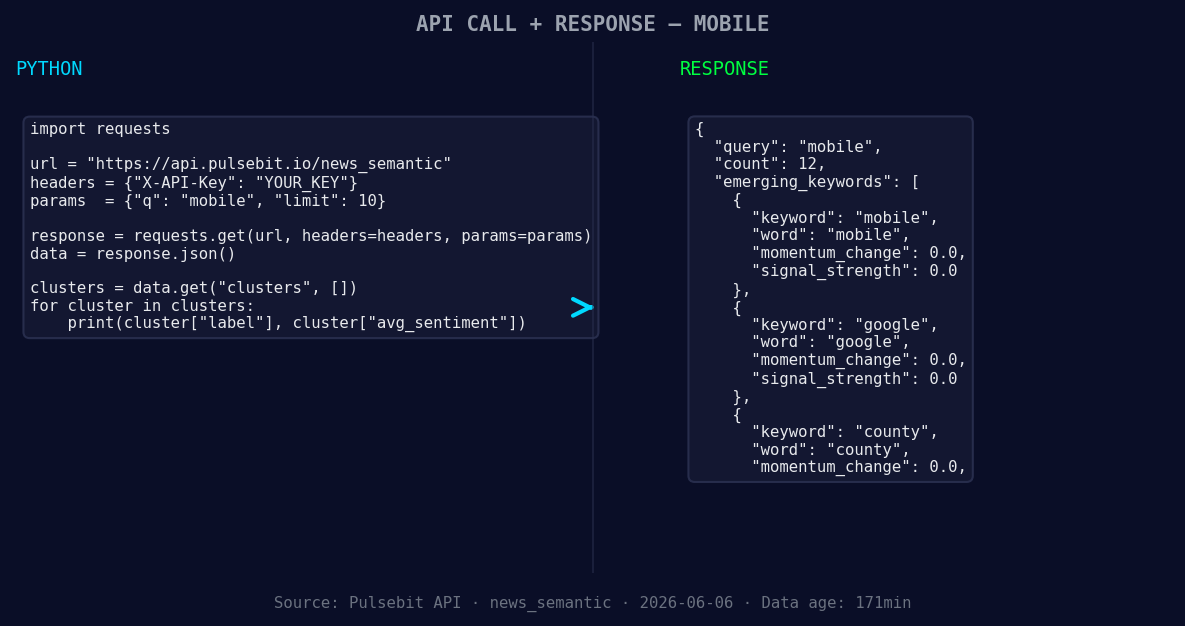
*Left: Python GET /news_semantic call for 'mobile'. Right: returned JSON response structure (clusters: 3). Source: Pulsebit /news_semantic.*
# Make the API call to get the sentiment data
response = requests.get("https://api.pulsebit.com/v1/sentiment", params=params)
data = response.json()
print(data)
Next, we need to run the cluster reason string through our API to score the narrative framing itself. This is crucial for understanding how the sentiment is shaped by the themes involved. Here’s how we do that:
# Define the narrative framing input
narrative_input = "Clustered by shared themes: mobile, veterinary, ambulance, services, avail."

# Make the POST request to score the narrative
response = requests.post("https://api.pulsebit.com/v1/sentiment", json={"text": narrative_input})
narrative_score = response.json()

print(narrative_score)
This two-step process allows us to capture not only the sentiment around mobile services but also the thematic framing that drives it.
Three Builds Tonight
Here are three specific builds we can create with this momentum spike:
- Geo-filtered Sentiment Dashboard: Build a dashboard that displays sentiment for mobile-related services filtered by geographic location. Use the geo filter to identify regions where mobile veterinary services are gaining traction, setting a threshold score of +0.100.

Geographic detection output for mobile. India leads with 10 articles and sentiment +0.33. Source: Pulsebit /news_recent geographic fields.
Meta-Sentiment Analysis Tool: Create a tool that automatically scores narratives around emerging topics. Use the meta-sentiment loop to enrich your analysis, focusing on the cluster reason string. Set a threshold confidence level of 0.75 to ensure you're only acting on reliable insights.
Trending Themes Alert System: Develop an alert system that notifies you when sentiments around specific themes reach a certain level. For instance, trigger an alert when sentiment for "mobile" or "veterinary" exceeds a score of +0.150, especially when compared against mainstream topics like "ambulance".
Get Started
To dive into this, visit pulsebit.lojenterprise.com/docs. With our API, you can copy-paste the code we’ve shared and run it in under 10 minutes. Don’t let your pipeline lag behind—leverage these insights to stay ahead.


Top comments (0)