

Your Pipeline Is 18.7h Behind: Catching Governance Sentiment Leads with Pulsebit
We recently discovered a compelling anomaly: a 24h momentum spike of +0.252, specifically in the topic of governance. This spike caught our attention because it indicates a significant shift in sentiment that you might be missing in your data pipeline. The leading language in this spike was English, which was ahead by 18.7 hours compared to German. This delay can have serious implications for your decision-making processes.
If your model isn't equipped to handle multilingual origins or entity dominance, you could be lagging behind critical insights. In this case, your pipeline missed this governance sentiment by a substantial 18.7 hours. Imagine how much ground you could lose if you're not accounting for such discrepancies, especially when your competitors might be capitalizing on this information.

English coverage led by 18.7 hours. German at T+18.7h. Confidence scores: English 0.85, Spanish 0.85, French 0.85 Source: Pulsebit /sentiment_by_lang.
To catch insights like this, we need to build a solution leveraging our API effectively. First, we’ll focus on the geographic origin filter to isolate English sources. Here's how to do it in Python:

Geographic detection output for governance. India leads with 6 articles and sentiment -0.07. Source: Pulsebit /news_recent geographic fields.
import requests
# Define the parameters
topic = 'governance'
lang = 'en'
# Make the API call
response = requests.get(f'https://api.pulsebit.com/v1/sentiment?topic={topic}&lang={lang}')
data = response.json()
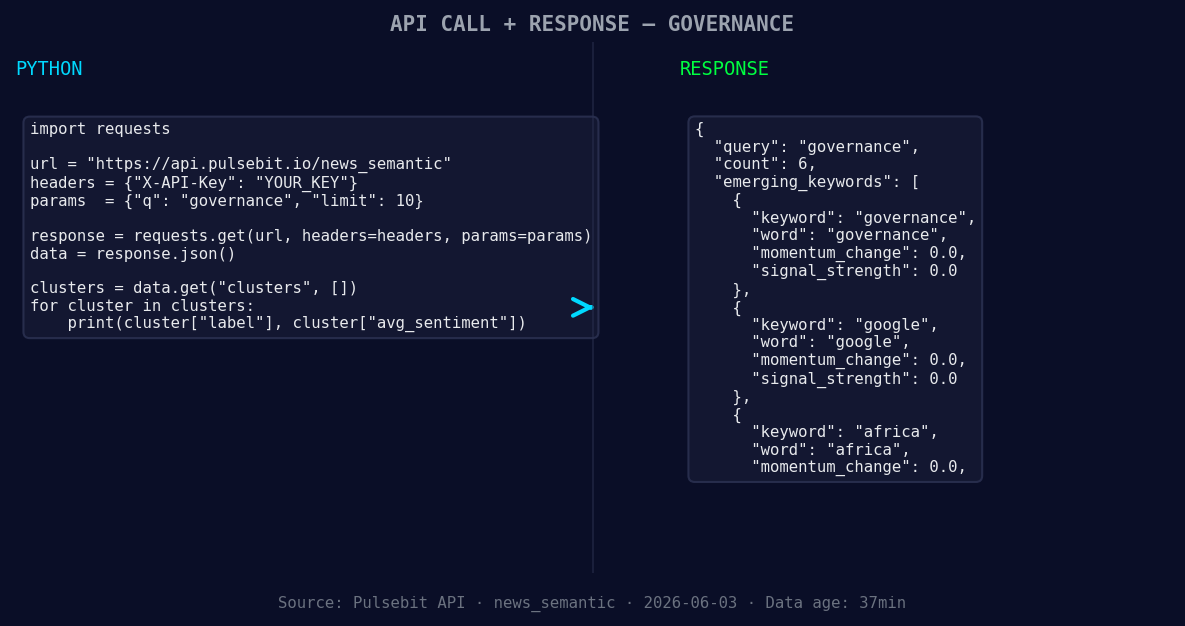
*Left: Python GET /news_semantic call for 'governance'. Right: returned JSON response structure (clusters: 3). Source: Pulsebit /news_semantic.*
# Check the response
print(data)
This call filters our sentiment analysis to focus on English-language articles, which is crucial when you're trying to capture timely insights.
Next, we need to evaluate the narrative framing of this spike. This involves running the cluster reason string through the sentiment scoring endpoint. Here’s how we can score the narrative:
# Define the cluster reason string
cluster_reason = "Clustered by shared themes: africa, urged, strengthen, governance, reforms."

# Make the POST request to score the narrative
score_response = requests.post('https://api.pulsebit.com/v1/sentiment/score', json={"text": cluster_reason})
narrative_data = score_response.json()

# Check the narrative score
print(narrative_data)
This POST request evaluates the sentiment surrounding the themes that are emerging. In our case, the themes of governance, Africa, and reforms are critical focal points that could guide your analysis and decision-making.
Now that we've discussed how to catch these insights, here are three actionable builds you can implement based on this momentum spike:
Signal Monitoring for Governance: Set up a threshold alert that triggers when the sentiment score for governance exceeds +0.500. This could help you identify rising trends in governance sentiment before they become mainstream.
Geo-Filtered Insights: Create a dashboard that visualizes sentiment data filtered for specific regions. Use the geographic origin filter to pull insights from English-speaking countries, allowing you to monitor sentiment shifts in real-time.
Meta-Sentiment Analysis: Use the meta-sentiment loop we've discussed to analyze narratives around emerging themes. You can set a threshold to flag when certain themes—like governance, Africa, or reforms—start clustering together, indicating a potential shift in public discourse.
By implementing these strategies, you can enhance your ability to respond to sentiment changes proactively. These are not just abstract ideas; they are grounded in the data we’ve just analyzed.
For detailed guidance on getting started with our API, check out our documentation at pulsebit.lojenterprise.com/docs. You can copy-paste and run this in under 10 minutes. Don't let your pipeline fall behind; seize these insights now!


Top comments (0)