

Your Pipeline Is 9.9h Behind: Catching Defence Sentiment Leads with Pulsebit
Just the other day, we identified a fascinating anomaly: a 24h momentum spike of +0.518 around the topic of defence. This spike was notably driven by an English-language press narrative surrounding "France's Ban on Israeli Weapons at Defence Show." With two prominent articles clustering around shared themes like "Israeli," "major," "defence," and "bans," it illustrates how quickly sentiment can shift in response to geopolitical events. If your model isn’t monitoring these shifts effectively, you’re missing critical insights.
Let’s face it: if your pipeline isn’t equipped to handle multilingual origins or entity dominance, you might have missed this significant spike by 9.9 hours. That’s a lifetime in the world of sentiment analysis. The leading language was English, and the dominant entity revolved around defence. This is a prime example of how structural gaps in your processing pipeline can delay your response to emerging narratives, leaving you behind when it matters most.

English coverage led by 9.9 hours. No at T+9.9h. Confidence scores: English 0.85, Spanish 0.85, French 0.85 Source: Pulsebit /sentiment_by_lang.
Here’s how we can catch these rapid sentiment shifts using our API. We’ll create an API call that filters for English-language articles related to "defence," capturing the momentum spike we identified.

Left: Python GET /news_semantic call for 'defence'. Right: returned JSON response structure (clusters: 3). Source: Pulsebit /news_semantic.
import requests
# Define the parameters
topic = 'defence'
score = -0.073
confidence = 0.85
momentum = +0.518
lang = 'en'
# Geographic origin filter: query by language/country
response = requests.get(
f'https://api.pulsebit.com/sentiment?topic={topic}&lang={lang}&momentum={momentum}'
)
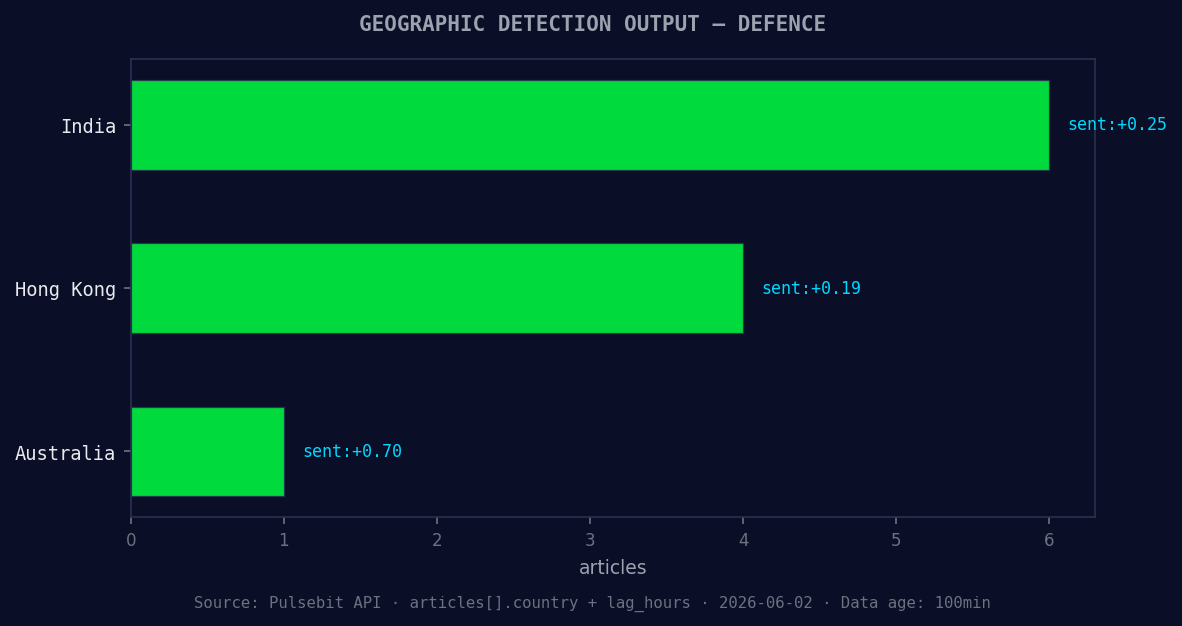
*Geographic detection output for defence. India leads with 6 articles and sentiment +0.25. Source: Pulsebit /news_recent geographic fields.*
# Check the response
data = response.json()
print(data)
Next, we need to score the narrative framing itself. To do this, we’ll input the cluster reason string back through our sentiment endpoint to assess how the narratives are being shaped.
# Meta-sentiment moment
cluster_reason = "Clustered by shared themes: sexual, violence, landmark, military, inquiry."
sentiment_response = requests.post(
    'https://api.pulsebit.com/sentiment',
    json={'text': cluster_reason}
)

# Process the sentiment scoring response
sentiment_data = sentiment_response.json()
print(sentiment_data)
By running this code, we not only filter for critical information but also evaluate how the sentiment around the narrative itself is evolving, ensuring we’re not just reacting to the surface-level data.
Now that we have this insight, here are three specific builds we can implement with this pattern:
Geo-Filtered Spike Tracker: Set a signal threshold of +0.5 momentum for articles in English regarding "defence." This helps us catch any emerging narratives before they peak.
Meta-Sentiment Alerts: Create an alert system that triggers when the meta-sentiment score drops below -0.1 for cluster reasons linked to "defence." This will keep us ahead of negative narratives that could impact sentiment.
Forming Theme Monitor: Monitor for forming themes with scores of +0.00 in topics like "google" and "minister," contrasting them with mainstream topics such as "sexual," "violence," and "landmark." This will help us identify potential cross-narrative impacts.
By employing these strategies, we can ensure our models are responsive, adaptive, and ahead of the curve.
Ready to get started? Head over to our documentation at pulsebit.lojenterprise.com/docs. You can copy-paste this in under 10 minutes and start extracting insights from the latest sentiment data.


Top comments (0)