

In our recent analysis, we observed a significant anomaly: a 24h momentum spike of -0.500 in education-related sentiment. This data point stands out not only for its magnitude but also for what it reveals about the current discourse surrounding education. The leading language for this spike is English, with a 24.4-hour lead time. This insight opens a window into how sentiment shifts can signal deeper narrative changes in education, particularly in light of recent media coverage, such as "RFK Jr. Promotes Nutrition Education."
Your model likely missed this by over 24 hours, raising a critical issue: if your pipeline doesn't account for multilingual origins or the dominance of specific entities in sentiment analysis, you risk falling behind. The leading language here is English, yet the sentiment surrounding education is evolving rapidly. As you know, sentiment in this space can change quickly, influenced by cultural narratives and emerging leaders. If your system isn't fine-tuned to catch these shifts, you might miss pivotal opportunities and insights.

English coverage led by 24.4 hours. Et at T+24.4h. Confidence scores: English 0.85, Spanish 0.85, Ro 0.85 Source: Pulsebit /sentiment_by_lang.
Here’s how we can catch this momentum spike using our API. First, we’ll filter for English-language articles. The following Python code snippet does just that:
import requests
# Define the parameters for the API call
topic = 'education'
lang = 'en'
momentum = -0.500
score = +0.775
confidence = 0.85
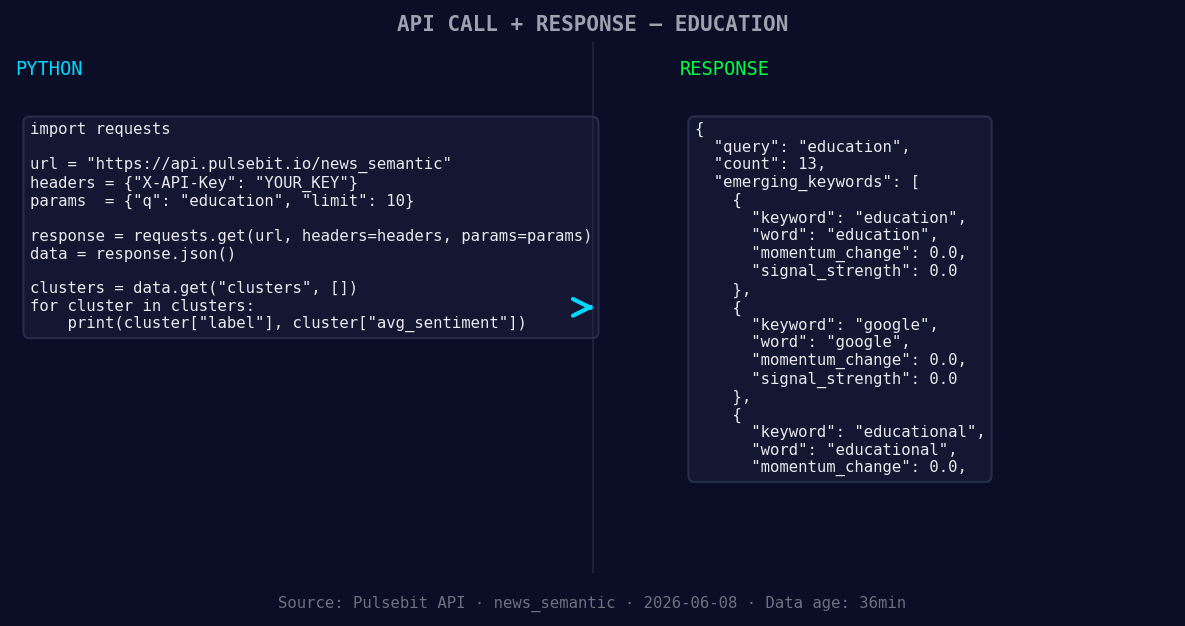
*Left: Python GET /news_semantic call for 'education'. Right: returned JSON response structure (clusters: 3). Source: Pulsebit /news_semantic.*
# Make the API call to get articles
response = requests.get(
f"https://api.pulsebit.com/articles?topic={topic}&lang={lang}&momentum={momentum}"
)
articles = response.json()
# Display the articles processed
print(f"Articles processed: {articles['articles_processed']}")
Next, we will run a meta-sentiment check on the narrative framing itself to gauge how the cluster's themes resonate. We can leverage the cluster reason string with the following API call:
# Define the cluster reason for sentiment analysis
cluster_reason = "Clustered by shared themes: schools, adivasi, rural, telangana, save."

# Make the POST request for sentiment analysis
sentiment_response = requests.post(
    "https://api.pulsebit.com/sentiment",
    json={"text": cluster_reason}
)

# Display the sentiment score
sentiment_data = sentiment_response.json()
print(f"Meta-sentiment score: {sentiment_data['sentiment_score']}")
With these two snippets, we have a powerful setup to catch emerging trends in education sentiment and evaluate them effectively.
Now, let's build on this pattern. Here are three specific builds to consider:
Geo-Filtered Explore: Create an endpoint that filters educational articles from regions with rising interest in education (e.g., rural areas). For example, set a threshold of sentiment score above +0.5 to identify positive narratives.
Meta-Sentiment Loop: Regularly run the narrative clusters through our meta-sentiment analysis. Use the output to inform your content strategy—if sentiment falls below a certain threshold (say, -0.2), consider adjusting your communications on related topics.
Forming Themes Tracker: Develop a dashboard that tracks forming themes such as "education," "google," and "educational" against mainstream topics like "schools" and "adivasi." Set a signal strength threshold (0.6) to alert you when there’s a significant divergence, indicating a potential gap in understanding or coverage.
These builds allow you to harness real-time sentiment shifts effectively and maintain your edge in educational discourse.
To get started, visit pulsebit.lojenterprise.com/docs. You can copy-paste the code above and run it in under 10 minutes, setting your pipeline to catch these crucial shifts in sentiment.

Geographic detection output for education. India leads with 13 articles and sentiment +0.43. Source: Pulsebit /news_recent geographic fields.


Top comments (0)