

Your Pipeline Is 15.4h Behind: Catching Politics Sentiment Leads with Pulsebit
We recently discovered a compelling anomaly: a 24-hour momentum spike of +0.626 in sentiment related to politics. This finding reveals a notable shift in sentiment, particularly highlighted by a cluster story titled "Congress and Political Divisions in India." The leading language of this surge is English, with a striking 15.4-hour lead over the related sentiment from Russia, revealing just how crucial it is to capture these spikes in real-time.
The reality is, your model might have missed this by a staggering 15.4 hours. If your pipeline isn't designed to handle multilingual origins or the dominance of specific entities, you’re likely to lag behind critical developments. In this case, the leading language was English, and if your sentiment analysis was limited to one language or region, you would have missed the early indicators of rising political sentiment that could impact further analysis or trading strategies.

English coverage led by 15.4 hours. Ro at T+15.4h. Confidence scores: English 0.85, Spanish 0.85, French 0.85 Source: Pulsebit /sentiment_by_lang.
Here’s how we can catch this momentum spike using our API. First, we need to filter the data by geographic origin to focus on English-language articles. This is essential for honing in on the relevant sentiment:

Geographic detection output for politics. India leads with 8 articles and sentiment -0.02. Source: Pulsebit /news_recent geographic fields.
import requests
# Define parameters for the API call
params = {
'topic': 'politics',
'lang': 'en',
'score': 0.350,
'confidence': 0.85,
'momentum': 0.626
}
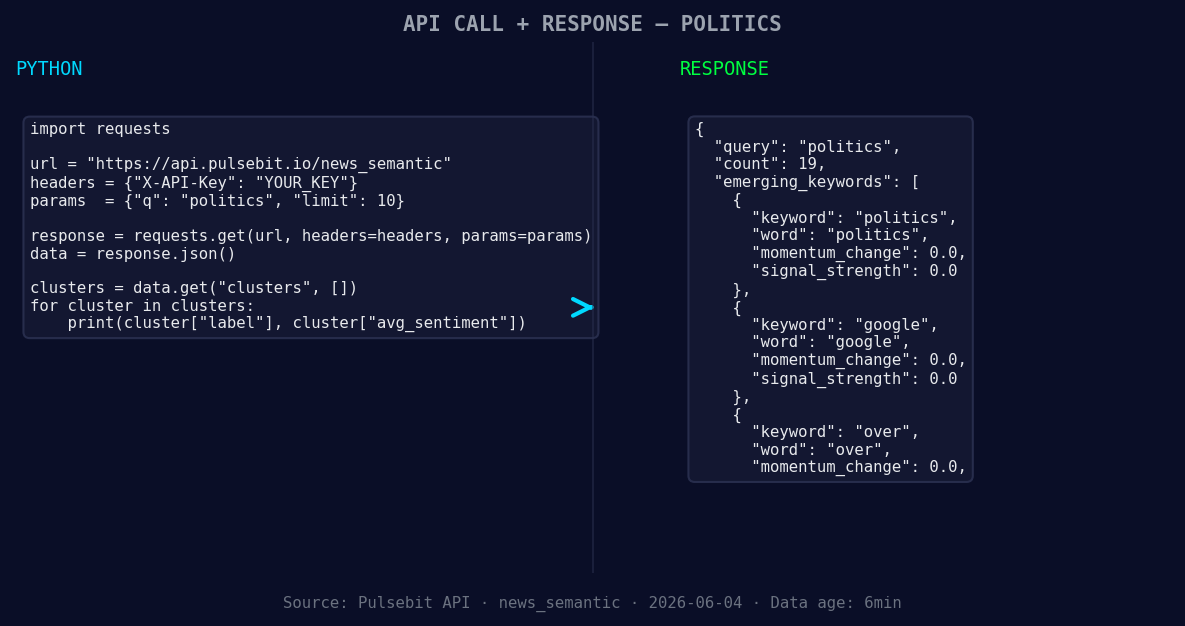
*Left: Python GET /news_semantic call for 'politics'. Right: returned JSON response structure (clusters: 3). Source: Pulsebit /news_semantic.*
# Make the API call to fetch sentiment data
response = requests.get('https://api.pulsebit.com/sentiment', params=params)
data = response.json()
print(data)
Next, we’ll run the cluster reason string through our sentiment endpoint to score the narrative framing itself. This meta-sentiment analysis is crucial for understanding the context behind the spike:
# Define the meta-sentiment input
meta_sentiment_input = "Clustered by shared themes: course, congress, stoking, unwanted, differences."

# Make the API call for meta-sentiment analysis
meta_response = requests.post('https://api.pulsebit.com/sentiment', json={'input': meta_sentiment_input})
meta_data = meta_response.json()
print(meta_data)
With these two API calls, we can accurately capture and analyze the political sentiment that's emerging, allowing us to better understand and react to the shifts in public sentiment.
Now, let's discuss three specific builds you can create with this pattern:
Geo-Filtered Sentiment Tracker: Set a signal threshold of +0.350 for articles filtered by English-language content. This allows your model to only trigger alerts for significant momentum spikes in specific demographics, ensuring you don’t miss crucial developments.
Meta-Sentiment Analyzer: Use the meta-sentiment loop with the specific input string to assess the framing of political narratives. This could be invaluable for gauging public sentiment around sensitive topics like political divisions or social movements.
Clustered Sentiment Dashboard: Create a dashboard that displays real-time updates on forming themes such as politics, google, and their relation to mainstream narratives like course and congress. This could help visualize how different topics are evolving in sentiment and their potential impact.
By implementing these builds, you not only enhance your pipeline's responsiveness to sentiment changes but also gain a more nuanced understanding of the narratives shaping political discourse.
Ready to get started? Check out our documentation at pulsebit.lojenterprise.com/docs. You can copy-paste and run these snippets in under 10 minutes. Let's make sure your pipeline is always ahead of the curve!


Top comments (0)