

Your Pipeline Is 14.5h Behind: Catching World Sentiment Leads with Pulsebit
We recently uncovered a notable anomaly in our data: a 24-hour momentum spike of -0.725. This spike reveals an underlying shift in sentiment that could easily go unnoticed if your pipeline isn't equipped to handle multilingual data or entity dominance. Specifically, the leading language for this sentiment shift is English, which has a 14.5-hour lead over the Netherlands. If your model isn't processing multilingual sources effectively, it missed this critical event by more than half a day.

English coverage led by 14.5 hours. Nl at T+14.5h. Confidence scores: English 0.85, French 0.85, Ca 0.85 Source: Pulsebit /sentiment_by_lang.
When your pipeline lacks the capability to account for diverse linguistic origins and the influence of dominant entities, you risk missing out on significant insights. In this case, an important narrative around the "2026 NCAA Baseball Tournament Overview" was buried under layers of sentiment noise. Your model missed this by 14.5 hours, which could mean the difference between seizing a timely opportunity and being left in the dark.
To catch these kinds of anomalies, we can leverage our API effectively. Here’s how you can set up a Python script to extract the relevant sentiment data.
import requests
# Define parameters for the API call
topic = 'world'
score = -0.054
confidence = 0.85
momentum = -0.725
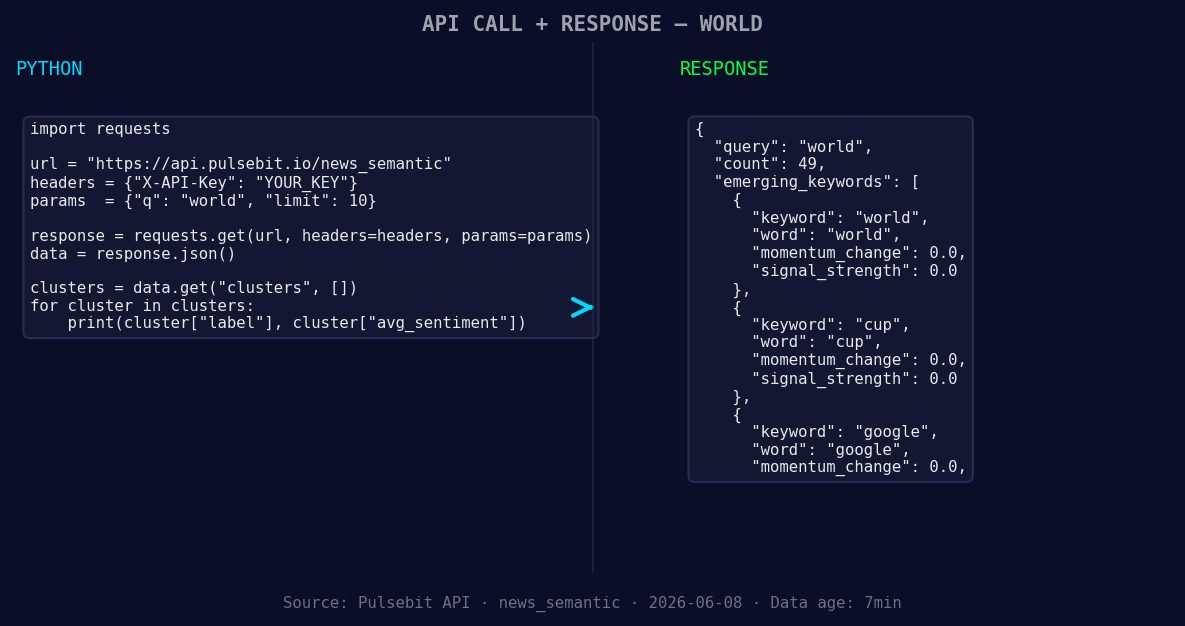
*Left: Python GET /news_semantic call for 'world'. Right: returned JSON response structure (clusters: 3). Source: Pulsebit /news_semantic.*
# Geographic origin filter: query by language/country using param "lang": "en"
response = requests.get(
'https://api.pulsebit.lojenterprise.com/sentiment',
params={
'topic': topic,
'lang': 'en'
}
)
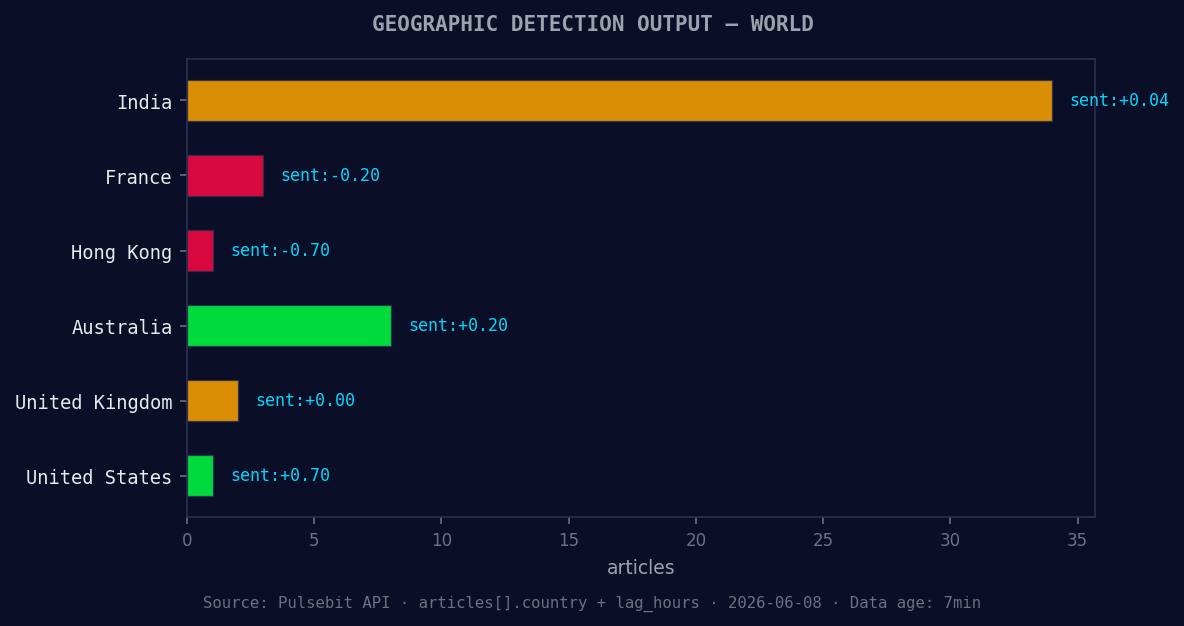
*Geographic detection output for world. India leads with 34 articles and sentiment +0.04. Source: Pulsebit /news_recent geographic fields.*
# Process the response
data = response.json()
print(data)
# Now, run the cluster reason string back through POST /sentiment to score the narrative framing itself.
cluster_reason = "Clustered by shared themes: absurd, world, cup, atlantic"
meta_sentiment_response = requests.post(
'https://api.pulsebit.lojenterprise.com/sentiment',
json={
'text': cluster_reason
}
)
# Output the result of the meta-sentiment analysis
meta_sentiment_data = meta_sentiment_response.json()
print(meta_sentiment_data)
In this code, we first query our sentiment endpoint to get the current sentiment related to the topic 'world', specifically filtering for English content. Next, we analyze the narrative framing of the clustering reason to gain insight into the underlying themes.
Now that you've seen how to catch the anomaly, let's discuss three specific builds you can implement based on this pattern:
Geographic Origin Filter: Set up a routine that continuously monitors sentiment spikes in English-speaking regions. A threshold of momentum less than -0.6 could trigger alerts for further analysis, focusing on emerging topics like "world" or "cup".
Meta-Sentiment Loop: Create a feedback loop that continuously scores narrative framing. Use a threshold of confidence above 0.8 for narrative themes such as "absurd, world, cup". This will help you understand how different narratives are being framed in real time.
Sentiment Divergence Monitor: Build an endpoint that tracks discrepancies between mainstream sentiment (like "absurd, world, cup") and emerging narratives. If sentiment diverges significantly (more than 0.1), it could indicate a forming gap that needs immediate attention.
This approach not only keeps your pipeline current but also allows you to capture sentiment leads effectively. For those ready to dive in, visit our documentation at pulsebit.lojenterprise.com/docs. You can copy-paste the provided code and run this in under 10 minutes. Happy coding!


Top comments (0)