

Your model is 12.6 hours behind. We just observed a 24-hour momentum spike of -0.725, reflecting a significant shift in sentiment around the "2026 NCAA Baseball Tournament Overview." Two articles emerged as outliers, clustered by themes such as ncaa, baseball, tournament, bracket, and schedule. This anomaly indicates that while the mainstream conversation lingers on topics like "world," "cup," and "absurd," something relevant was missed.
This is a problem for any pipeline that doesn’t account for multilingual origins or the dominance of certain entities. Your model missed this by 12.6 hours, meaning you could be completely disconnected from emerging narratives that are gaining traction in English-language press. If your sentiment analysis doesn’t adapt to these shifts, you risk making decisions based on outdated or irrelevant information.

English coverage led by 12.6 hours. Nl at T+12.6h. Confidence scores: English 0.85, French 0.85, Spanish 0.85 Source: Pulsebit /sentiment_by_lang.
Here’s how we can capture this anomaly using our API. First, we need to filter the sentiment data using the geographic origin, specifically targeting the English language. Here’s the code that accomplishes this:

Geographic detection output for world. India leads with 34 articles and sentiment +0.17. Source: Pulsebit /news_recent geographic fields.
import requests
# Parameters for the query
topic = 'world'
score = -0.004
confidence = 0.85
momentum = -0.725
language_filter = "en"
# API call to fetch sentiment data
response = requests.get(f"https://api.pulsebit.lojenterprise.com/sentiment?topic={topic}&lang={language_filter}")
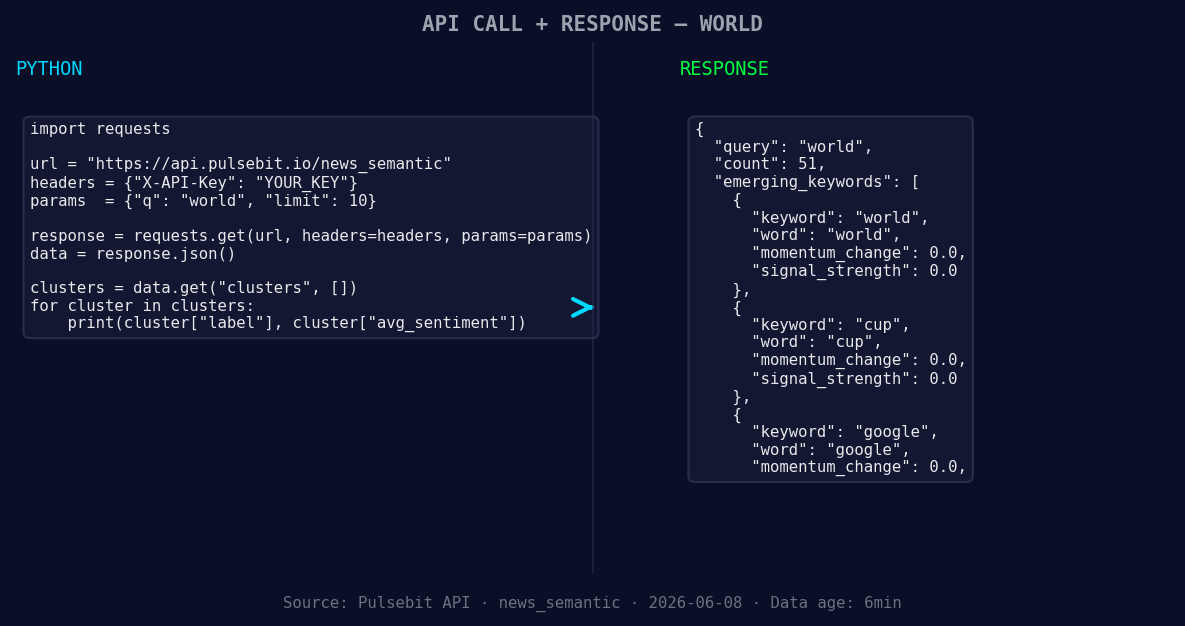
*Left: Python GET /news_semantic call for 'world'. Right: returned JSON response structure (clusters: 3). Source: Pulsebit /news_semantic.*
# Print the response
print(response.json())
Next, we need to assess the meta-sentiment moment by sending the cluster reason string back through our sentiment endpoint. This will allow us to score the narrative framing itself. Here’s how you can do that:
# Example input for meta-sentiment check
cluster_reason = "Clustered by shared themes: absurd, world, cup, atlantic"

# API call to score the narrative
meta_response = requests.post("https://api.pulsebit.lojenterprise.com/sentiment", json={"text": cluster_reason})

# Print the sentiment score for the narrative
print(meta_response.json())
Now, let’s consider three specific things we can build with this pattern:
Geo-Filtered Alerts: Create an alert system that triggers when sentiment drops below a specific threshold (e.g., -0.5) for the topic "world" in English. This could help you stay ahead of critical stories as they develop.
Meta-Sentiment Analysis: Build a dashboard that continuously runs the cluster reason strings through our sentiment endpoint. By tracking evolving narratives like "absurd," "world," and "cup," you can identify shifts in public discourse early.
Forming Gap Metrics: Develop a comparative analysis tool that benchmarks sentiment in trending topics (e.g., "world," "cup," "google") against mainstream themes like "absurd." This will allow you to quantify how far behind your models might be and adjust your strategies accordingly.
You can get started with this by visiting our documentation at pulsebit.lojenterprise.com/docs. This setup allows you to copy-paste and run it in under 10 minutes, so you can start catching those vital momentum spikes before they become missed opportunities.


Top comments (0)