

Your Pipeline Is 26.5h Behind: Catching Finance Sentiment Leads with Pulsebit
We recently stumbled across a fascinating anomaly: a 24-hour momentum spike of +1.300 in the finance sector. This spike stands out, especially considering the leading English press, which was ahead by 26.5 hours. The narrative revolves around a mismatch in the 16th Union Finance Commission allocation for Kerala’s urban population. It’s a clear signal that something significant is happening, but it also highlights a critical gap in how we process multilingual content and entity dominance in our pipelines.

English coverage led by 26.5 hours. Et at T+26.5h. Confidence scores: English 0.90, Spanish 0.90, French 0.90 Source: Pulsebit /sentiment_by_lang.
If your model doesn’t accommodate for multiple languages or prioritize dominant entities correctly, you might be missing out on crucial signals. You could have been alerted to this momentum shift 26.5 hours earlier if your pipeline had the capability to process English-language articles effectively. The leading story indicates an urgent issue in financial allocations that could affect stakeholders significantly. Ignoring this gap in your data processing could lead to missed opportunities or delayed reactions to emerging trends.
To catch this momentum spike effectively, we can leverage our API to filter and analyze sentiment. Below is the Python code that demonstrates how to do this:
import requests
# Define API endpoint and parameters
endpoint = 'https://api.pulsebit.com/v1/search'
params = {
"topic": "finance",
"momentum": "+1.300",
"lang": "en" # Geographic origin filter
}
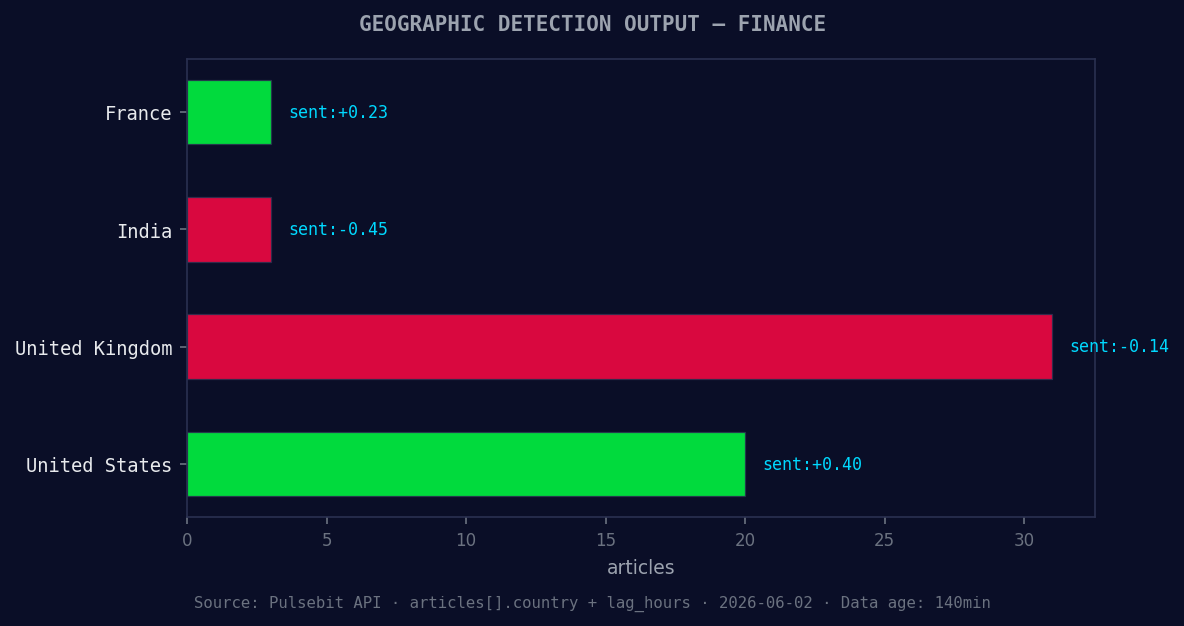
*Geographic detection output for finance. France leads with 3 articles and sentiment +0.23. Source: Pulsebit /news_recent geographic fields.*
# Make API call to fetch relevant articles
response = requests.get(endpoint, params=params)
data = response.json()
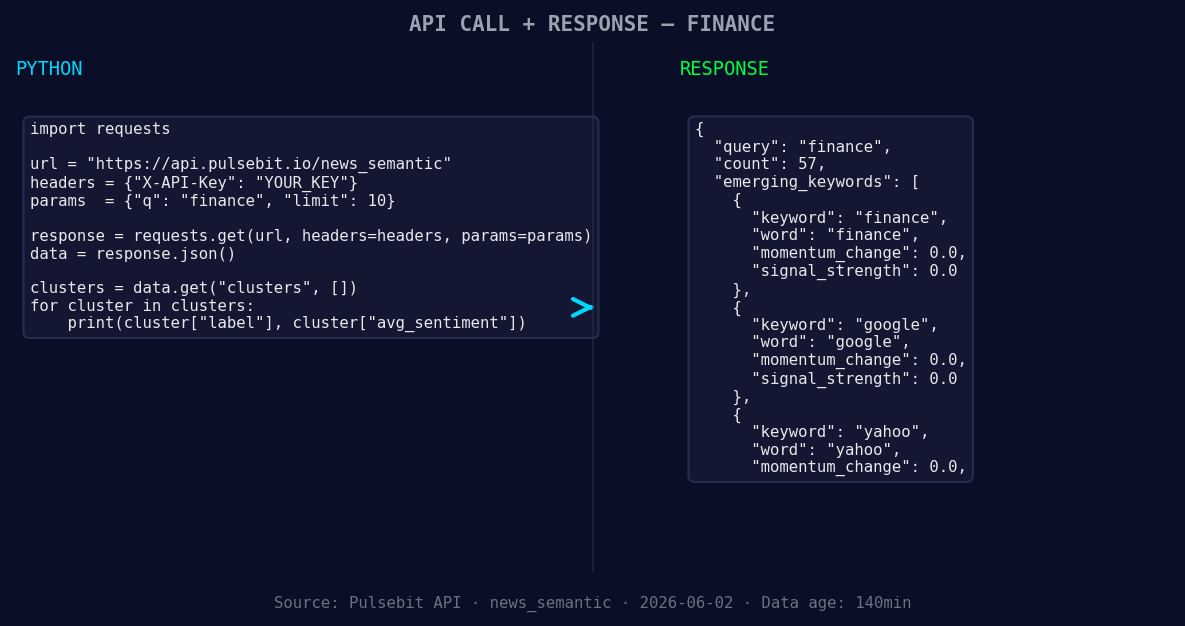
*Left: Python GET /news_semantic call for 'finance'. Right: returned JSON response structure (clusters: 3). Source: Pulsebit /news_semantic.*
# Check if we received articles
if data['articles_processed'] > 0:
print("Articles retrieved:", data['articles_processed'])
else:
print("No articles found.")
# Meta-sentiment moment: run the cluster reason string through sentiment analysis
cluster_reason = "Clustered by shared themes: finance, commission, mismatch, 16th, union."
sentiment_endpoint = 'https://api.pulsebit.com/v1/sentiment'
sentiment_response = requests.post(sentiment_endpoint, json={"text": cluster_reason})
sentiment_data = sentiment_response.json()
print("Sentiment Score:", sentiment_data['sentiment_score'])
print("Confidence Level:", sentiment_data['confidence'])
In this snippet, we first set up a search request to our API, filtering by the topic 'finance' and ensuring we only pull English language articles. This geographic origin filter is crucial for narrowing down the content that’s relevant to our analysis.
Next, we run a meta-sentiment analysis on the cluster reason: "Clustered by shared themes: finance, commission, mismatch, 16th, union." This step allows us to understand how the framing of the narrative itself relates to our sentiment scores. It’s not just about the numbers; it’s about the story behind them.
So, what can we build using this pattern? Here are three concrete ideas:
Real-Time Alerts for Financial Anomalies: Set a threshold for momentum spikes. For example, whenever you detect a momentum score greater than +1.000 in the finance sector, trigger an alert to your team for immediate review.
Enhanced Narrative Analysis: Use the meta-sentiment loop to analyze article clusters. If you notice a sentiment score below a certain threshold (e.g., +0.005), dive deeper into those narratives. The framing might reveal hidden risks or opportunities that aren’t immediately apparent.
Cross-Platform Sentiment Tracking: Compare the sentiment scores of finance topics across different platforms. For example, set up a comparison between Google News and Yahoo News for the same topics and see if there are any discrepancies indicating emerging trends in mainstream versus alternative news outlets.
By leveraging these insights, we can bridge the gap in our data pipelines and respond faster to financial trends.
To get started, check out our documentation at pulsebit.lojenterprise.com/docs. You can copy-paste the code above and run it in under 10 minutes. Happy developing!


Top comments (0)