

Your Pipeline Is 27.5h Behind: Catching Business Sentiment Leads with Pulsebit
We just uncovered a striking anomaly: a 24h momentum spike of +0.653 in the business sentiment surrounding "Lagos as Africa's Business Gateway." This unexpected rise reveals significant activity in the Spanish press, leading the narrative with a 27.5-hour head start. If you’re not tuned into multilingual sources, you might be missing crucial information that could shape your business decisions.

Spanish coverage led by 27.5 hours. Nl at T+27.5h. Confidence scores: Spanish 0.75, French 0.75, English 0.75 Source: Pulsebit /sentiment_by_lang.
The Problem
Imagine your sentiment analysis pipeline, which predominantly processes English-language content, missing out on this momentum by over 27 hours. If your model isn't designed to handle multilingual origins or entity dominance, you could be lagging behind critical developments. In this case, the Spanish press is taking the lead, and your insights are stale. You’re at a disadvantage when the leading language generates insights that directly impact business strategies.
The Code
Here’s how we can catch this momentum spike using our API. First, we’ll filter for Spanish articles to capture the sentiment around our topic of interest: "business."
import requests
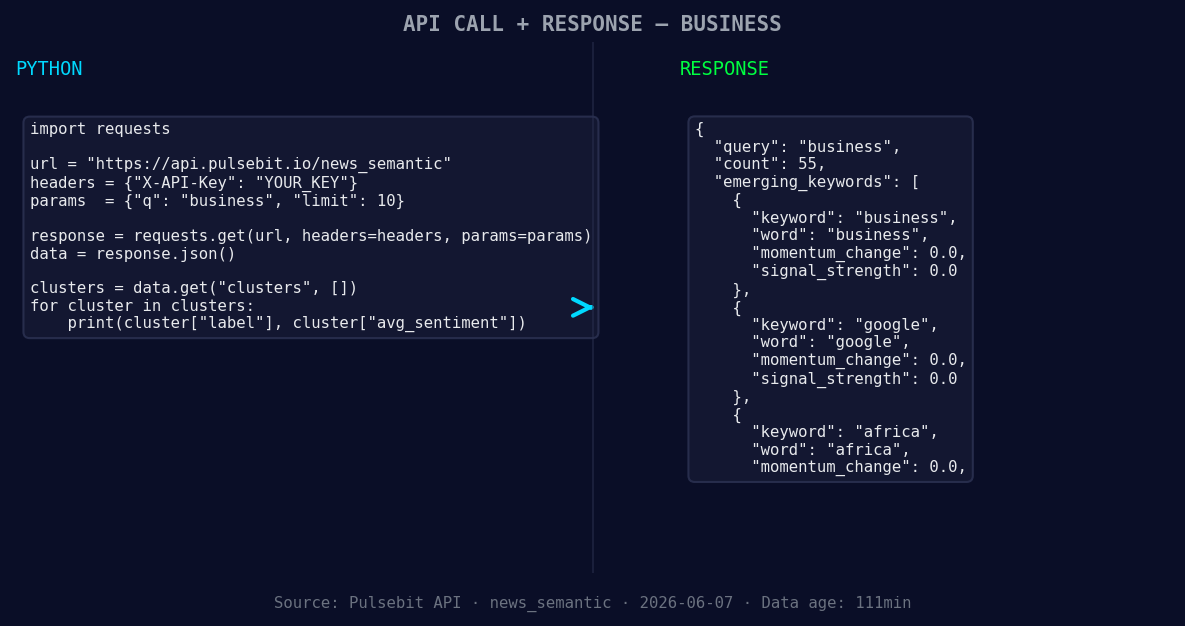
*Left: Python GET /news_semantic call for 'business'. Right: returned JSON response structure (clusters: 3). Source: Pulsebit /news_semantic.*
# Define our parameters
topic = 'business'
score = -0.071
confidence = 0.75
momentum = +0.653
lang = 'sp'
# Geographic origin filter
response = requests.get(
f"https://api.pulsebit.com/v1/articles?topic={topic}&lang={lang}"
)
articles = response.json()
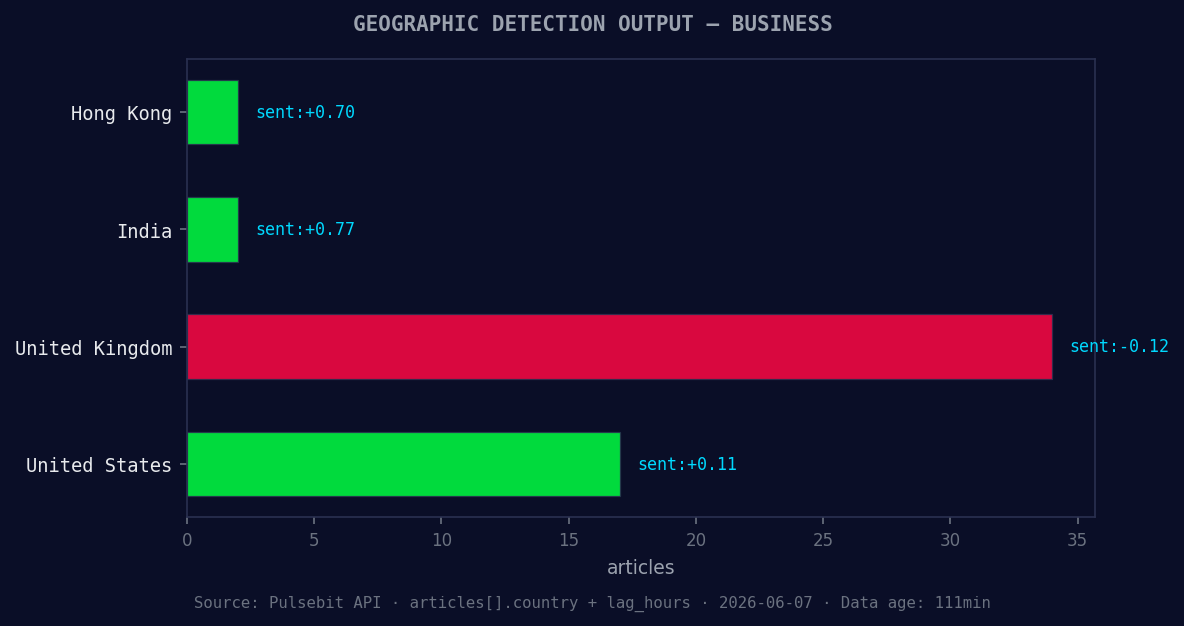
*Geographic detection output for business. Hong Kong leads with 2 articles and sentiment +0.70. Source: Pulsebit /news_recent geographic fields.*
# Output the articles processed
print(f"Articles Processed: {len(articles)}")
Next, we’ll run the narrative framing through our sentiment scoring endpoint to evaluate its meta-sentiment. The string we’ll analyze is: "Clustered by shared themes: named, Africa’s, top, business, destination."
# Meta-sentiment moment
cluster_reason = "Clustered by shared themes: named, africa’s, top, business, destination."
sentiment_response = requests.post(
    "https://api.pulsebit.com/v1/sentiment",
    json={"text": cluster_reason}
)

meta_sentiment = sentiment_response.json()
print(f"Meta-Sentiment Score: {meta_sentiment['score']}, Confidence: {meta_sentiment['confidence']}")
Three Builds Tonight
Geo Filter Alert: Set up a pipeline that triggers alerts when the sentiment score exceeds a threshold (e.g., score < -0.05) for articles in Spanish. This way, you stay informed about critical shifts in sentiment that could affect your business strategies.
Meta-Sentiment Analyzer: Build a component that automatically runs the cluster reason strings through our sentiment endpoint whenever there's a significant momentum spike. You can set a threshold for momentum (e.g., momentum > +0.5) to trigger this analysis, giving you a deeper understanding of emerging narratives.
Thematic Comparison: Create a comparison tool that analyzes forming themes like "business(+0.00), Google(+0.00), Africa(+0.00)" against mainstream narratives. Set a signal strength threshold (e.g., signal_strength > 0.80) to ensure only relevant insights are surfaced, enabling you to identify market opportunities early.
Get Started
Check out our documentation at pulsebit.lojenterprise.com/docs. With the code provided, you can copy-paste and run this in under 10 minutes. Stay ahead of the curve by catching multilingual sentiment shifts before they become mainstream discussions.


Top comments (0)