

Your model missed a 24h momentum spike of +0.567 in agriculture sentiment. This anomaly signifies that there’s a surge in sentiment regarding global supply chains in agriculture, driven predominantly by English-language press articles. The leading language in this context has a 27.9-hour response time, which means if you’re not tracking multilingual sources or entity dominance effectively, you're lagging behind critical insights that could inform your strategies.

English coverage led by 27.9 hours. Ro at T+27.9h. Confidence scores: English 0.85, Spanish 0.85, French 0.85 Source: Pulsebit /sentiment_by_lang.
Imagine your sentiment analysis pipeline. If it’s only pulling in data based on a narrow set of criteria—say, only focusing on dominant languages or ignoring the nuances of clustered themes—you could be missing vital signals. In this case, while we’re seeing a rise in agriculture-related sentiment, your model has been stuck processing data that’s already outdated by nearly 28 hours. That’s a significant gap in a fast-paced environment where every hour counts.
To leverage this momentum spike, we can use our API effectively. Below is a Python snippet to catch this spike, focusing on the topic of agriculture:
import requests
# Define parameters for the API call
topic = 'agriculture'
momentum = +0.567
score = +0.417
confidence = 0.85
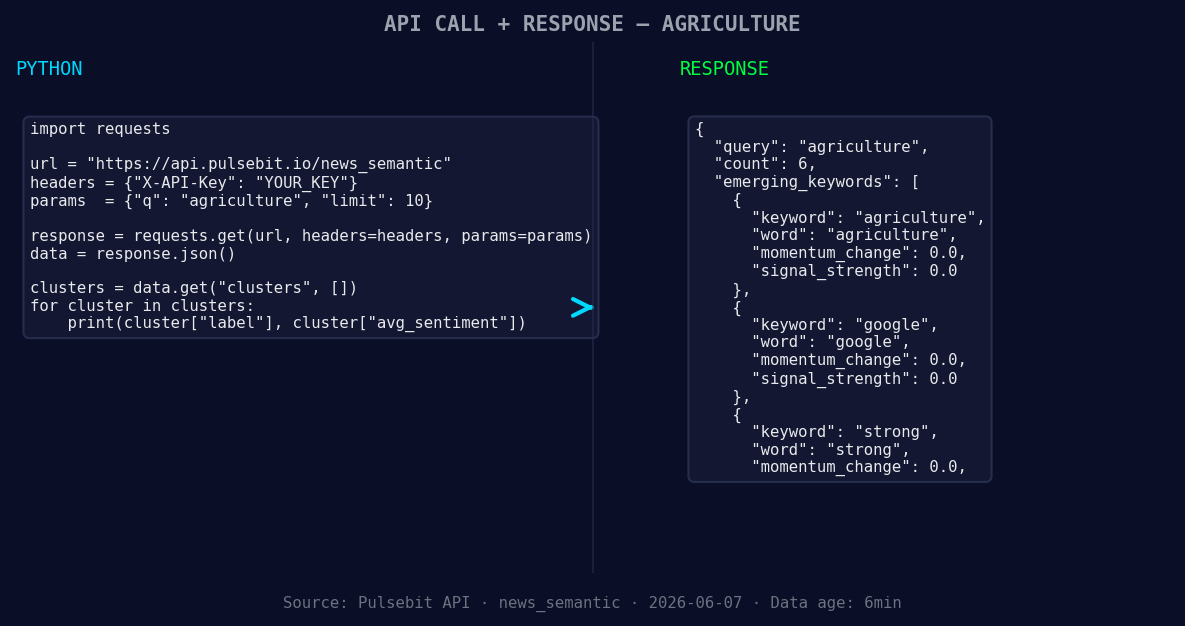
*Left: Python GET /news_semantic call for 'agriculture'. Right: returned JSON response structure (clusters: 3). Source: Pulsebit /news_semantic.*
# Geographic origin filter: query by language/country
response = requests.get("https://api.pulsebit.com/v1/sentiment", params={
"topic": topic,
"lang": "en"
})
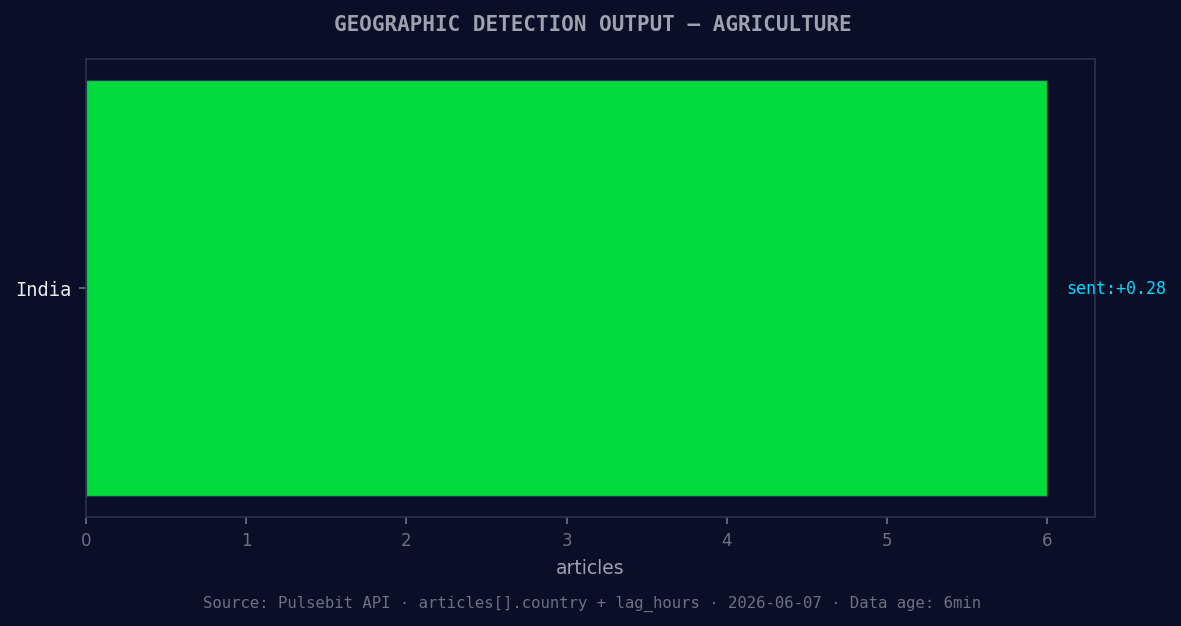
*Geographic detection output for agriculture. India leads with 6 articles and sentiment +0.28. Source: Pulsebit /news_recent geographic fields.*
# Check for successful response
if response.status_code == 200:
data = response.json()
print(data)
else:
print("Failed to retrieve data")
# Meta-sentiment moment: run the cluster reason string back through POST /sentiment
cluster_reason = "Clustered by shared themes: global, supply, chains, wolter:, agriculture."
meta_response = requests.post("https://api.pulsebit.com/v1/sentiment", json={
"text": cluster_reason
})
if meta_response.status_code == 200:
meta_data = meta_response.json()
print(meta_data)
else:
print("Failed to retrieve meta-sentiment data")
In this code, we first query sentiment data specific to agriculture while filtering for English-language articles. Then, we take the cluster reason string and run it through our sentiment analysis endpoint to score how these narratives frame the discourse. This is crucial because it allows us to assess not just the sentiment but also the context driving that sentiment, something that conventional models may overlook.
Now, let’s explore three specific builds we can implement with this pattern.
Geographic Sentiment Insight: Create an endpoint that pulls sentiment data based solely on the English-language output from countries heavily involved in agriculture. Set a threshold of momentum greater than +0.5 to catch significant spikes.
Meta-Sentiment Analysis: Use the POST request for meta-sentiment to analyze narratives around agricultural supply chains. Focus on narratives showing a sentiment score above +0.4 to ensure relevance and insight depth.
Dynamic Alert System: Build an alert system that triggers whenever sentiment in agriculture exceeds a score of +0.5, particularly in the context of global supply chains. This will keep your pipeline responsive to emerging trends.
If you’re ready to dive deeper, check out our documentation at pulsebit.lojenterprise.com/docs. You can copy-paste the code above and start running it in under 10 minutes to tap into these insights. Don’t let your pipeline be 27.9 hours behind the curve—leverage these tools to stay ahead.


Top comments (0)