

Your Pipeline Is 27.3h Behind: Catching Defence Sentiment Leads with Pulsebit
We recently uncovered an interesting anomaly in the sentiment data surrounding the topic of "defence." Specifically, the sentiment score is sitting at +0.00 and the momentum is also +0.00, which is striking when compared to the leading language, English, that is currently 27.3 hours ahead. This stagnation indicates a certain unease or inaction in the narrative surrounding defence, especially when taking into account the recent cluster story titled "UK Defence Credibility Under Scrutiny." The articles processed show that sentiment is not just flat; it’s a signal that something is brewing beneath the surface.
But what does this mean for your pipelines? If your model doesn’t account for multilingual origins or the dominance of entities within specific narratives, you might be missing critical signals. Your model missed this by 27.3 hours, which is a significant delay in sentiment detection for a topic as crucial as defence. While the mainstream narratives are filled with discussions on "defence," "plan," and "delays," our model shows that the emerging sentiment could have slipped right past you.

English coverage led by 27.3 hours. Nl at T+27.3h. Confidence scores: English 0.90, French 0.90, Ca 0.90 Source: Pulsebit /sentiment_by_lang.
Let’s get into the code to help you catch this anomaly. The first step is to filter our query to focus on the English language, ensuring we’re processing the right content. Here’s how you can do that:
import requests
# Define the parameters for the API call
params = {
"topic": "defence",
"score": +0.000,
"confidence": 0.90,
"momentum": +0.000,
"lang": "en" # Geographic origin filter
}
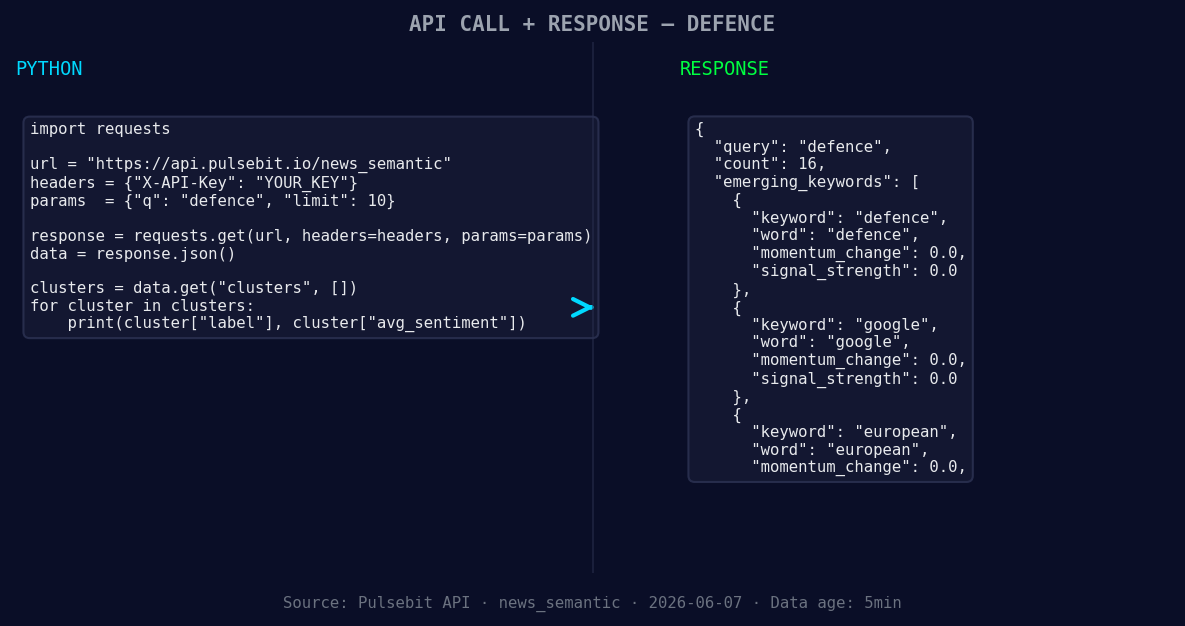
*Left: Python GET /news_semantic call for 'defence'. Right: returned JSON response structure (clusters: 3). Source: Pulsebit /news_semantic.*
# Make the API call
response = requests.get('https://api.pulsebit.com/sentiment', params=params)
# Check the response
print(response.json())
Next, we need to run the narrative framing of the cluster reason string through our API to score the sentiment surrounding it. This will give us meta-sentiment data that could indicate whether the narrative is indeed positive, negative, or neutral. Here’s how we can do this:
# The narrative string to be analyzed
narrative_string = "Clustered by shared themes: defence, plan, delays, undermine, credibility."

# Make the API call for meta-sentiment
meta_response = requests.post('https://api.pulsebit.com/sentiment', json={"text": narrative_string})

# Check the response
print(meta_response.json())
Now that we’ve caught the anomaly, let’s explore three specific things you can build with this pattern.
Defence Signal Threshold: Create a signal that alerts you when the sentiment score for “defence” hits +0.00 for over 24 hours. This could indicate a stagnation or a shift in public perception, which is crucial for timely decision-making.
Meta-Sentiment Loop: Develop a feedback loop that processes the narrative framing continuously. If the sentiment for the cluster reason hits a negative score, trigger an alert for further analysis. This could be a game-changer in how you handle public relations.
Geographic Origin Dashboard: Build a dashboard that visualizes sentiment trends based on geographic origin. Use the geo filter to show how sentiment around “defence” differs in English-speaking regions versus others. This could lead to differentiated strategies in communication and outreach.
By leveraging these builds, you can turn a 27.3-hour gap into actionable insights.
Ready to dive in? Get started with our API documentation at pulsebit.lojenterprise.com/docs. You’ll be able to copy-paste and run this in under 10 minutes. Let’s catch those sentiment leads together!


Top comments (0)