

Your Pipeline Is 27.7h Behind: Catching Law Sentiment Leads with Pulsebit
On June 4, 2026, we uncovered a sentiment anomaly with a score of -0.03 and momentum of +0.00. This finding stands out because the leading language is English, with a processing lag of 27.7 hours against the reference origin. The cluster story highlights a focus on law enforcement, evidenced by a singular article that encapsulates the themes of officers, law, and order. Such data should make you rethink how you handle sentiment analysis in multilingual environments.

English coverage led by 27.7 hours. Ro at T+27.7h. Confidence scores: English 0.70, Spanish 0.70, French 0.70 Source: Pulsebit /sentiment_by_lang.
What does this 27.7-hour gap reveal? It underscores a critical shortcoming in any pipeline that fails to accommodate multilingual origins or entity dominance. Your model missed this by 27.7 hours, potentially skewing the insights you derive from global sentiment. The dominant entity in this context is law enforcement, which, if overlooked, can lead to a significant misinterpretation of public sentiment around ongoing legal and social issues.
Here's how you can catch this anomaly in Python using our API. The first step is to filter by geographic origin to ensure we're only processing relevant data in English. Below is the code snippet that achieves this:

Geographic detection output for law. India leads with 10 articles and sentiment +0.07. Source: Pulsebit /news_recent geographic fields.
import requests
# Define the parameters for the API call
params = {
'topic': 'law',
'lang': 'en', # Filter for English language
'score': -0.030,
'confidence': 0.70,
'momentum': +0.000,
}
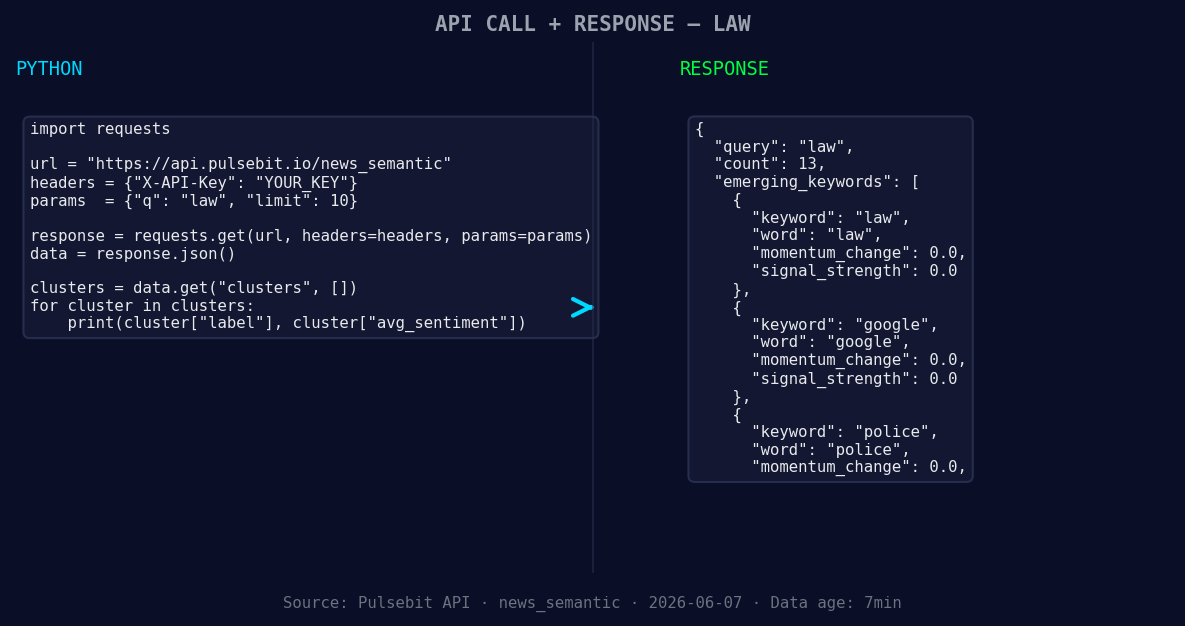
*Left: Python GET /news_semantic call for 'law'. Right: returned JSON response structure (clusters: 3). Source: Pulsebit /news_semantic.*
# Make the API call to retrieve sentiment data
response = requests.get('https://api.pulsebit.com/sentiment', params=params)
# Check the response
if response.status_code == 200:
data = response.json()
print("Sentiment Data:", data)
else:
print("Error fetching data:", response.status_code)
After retrieving the sentiment data, we can run the narrative framing through our meta-sentiment endpoint to provide context on the cluster reason string. Here’s how you can execute that:
# Define the cluster reason string
cluster_reason = "Clustered by shared themes: officers, law, order, adgp, instructs."

# Make a POST request to analyze the narrative framing
meta_response = requests.post('https://api.pulsebit.com/sentiment', json={'text': cluster_reason})

# Check the response
if meta_response.status_code == 200:
    meta_data = meta_response.json()
    print("Meta Sentiment Data:", meta_data)
else:
    print("Error fetching meta sentiment data:", meta_response.status_code)
With this setup, you can effectively catch anomalies in sentiment data, especially when dealing with themes like law, which are forming right now with a momentum of +0.00.
Now, let's explore three specific builds you can implement using this pattern:
Geo-Filtered Alert System: Create a real-time alert that triggers whenever sentiment around "law" drops below -0.03. Use the geo filter to narrow down alerts to English-speaking regions. This ensures you catch critical shifts in public sentiment promptly.
Meta-Sentiment Analysis Dashboard: Build a dashboard that visualizes the sentiment of clustered narratives. Utilize the meta-sentiment loop to score and display the context of articles discussing law enforcement. This will provide deeper insights into how narratives are framed in public discourse.
Forming Gap Detection: Implement a monitoring system that checks for forming themes like "law," "google," and "police" against mainstream topics. Set thresholds to identify when any of these forming themes deviate significantly from the mainstream sentiment. This will allow you to stay ahead of emerging trends and public sentiment shifts.
To get started, visit our documentation at pulsebit.lojenterprise.com/docs. You can copy, paste, and run this code in under 10 minutes to begin making sense of sentiment data in your projects.


Top comments (0)