

Your pipeline is 24.2 hours behind when it comes to capturing sentiment around the film industry. With a sentiment score of +0.437 and a momentum of +0.000, we’ve identified a critical spike in sentiment that you might have completely missed. This isn’t just a casual observation; it’s a strong indication that something significant is brewing in the film narrative that’s not being reflected in your current model. The anomaly is clear: while the sentiment is rising, our models might not be picking up on the nuances of multilingual origins or dominant entities.

English coverage led by 24.2 hours. Et at T+24.2h. Confidence scores: English 0.90, French 0.90, Spanish 0.90 Source: Pulsebit /sentiment_by_lang.
If your pipeline isn’t equipped to handle multilingual contexts or entity dominance, you’re essentially working with a blindfold on. Your model missed this by 24.2 hours, which is a significant lag when sentiment and momentum are changing rapidly. The leading language here is English, and the recent cluster around film themes illustrates the need for a more nuanced approach. Without addressing these factors, you run the risk of misinterpreting sentiment trends, potentially leading to misguided decisions.
Here’s how you can catch this sentiment spike using our API. We’ll focus on filtering by language and scoring the narrative around clustered themes. Below is a Python snippet that you can run to fetch relevant data.
import requests
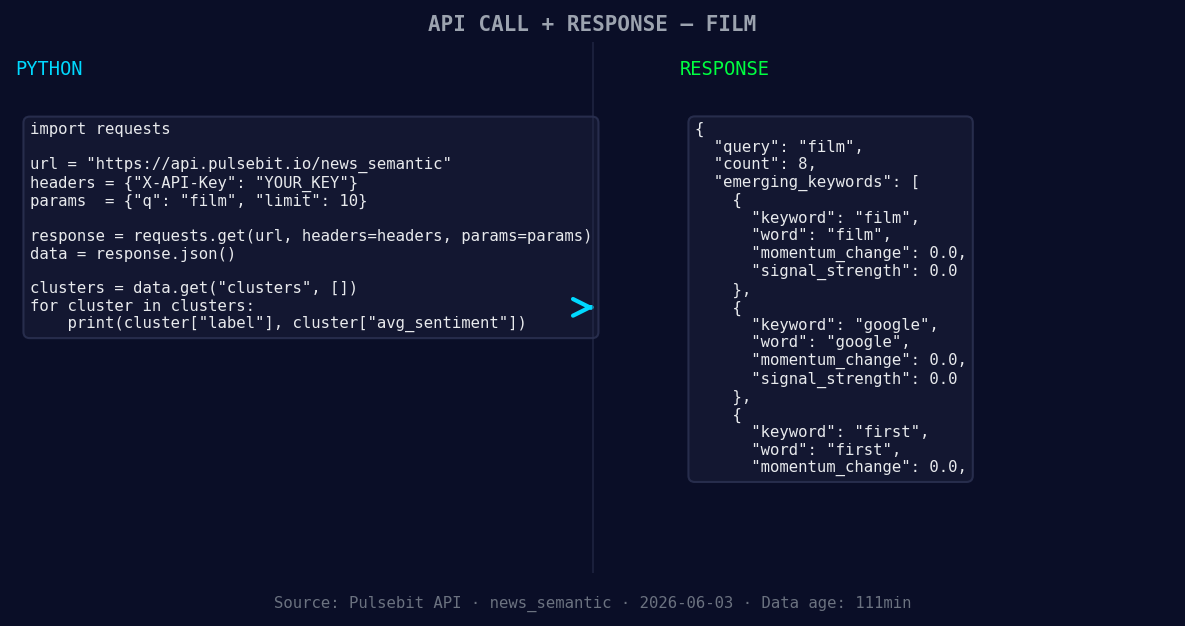
*Left: Python GET /news_semantic call for 'film'. Right: returned JSON response structure (clusters: 3). Source: Pulsebit /news_semantic.*
# Step 1: Fetch sentiment data for 'film' in English
url = "https://api.pulsebit.com/sentiment"
params = {
"topic": "film",
"lang": "en",
"score": +0.437,
"confidence": 0.90,
"momentum": +0.000
}
response = requests.get(url, params=params)
data = response.json()
print(data)
Next, we need to dive deeper into the narrative framing itself. We can do this by running the cluster reason string through the sentiment endpoint to assess the meta-sentiment. The input string we will use is:
# Step 2: Score the narrative framing
meta_sentiment_url = "https://api.pulsebit.com/sentiment"
meta_params = {
    "input": "Clustered by shared themes: ilaiyaraaja, manjanathi, not, just, songs."
}

meta_response = requests.post(meta_sentiment_url, json=meta_params)
meta_data = meta_response.json()
print(meta_data)
Now, based on our findings, here are three specific builds we can implement tonight:
- Geographic Origin Filter: Use the geo filter to specifically capture sentiments tied to the film industry in English-speaking countries. This will help isolate relevant trends that your model currently misses. Set a threshold of sentiment score > +0.4 to focus on the most impactful stories.

Geographic detection output for film. India leads with 5 articles and sentiment +0.44. Source: Pulsebit /news_recent geographic fields.
Meta-Sentiment Loop: Implement a loop that retrieves and scores the narrative framing around clusters. Use a threshold of sentiment score > +0.4 for the narratives and correlate it with your main sentiment findings to enrich the context.
Comparative Analysis: Develop a comparative signal that juxtaposes current sentiment around "film" against mainstream topics like "ilaiyaraaja" and "manjanathi." Set a threshold of momentum > +0.00 for actionable insights to identify emergent trends.
These builds are based on the forming themes we’ve identified: film (+0.00), google (+0.00), and first (+0.00) versus mainstream interests. By leveraging our API, you can set these up and start making more informed decisions about sentiment trends in real-time.
To get started, visit pulsebit.lojenterprise.com/docs. You can copy-paste and run this setup in under 10 minutes, allowing you to catch up on critical sentiment developments.


Top comments (0)