

Your 24h momentum spike of +0.203 in the cybersecurity sector reveals a critical shift in sentiment that you simply can't ignore. This isn't just a modest fluctuation; it’s indicative of a growing urgency around foundational cybersecurity measures. With the leading press in English picking up this story 21.0 hours ahead of other languages, it’s clear that your pipeline may not be processing multilingual sentiment effectively. If your model isn’t tuned to catch these shifts, you might be missing out on significant insights, leaving you 21 hours behind the curve.

English coverage led by 21.0 hours. German at T+21.0h. Confidence scores: English 0.85, Spanish 0.85, French 0.85 Source: Pulsebit /sentiment_by_lang.
This gap highlights a fundamental oversight in many sentiment pipelines: the failure to account for linguistic origin and entity dominance. When your model overlooks these aspects, you risk missing key developments. In this case, while your peers are already digesting the implications of a DoD CIO urging the industry to prioritize cybersecurity, your model could be lagging behind by a full day. It’s a wake-up call to ensure that you’re not just processing data but doing so in a way that reflects the true dynamics at play.
Let’s take a look at how to address this with some real code. First, we need to capture the sentiment around cybersecurity with our geographic origin filter set to English. Here’s how we can do that:

Geographic detection output for cybersecurity. United States leads with 2 articles and sentiment +0.85. Source: Pulsebit /news_recent geographic fields.
import requests
# Define parameters
topic = 'cybersecurity'
score = +0.525
confidence = 0.85
momentum = +0.203
lang = "en"
# API call to fetch articles
response = requests.get(f"https://api.pulsebit.com/articles?topic={topic}&lang={lang}&momentum={momentum}")
articles = response.json()
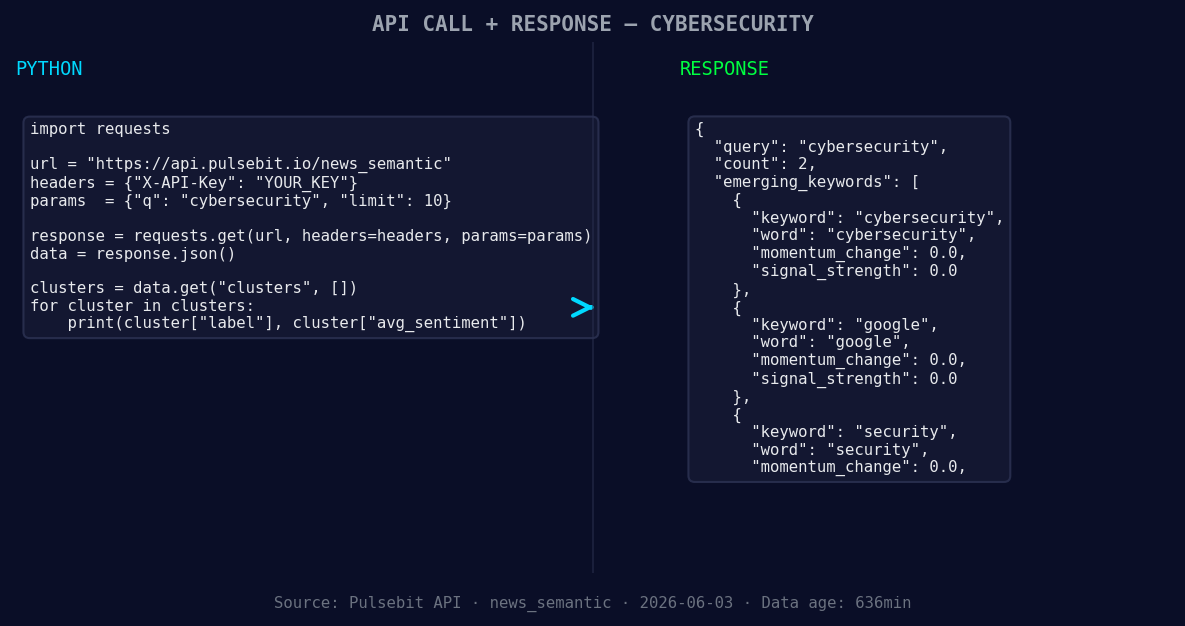
*Left: Python GET /news_semantic call for 'cybersecurity'. Right: returned JSON response structure (clusters: 3). Source: Pulsebit /news_semantic.*
print(articles)
This request filters articles specifically in English, allowing us to hone in on the critical narrative forming around cybersecurity. But that’s just the starting point. The next step is to run the cluster reason string back through our sentiment analysis to score the narrative framing itself.
Here’s how you can do that:
# Meta-sentiment moment
cluster_reason = "Clustered by shared themes: cio, implores, industry, put, greater."
sentiment_response = requests.post("https://api.pulsebit.com/sentiment", json={"text": cluster_reason})
sentiment_analysis = sentiment_response.json()

print(sentiment_analysis)
This POST request evaluates the sentiment of the clustered themes, giving you deeper insights into how the narrative itself is shaping up.
Now, let’s talk about three specific things you can build with this newfound pattern in mind:
Geo-filtered Alerts: Create a real-time alert system that triggers when the momentum score exceeds a threshold of +0.2 for English articles on cybersecurity. This ensures you’re always in the loop when critical conversations are happening.
Meta-sentiment Dashboard: Build a dashboard that visualizes the sentiment analysis of clustered themes, particularly focusing on narratives that include terms like "CIO," "implores," and "industry." This helps you track how sentiments evolve over time.
Comparative Analysis Tool: Develop a tool that compares sentiment scores between English and German articles on the same topic. Set a threshold to highlight discrepancies in coverage between the two languages, particularly for topics like cybersecurity, Google, and security.
If you want to get started with these ideas, check out our documentation at pulsebit.lojenterprise.com/docs. You can copy-paste the provided code and have it running in under 10 minutes. Don't let your pipeline stay behind; catch those sentiment leads and stay ahead of the game!


Top comments (0)