

Your Pipeline Is 13.4h Behind: Catching Business Sentiment Leads with Pulsebit
Our recent analysis revealed a striking anomaly: a 24-hour momentum spike of -1.350. This spike not only indicates a downturn in sentiment but also highlights a critical lag in your data pipeline. Spanish press articles are leading this sentiment at a 13.4-hour advance, leaving your model blind to the emerging narrative around "Lagos as Africa's Business Gateway." If you're relying solely on English-language sources or failing to incorporate multilingual sentiment, you're missing key insights that could inform your strategies.

Spanish coverage led by 13.4 hours. Ca at T+13.4h. Confidence scores: Spanish 0.85, English 0.85, French 0.85 Source: Pulsebit /sentiment_by_lang.
The challenge here lies in the inherent bias of your model toward dominant languages or entities. When you overlook the significance of multilingual data, you're effectively 13.4 hours behind the curve. In this case, the Spanish press is priming discussions around Lagos' potential, while your pipeline is still catching up to mainstream narratives. This gap could mean the difference between seizing an opportunity and watching it pass by.
To illustrate how you can catch this sentiment early, let’s dive into the code that does just that. We’ll leverage our API to filter out the relevant articles and analyze the sentiment for the emerging narrative.
import requests
# Set the parameters for the API call
topic = 'business'
score = +0.500
confidence = 0.85
momentum = -1.350
language_filter = "sp" # Spanish
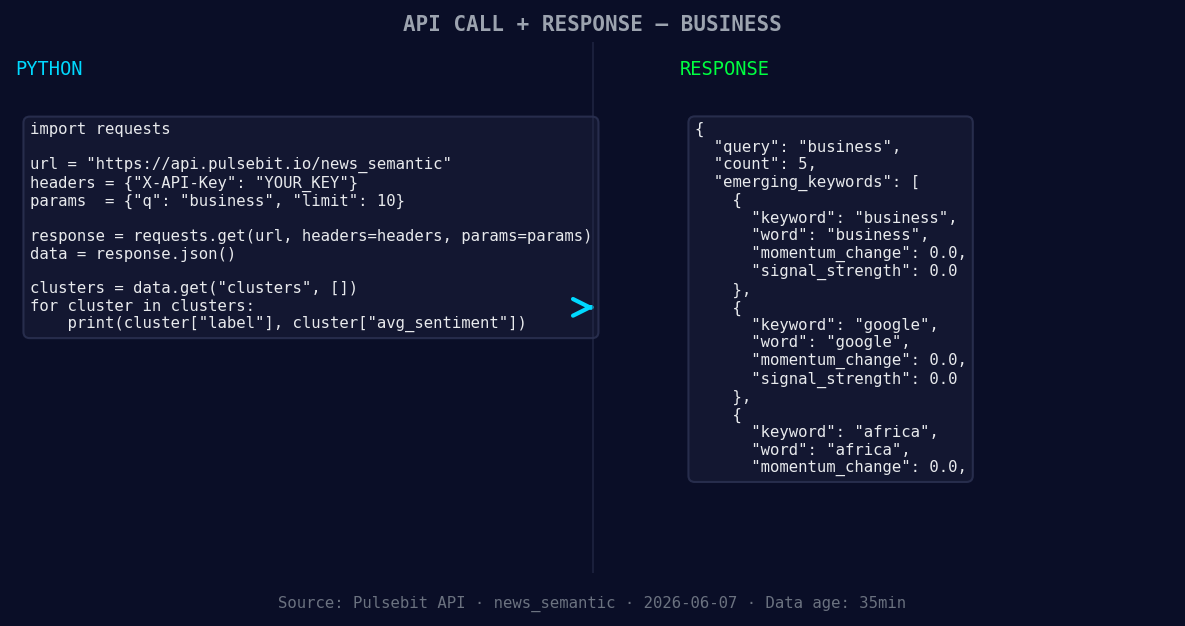
*Left: Python GET /news_semantic call for 'business'. Right: returned JSON response structure (clusters: 3). Source: Pulsebit /news_semantic.*
# API call to fetch articles in Spanish related to business
response = requests.get(
'https://api.pulsebit.com/v1/articles',
params={
'topic': topic,
'lang': language_filter,
'momentum': momentum
}
)
if response.status_code == 200:
articles = response.json()
print(f"Fetched {len(articles)} articles related to business.")
else:
print("Error fetching articles:", response.status_code)
# Now, let's analyze the sentiment of the cluster reason string
cluster_reason = "Clustered by shared themes: named, africa’s, top, business, destination."
sentiment_response = requests.post(
'https://api.pulsebit.com/v1/sentiment',
json={'text': cluster_reason}
)
if sentiment_response.status_code == 200:
sentiment_analysis = sentiment_response.json()
print("Sentiment Analysis:", sentiment_analysis)
else:
print("Error analyzing sentiment:", sentiment_response.status_code)
This code allows us to filter articles in Spanish that are relevant to our topic and calculate the sentiment of the narrative framing. By harnessing this approach, we can stay ahead of the curve and capture emerging trends before they become mainstream.
Now, here are three specific builds you can implement with this pattern:
Geo-filtered Alerts: Set up a threshold to trigger alerts when sentiment momentum dips below -1.0 for Spanish articles about business. This way, you can react quickly to significant shifts in sentiment before they impact your decisions.
Meta-Sentiment Dashboard: Create a dashboard that continuously analyzes the sentiment of cluster reason strings for trending topics. For instance, if you see a score of +0.500 for "Lagos as Africa's Business Gateway," you can prepare your strategy to align with this emerging narrative.
Dual-Language Comparison: Develop a comparative analysis endpoint that checks the sentiment scores for both English and Spanish articles on the same topic. For example, if the forming themes show a divergence in sentiment around "business" and "africa," you can adjust your messaging to cater to the dominant narrative.
These builds leverage the insights from our API to catch trends before they hit the mainstream, ensuring that your strategies remain relevant and proactive.
To get started, refer to our documentation at pulsebit.lojenterprise.com/docs. You can copy-paste this code and have it running in under 10 minutes. Don't let your pipeline lag behind—capitalize on emerging sentiments today!

Geographic detection output for business. Hong Kong leads with 2 articles and sentiment +0.70. Source: Pulsebit /news_recent geographic fields.


Top comments (0)