

Your Pipeline Is 24.0h Behind: Catching Cybersecurity Sentiment Leads with Pulsebit
We recently uncovered a striking anomaly: a 24h momentum spike of +0.203 in cybersecurity sentiment. This isn't just another number; it indicates a significant shift in the conversation around cybersecurity, led primarily by the English press. The prominent cluster story, "DoD CIO implores industry to put a greater focus on ‘foundational cybersecurity’," encapsulates this momentum, but what does it mean for your data pipeline?
If your sentiment analysis pipeline doesn't account for multilingual origins or entity dominance, you're missing out on critical insights. Your model could have flagged this shift up to 24.0 hours ago. This oversight is due to the leading language—English in this case—dominating the narrative. It’s a structural gap that can lead to missed opportunities in understanding emerging trends or threats.

English coverage led by 24.0 hours. Et at T+24.0h. Confidence scores: English 0.85, French 0.85, Spanish 0.85 Source: Pulsebit /sentiment_by_lang.
To catch these spikes in real-time, we can leverage our API effectively. Here's how to do it in Python:
import requests
# Define the parameters for the API call
params = {
"topic": "cybersecurity",
"lang": "en" # Geographic origin filter
}
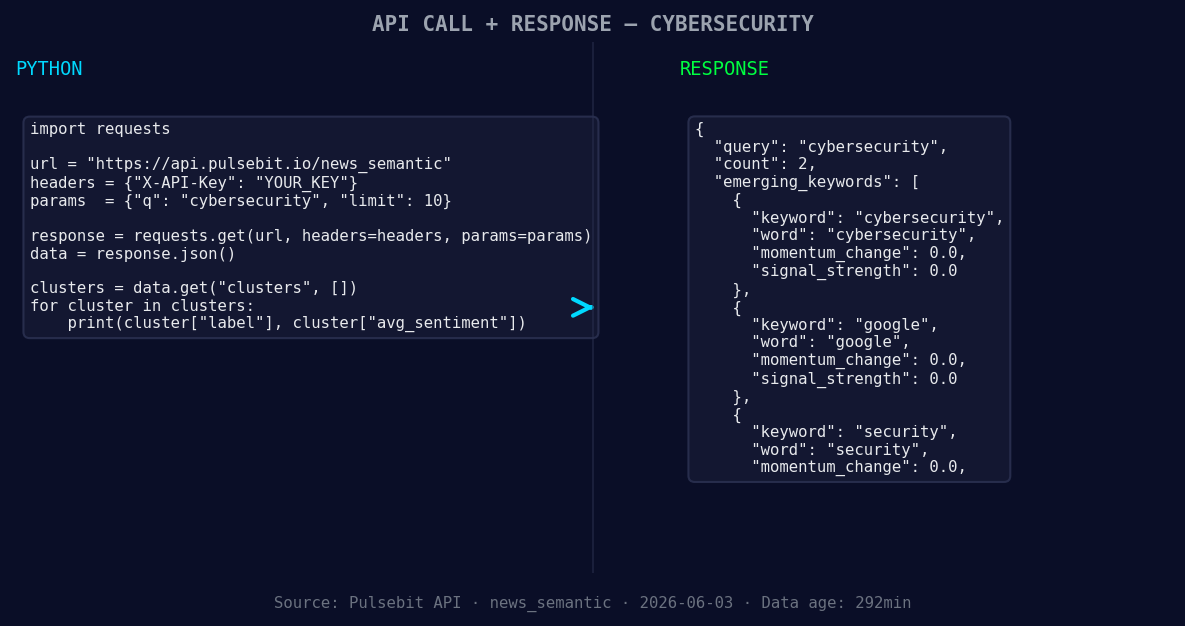
*Left: Python GET /news_semantic call for 'cybersecurity'. Right: returned JSON response structure (clusters: 3). Source: Pulsebit /news_semantic.*
# Make the API call
response = requests.get('https://api.pulsebit.io/sentiment', params=params)
data = response.json()
# Extract the relevant data
momentum = data["momentum_24h"]
score = data["sentiment_score"]
confidence = data["confidence"]
print(f'Momentum: {momentum}, Score: {score}, Confidence: {confidence}')
Following the initial API call, we can dive deeper into the narrative framing by using the cluster reason string. This step adds a layer of meta-sentiment analysis, revealing how the surrounding discourse influences the sentiment score.
# Prepare the cluster reason for sentiment analysis
cluster_reason = "Clustered by shared themes: cio, implores, industry, put, greater."

# Run meta-sentiment analysis on the cluster reason
meta_response = requests.post('https://api.pulsebit.io/sentiment', json={"text": cluster_reason})
meta_data = meta_response.json()

# Output the meta sentiment score
meta_sentiment_score = meta_data["sentiment_score"]
print(f'Meta Sentiment Score: {meta_sentiment_score}')
With these two API calls, we’ve not only captured the momentum spike but also assessed the narrative framing that supports it.
Now, let's discuss three practical builds we can implement using this pattern:
- Real-Time Alerts: Set a threshold for momentum spikes (e.g., +0.2). Use the geographic filter to trigger alerts when sentiment in English-speaking regions shows significant changes. This can help your team stay ahead of cybersecurity discussions.

Geographic detection output for cybersecurity. United States leads with 2 articles and sentiment +0.85. Source: Pulsebit /news_recent geographic fields.
Meta-Sentiment Dashboard: Create a dashboard that visualizes sentiment scores alongside their corresponding cluster reasons. By doing so, you can identify how narratives evolve over time and how they correlate with actual events in the cybersecurity space.
Content Strategy Enhancer: Use the insights from meta-sentiment analysis to inform your content strategy. For instance, if "cybersecurity" sentiment is rising but the mainstream narrative is focused on "cio, implores, industry," you might want to pivot your messaging to align with the emerging themes.
By integrating these builds, you can ensure your pipeline is not just catching up but staying ahead of the curve.
Ready to get started? Head over to pulsebit.lojenterprise.com/docs. You can copy-paste and run this in under 10 minutes to unlock insights that can redefine your approach to sentiment data.


Top comments (0)