

Your Pipeline Is 16.4h Behind: Catching World Sentiment Leads with Pulsebit
We just uncovered a significant anomaly: a 24-hour momentum spike of +0.185 in the sentiment surrounding global education news. This spike led by English press is marked by a 16.4-hour lead time, leaving your current model in the dust. If you're still running a pipeline that doesn't account for multilingual origins or entity dominance, you’re likely missing critical insights like this one.

English coverage led by 16.4 hours. Ro at T+16.4h. Confidence scores: English 0.75, Nl 0.75, French 0.75 Source: Pulsebit /sentiment_by_lang.
The problem is clear: your pipeline is lagging behind by 16.4 hours while important narratives unfold. With the leading language in this context being English, if your model isn’t designed to capture these nuances, it risks falling short in recognizing emerging trends before they're mainstream. This gap can result in missed opportunities and an incomplete picture of public sentiment, especially in today's fast-paced information landscape.
Let’s take a look at the code that can help you catch this momentum spike. First, we need to query our API for sentiment data filtered by language. Here’s how you can do it in Python:
import requests
# Define parameters for the API call
topic = 'world'
score = +0.003
confidence = 0.75
momentum = +0.185
lang = 'en'
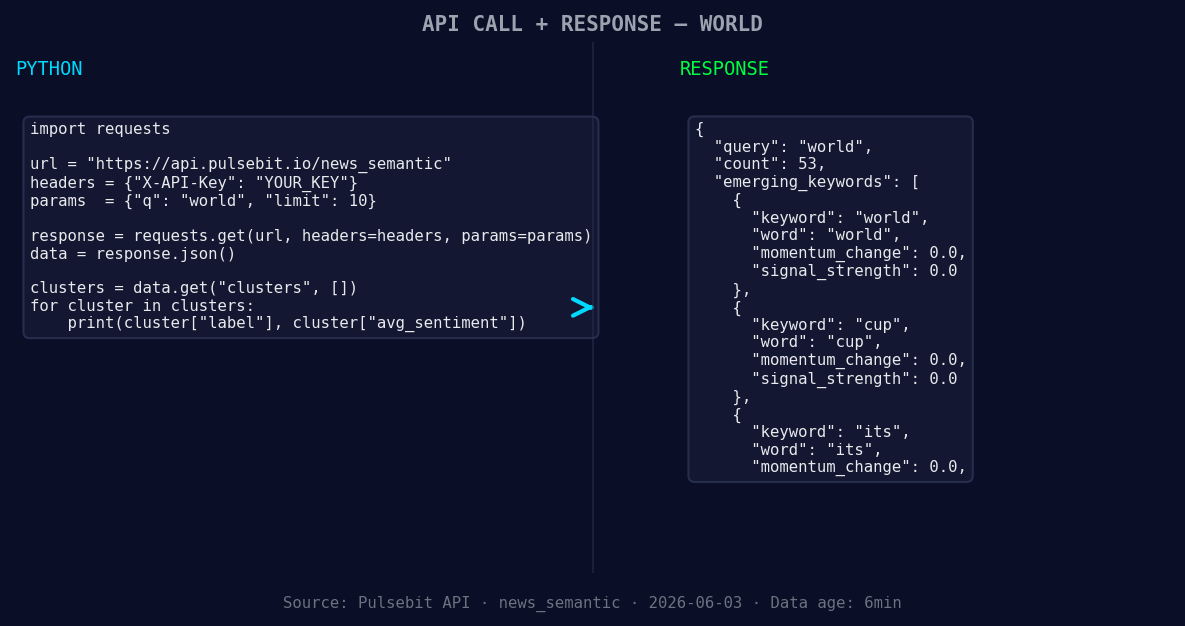
*Left: Python GET /news_semantic call for 'world'. Right: returned JSON response structure (clusters: 3). Source: Pulsebit /news_semantic.*
# Geographic origin filter: query by language
response = requests.get(f'https://api.pulsebit.com/sentiment?topic={topic}&lang={lang}')
data = response.json()
print(data)
Now that we have the data, let’s run the cluster reason string through our sentiment endpoint to evaluate the narrative's framing:
# Input example for the meta-sentiment moment
cluster_reason = "Clustered by shared themes: news, world, education:, june, 2026."

# Running the cluster reason through POST /sentiment
meta_sentiment_response = requests.post(
    'https://api.pulsebit.com/sentiment',
    json={'input': cluster_reason}
)
meta_sentiment_data = meta_sentiment_response.json()
print(meta_sentiment_data)
These two API calls will help you capture not just the sentiment data but also the context behind it, allowing you to make informed decisions based on the latest trends.
Now, let’s explore three specific builds we can implement with this pattern:
- Geo-Filtered Insights: Create an endpoint that uses the geographic filter to pull in sentiment data specifically for 'world' events. Set a threshold of momentum > +0.150 to identify significant spikes. This can alert you to global trends before they become widespread.

Geographic detection output for world. India leads with 15 articles and sentiment +0.29. Source: Pulsebit /news_recent geographic fields.
Meta-Sentiment Tracking: Develop a function that continuously monitors the cluster reasons and runs them through our sentiment endpoint. By setting up a scheduled task that checks for new clusters every hour, you can stay ahead of the curve on evolving narratives.
Forming Themes Analysis: Implement a signal that evaluates forming themes against mainstream sentiment. Monitor the topics of 'world', 'cup', and 'its' with a threshold of score > +0.002. This will help you identify subtle shifts in public interest and sentiment that could lead to larger trends.
Ready to dive in? Check out our documentation at pulsebit.lojenterprise.com/docs for more details and start implementing this in under 10 minutes. With these insights, you can ensure your pipeline is not just reactive, but proactive in capturing sentiment shifts as they happen.


Top comments (0)