

Your pipeline just missed a significant 24h momentum spike of +0.440 around the topic of human rights. This isn't just any spike; it's an anomaly that suggests a rapidly evolving sentiment landscape. The leading language for this spike is English, with a notable 26.7-hour lead time, indicating that sentiment was already shifting while many models were still catching up. In this case, we see a clustered story titled "Discussion on Human Rights Ordinance in East Lansing," signaling that there’s more to unpack here than meets the eye.
The Problem
For those of you working with sentiment analysis, this data reveals a structural gap in pipelines that don’t account for multilingual origins or dominant entities. Your model missed this by over 26 hours—an eternity in the fast-paced world of sentiment analysis. The dominant entity here is English, but it highlights how quickly narratives can evolve, especially in localized contexts like East Lansing. If your system isn’t agile enough to adapt to these shifts, you’ll miss crucial insights in your sentiment readings.

English coverage led by 26.7 hours. Et at T+26.7h. Confidence scores: English 0.75, Spanish 0.75, French 0.75 Source: Pulsebit /sentiment_by_lang.
The Code
To catch this anomaly, we can leverage our API for precise, targeted queries. Below is a Python snippet that filters the data based on the geographic origin, focusing on the English language:
import requests
# Define the API endpoint and parameters
api_url = "https://api.pulsebit.lojenterprise.com/query"
params = {
"topic": "human rights",
"lang": "en"
}
# Make the API call
response = requests.get(api_url, params=params)
data = response.json()
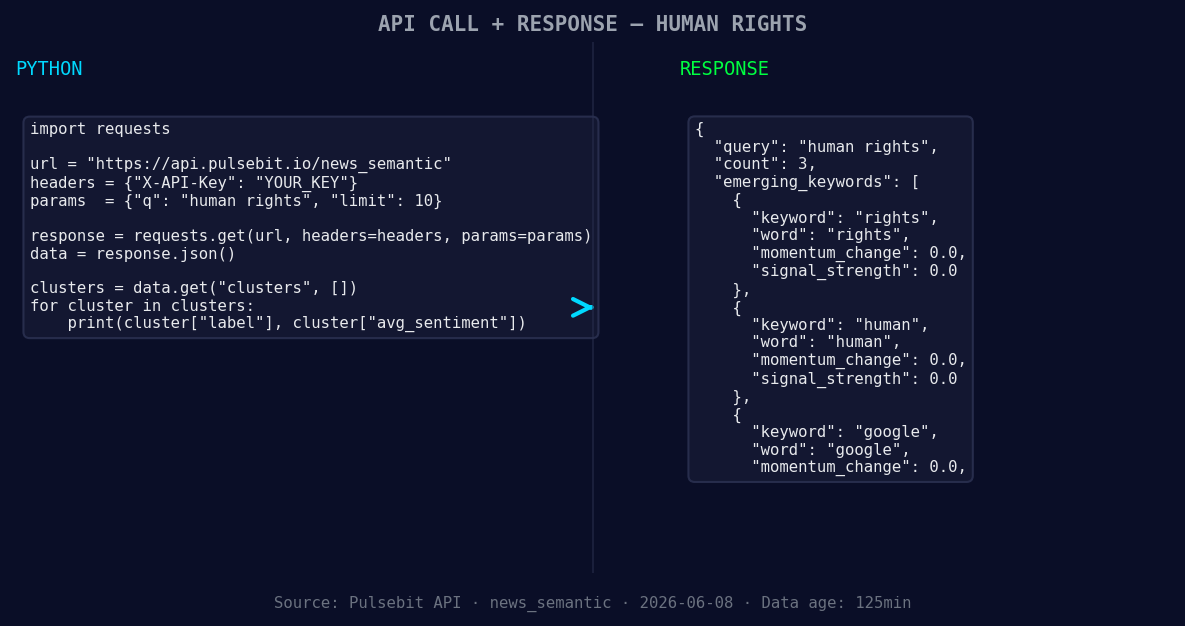
*Left: Python GET /news_semantic call for 'human rights'. Right: returned JSON response structure (clusters: 3). Source: Pulsebit /news_semantic.*
print(data) # Print the retrieved data
Next, we’ll assess the narrative framing by running the cluster reason string through our sentiment scoring endpoint:
# Define the sentiment API endpoint
sentiment_url = "https://api.pulsebit.lojenterprise.com/sentiment"
cluster_reason = "Clustered by shared themes: lansing, residents, invited, discuss, human."

# Make the API call to get sentiment score
sentiment_response = requests.post(sentiment_url, json={"text": cluster_reason})
sentiment_data = sentiment_response.json()

print(sentiment_data)  # Print the sentiment score
By pulling together the data from both calls, you’ll have a comprehensive look at the sentiment landscape surrounding human rights as discussed in East Lansing.
Three Builds Tonight
- Geographic Filter for Localized Insights: Use the geographic origin filter to focus on the human rights topic, ensuring that your results only come from English-speaking areas. This can drastically cut down noise from irrelevant data and enhance your signal strength.

Geographic detection output for human rights. Hong Kong leads with 2 articles and sentiment -0.70. Source: Pulsebit /news_recent geographic fields.
Meta-Sentiment Analysis: Implement the meta-sentiment loop to evaluate the narrative framing around clustered articles. By using the cluster reason string, you can extract nuanced sentiment scores that reflect the underlying emotions of specific discussions. This adds depth to your analysis and helps you interpret sentiment shifts better.
Dynamic Threshold Alerts: Set up alerts for any topic that moves beyond a +0.200 threshold in sentiment scores. This way, you can catch emerging narratives in real-time. Specifically, keep an eye on the forming themes: rights (+0.00), human (+0.00), and how they contrast with mainstream discussions around lansing, residents, and invited.
Get Started
Dive deeper and experiment with our API at pulsebit.lojenterprise.com/docs. You can copy-paste and run the above code snippets in under 10 minutes to start catching these critical sentiment shifts. This isn’t just about data; it’s about staying ahead in a rapidly evolving sentiment landscape.


Top comments (0)