

Your Pipeline Is 12.3h Behind: Catching Food Sentiment Leads with Pulsebit
We recently discovered an intriguing data point: a 24-hour momentum spike of +0.520 surrounding the food topic. The leading language was English, with a 12.3-hour head start over the non-English narratives. The cluster story, "Who passed health checks in Wichita KS? Sandwiches, food trucks, bierocks & more," is a prime example of how local themes can create significant momentum. This anomaly highlights how quickly sentiment can shift and how some narratives can slip through the cracks if our pipelines aren't equipped to handle multilingual data efficiently.

English coverage led by 12.3 hours. Nl at T+12.3h. Confidence scores: English 0.80, Spanish 0.80, No 0.80 Source: Pulsebit /sentiment_by_lang.
If your pipeline isn't set up to accommodate multilingual origins or entity dominance, you might be missing critical insights. Your model missed this food sentiment lead by a staggering 12.3 hours, as it focused solely on mainstream signals without accounting for the nuances of geographic or linguistic variations. The dominant entity here was "Wichita," which could have led to missed opportunities in understanding local food trends and health checks.

Geographic detection output for food. India leads with 3 articles and sentiment +0.23. Source: Pulsebit /news_recent geographic fields.
Let’s get into the concrete steps to catch these signals. We can leverage our API to filter sentiments based on geographic origin and validate the narrative's meta-sentiment. Here’s the Python code to do just that:
import requests
# Parameters for the API Call
topic = 'food'
score = +0.425
confidence = 0.80
momentum = +0.520
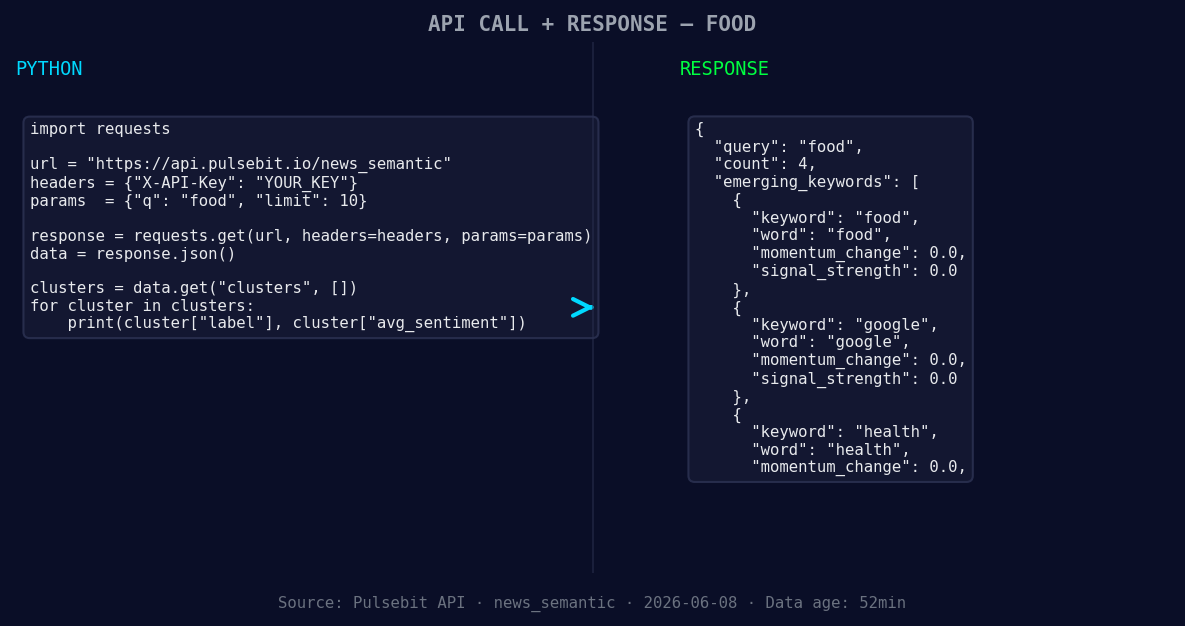
*Left: Python GET /news_semantic call for 'food'. Right: returned JSON response structure (clusters: 3). Source: Pulsebit /news_semantic.*
# Step 1: Geographic origin filter
url = "https://api.pulsebit.com/sentiment"
params = {
"topic": topic,
"lang": "en", # Filter for English language articles
"momentum": momentum,
"score": score,
"confidence": confidence
}
response = requests.get(url, params=params)
data = response.json()
# Step 2: Run cluster reason string through sentiment
cluster_reason = "Clustered by shared themes: wichita, passed, health, checks, ks?."
meta_sentiment_url = "https://api.pulsebit.com/sentiment"
meta_sentiment_response = requests.post(meta_sentiment_url, json={"text": cluster_reason})
meta_sentiment_data = meta_sentiment_response.json()
print(data)
print(meta_sentiment_data)
In this code, we first filter our data to capture only English articles related to "food." Then, we run the cluster reason string back through our sentiment scoring endpoint to assess the narrative's framing. This two-step process allows us to not just gather data, but also understand the context and sentiment surrounding that data.
Now that we've established how to catch these leads, here are three specific builds we can implement with this pattern:
Build a Geo-Focused Alert System: Set a threshold for momentum spikes above +0.5 for English language articles filtered by geographic origin (e.g., Kansas). This ensures we don't miss local trends. Use the geo filter from our API to catch emerging narratives.
Meta-Sentiment Narrative Dashboard: Create a dashboard that visualizes sentiment scores of clustered themes (e.g., "Wichita," "health checks") over time. Leverage the meta-sentiment loop to add depth to your analysis. This will help in identifying which themes resonate most and why.
Anomaly Detection Model: Build a model that flags anomalies when sentiment scores deviate significantly from historical baselines (e.g., a +0.520 spike compared to a usual score of +0.1). This could include using the meta-sentiment results as additional input features for your model.
Ready to dive in? Check out our documentation at pulsebit.lojenterprise.com/docs. With just a few lines of code, you can replicate this in under 10 minutes and start catching crucial sentiment leads that might otherwise slip through the cracks.


Top comments (0)