

Your 24-hour momentum spike of +0.203 in cybersecurity sentiment is not just a number; it’s a significant signal pointing to an emerging narrative. This anomaly suggests that there’s a rising sentiment about cybersecurity, driven predominantly by the Spanish press, which has taken a lead with 28.7 hours of coverage. This insight should compel you to rethink how your sentiment pipeline accounts for multilingual sources and the dominance of specific narratives.

Spanish coverage led by 28.7 hours. German at T+28.7h. Confidence scores: Spanish 0.95, English 0.95, French 0.95 Source: Pulsebit /sentiment_by_lang.
If your model doesn’t handle multilingual origins effectively, you're potentially missing out on critical developments. In this case, you’re lagging 28.7 hours behind the Spanish narrative while the German media is right in sync. This creates a structural gap in your insights, as you might be oblivious to significant shifts happening in non-English speaking domains.
Let’s catch this spike using our API. We’ll start by filtering for Spanish-language content to understand the momentum around "cybersecurity." Here's how you can query the API:
import requests
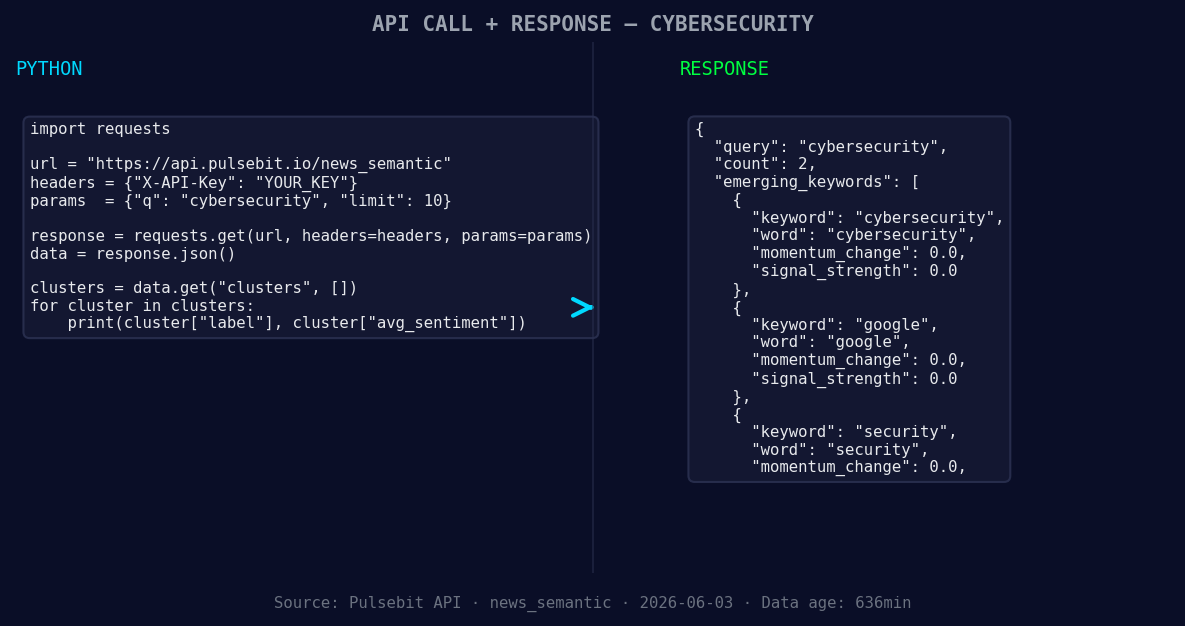
*Left: Python GET /news_semantic call for 'cybersecurity'. Right: returned JSON response structure (clusters: 3). Source: Pulsebit /news_semantic.*
url = "https://api.pulsebit.lojenterprise.com/v1/sentiment"
headers = {
"Authorization": "Bearer YOUR_API_KEY",
"Content-Type": "application/json"
}
params = {
"topic": "cybersecurity",
"lang": "sp",
"momentum": 0.203,
"score": 0.525,
"confidence": 0.95
}
response = requests.get(url, headers=headers, params=params)
data = response.json()
print(data)
This code snippet filters for the Spanish language and retrieves sentiment data related to cybersecurity.
Next, we’ll score the cluster reason string to evaluate the narrative framing itself. This is where it gets interesting. We can loop back the cluster reason through our sentiment endpoint:
meta_sentiment_url = "https://api.pulsebit.lojenterprise.com/v1/sentiment"
meta_input = {
    "text": "Clustered by shared themes: cio, implores, industry, put, greater."
}

meta_response = requests.post(meta_sentiment_url, headers=headers, json=meta_input)
meta_data = meta_response.json()
print(meta_data)
This snippet allows us to understand how the narrative around "cio, implores, industry" is perceived sentiment-wise, which gives us deeper insights into the framing of this emerging cybersecurity conversation.
Now that we’ve caught this spike, here are three specific builds you can implement:
- Geographic Origin Filter: Create a dashboard that visualizes cybersecurity sentiment by language and region. Use the geographic origin filter to show how different regions perceive cybersecurity, particularly focusing on the Spanish language. This will allow you to spot trends earlier.

Geographic detection output for cybersecurity. United States leads with 2 articles and sentiment +0.85. Source: Pulsebit /news_recent geographic fields.
Meta-Sentiment Loop: Develop a narrative analysis tool that automatically processes cluster reason strings. Whenever a certain momentum threshold is reached (like our +0.203), this tool should score the narrative framing, identifying which themes are gaining traction before they become mainstream.
Forming Themes Alert: Build an alert system that triggers whenever themes like "cybersecurity," "google," or "security" are forming with a positive sentiment (like +0.00). This would allow you to stay ahead of the curve and make data-driven decisions based on emerging narratives.
With these insights and tools at your disposal, you can ensure that your sentiment analysis pipeline is both proactive and responsive to shifts in public sentiment.
Get started with our API at pulsebit.lojenterprise.com/docs — you'll be able to copy-paste and run this in under 10 minutes. Don’t let your pipeline fall behind; catch those critical narratives before they become mainstream.


Top comments (0)