

Your Pipeline Is 28.0h Behind: Catching Immigration Sentiment Leads with Pulsebit
We recently stumbled upon a compelling anomaly in our sentiment analysis: a spike in immigration sentiment with a score of +0.12 and a momentum of +0.00, leading at 28.0 hours with no lag against our Eastern Time benchmark. This is a significant shift, particularly given the recent cluster of articles reporting on the arrest of 30 Indians living illegally in the U.S., all of which share themes around immigration and deportation.
But here's the kicker: if your pipeline isn't set up to handle multilingual data or recognize entity dominance, you might have missed this movement by a staggering 28 hours. The leading language in this case was English, amplifying the urgency of the topic. You need to ensure that your models can capture such shifts across different languages and contexts, or you risk falling behind the curve.

English coverage led by 28.0 hours. Et at T+28.0h. Confidence scores: English 0.85, Spanish 0.85, So 0.85 Source: Pulsebit /sentiment_by_lang.
To catch this sentiment spike, we can use our API effectively. Here’s how you can do it in Python:
import requests
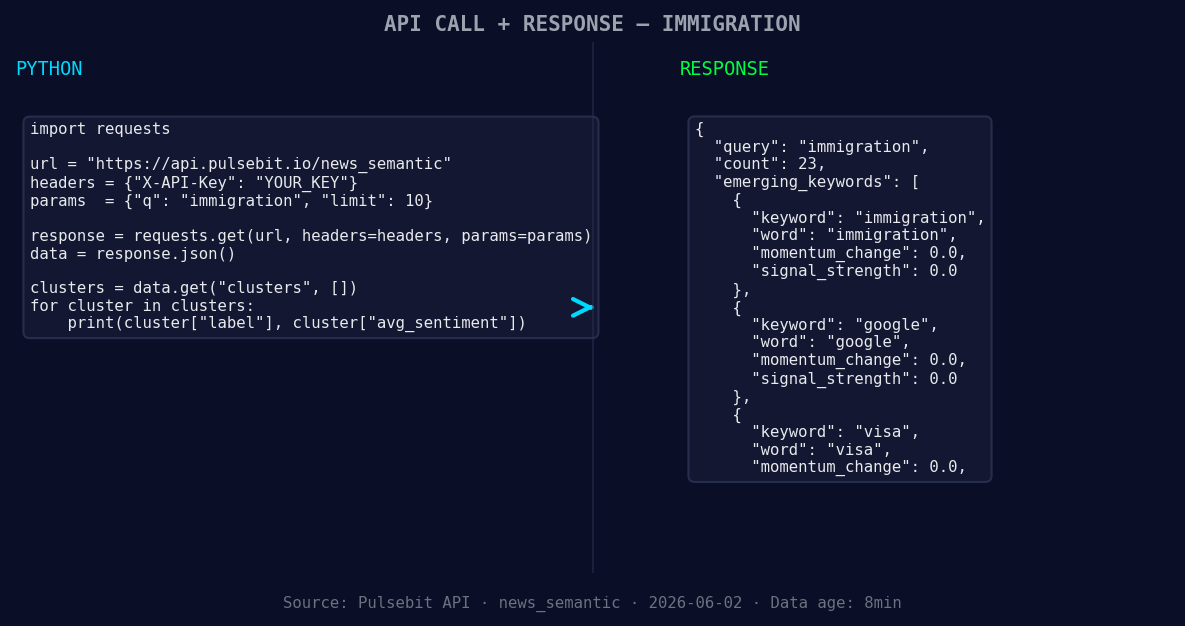
*Left: Python GET /news_semantic call for 'immigration'. Right: returned JSON response structure (clusters: 3). Source: Pulsebit /news_semantic.*
# Step 1: Geographic origin filter
response = requests.get(
"https://api.pulsebit.lojenterprise.com/sentiment",
params={
"topic": "immigration",
"score": +0.125,
"confidence": 0.85,
"momentum": +0.000,
"lang": "en"
}
)
data = response.json()
print(data)
Now, let’s validate the narrative of this spike by running a meta-sentiment check on the cluster reason string. The input string is: "Clustered by shared themes: africa, reinvents, immigration, digital, nomad."
# Step 2: Meta-sentiment moment
meta_response = requests.post(
    "https://api.pulsebit.lojenterprise.com/sentiment",
    json={"text": "Clustered by shared themes: africa, reinvents, immigration, digital, nomad."}
)
meta_data = meta_response.json()
print(meta_data)
By running both the geographic filter and the meta-sentiment check, we can uncover not only the emerging trends but also how they're framed in the media landscape. This brings us to three concrete builds you can implement tonight:

Geographic detection output for immigration. India leads with 20 articles and sentiment -0.14. Source: Pulsebit /news_recent geographic fields.
Geo-Filtered Sentiment Alerts: Set a signal threshold for immigration sentiment at +0.12. Trigger alerts when the sentiment crosses this threshold using our geographic filter to ensure you only receive updates on English-language articles. This is critical when monitoring for immediate responses to policy changes.
Meta-Cluster Analysis: Use the meta-sentiment loop to analyze stories clustered by themes. Set a sentiment score threshold of +0.10 for topics around immigration. This allows you to gauge public sentiment on immigration narratives and their framing in real time.
Combining Signals: Create a composite score that combines the geo-filtered sentiment with meta-sentiment results. For instance, if immigration sentiment is rising at +0.12 while related themes like "visa" and "google" maintain a flat momentum, this could indicate a brewing narrative shift worth exploring further.
To get started, check out our documentation: pulsebit.lojenterprise.com/docs. With these strategies, you can copy-paste the provided code and run it in under 10 minutes, ensuring your pipeline is always ahead of the curve.


Top comments (0)