

Your Pipeline Is 18.3h Behind: Catching Digital Transformation Sentiment Leads with Pulsebit
We recently observed a striking anomaly: a 24h momentum spike of +0.177 in digital transformation sentiment. This spike signifies a rapidly rising interest and positivity around digital transformation, especially as highlighted by the two articles clustering around the theme of "GeekyAnts Recognized for AI and Digital Transformation." What’s interesting is that this momentum is being led by English-language press with a notable lead time of 18.3 hours. If you’re not tracking this, your model is lagging behind by a significant margin.
The Problem
This leads us to a critical gap in many sentiment analysis pipelines. If your model isn't equipped to handle multilingual origins or entity dominance, you risk missing key insights like this momentum spike. Your model missed this by 18.3 hours, and the leading language in this case is English. Without the ability to process and prioritize sentiment data based on language and origin, you're left playing catch-up, possibly basing your decisions on stale or irrelevant information.

English coverage led by 18.3 hours. Et at T+18.3h. Confidence scores: English 0.85, French 0.85, Spanish 0.85 Source: Pulsebit /sentiment_by_lang.
The Code
To catch sentiment spikes like this effectively, we can leverage our API to filter by language and analyze the thematic narratives. Here's a simple Python script to achieve that:
import requests
# Set up parameters for the API call
topic = 'digital transformation'
momentum = +0.177
score = +0.850
confidence = 0.85
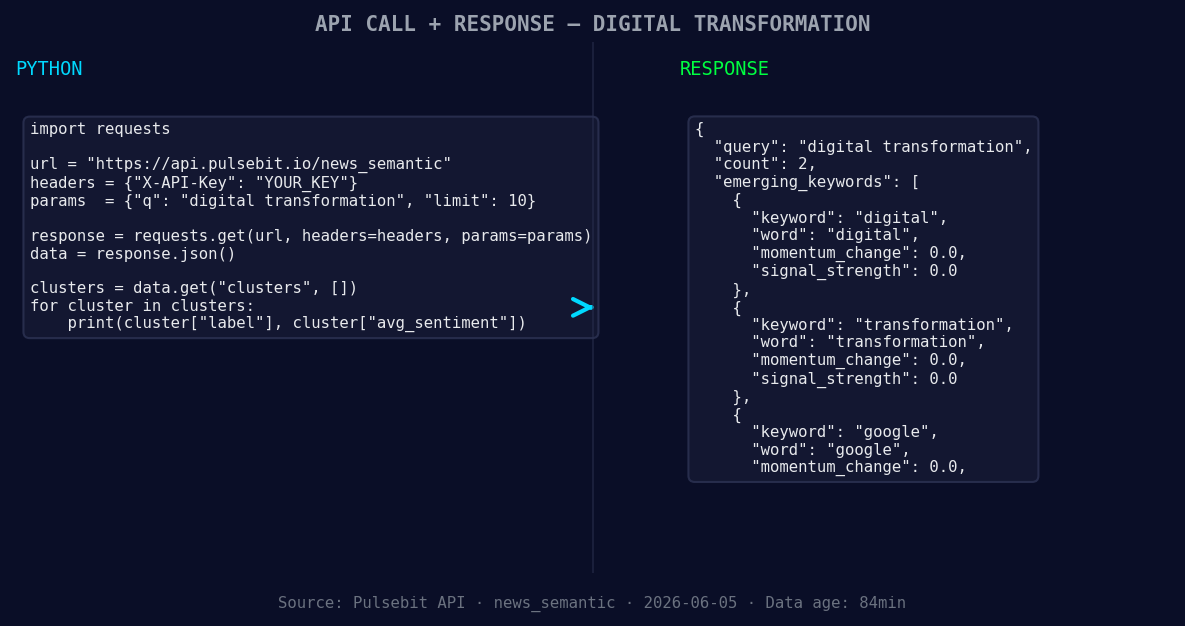
*Left: Python GET /news_semantic call for 'digital transformation'. Right: returned JSON response structure (clusters: 3). Source: Pulsebit /news_semantic.*
# Geographic origin filter: query by language
url = "https://api.pulsebit.com/v1/sentiment"
params = {
"topic": topic,
"lang": "en",
"momentum": momentum,
"score": score,
"confidence": confidence
}
response = requests.get(url, params=params)
data = response.json()
# Now, we run the cluster reason string through the sentiment endpoint
cluster_reason = "Clustered by shared themes: transformation, healthcare, market, hit, usd."
sentiment_response = requests.post(url, json={"text": cluster_reason})
sentiment_data = sentiment_response.json()
print(data)
print(sentiment_data)
In this code, we first filter sentiment data based on the English language and the specific topic of digital transformation. Next, we feed the cluster reason through the sentiment endpoint to score the narrative itself, ensuring we're capturing the full context of the emergent themes.
Three Builds Tonight
Here are three specific builds to consider based on this discovery:
- Geo-filtered Sentiment Dashboard: Create a dashboard that utilizes the geographic filter to visualize sentiment trends in real-time. Set a threshold of momentum > +0.1 for alerts. This will allow you to catch spikes as they happen.

Geographic detection output for digital transformation. Hong Kong leads with 1 articles and sentiment +0.85. Source: Pulsebit /news_recent geographic fields.
Meta-Sentiment Analysis Tool: Build a tool that automatically fetches cluster narratives and scores them against our sentiment endpoint. Use the output to identify key themes forming around digital transformation while filtering out noise from unrelated sectors like healthcare and market trends.
Historical Context Comparisons: Develop a feature that compares current sentiment against historical baselines. For instance, track spikes in digital transformation sentiment against previous periods to determine the significance of the current +0.177 momentum.
Get Started
You can dive into this right away at pulsebit.lojenterprise.com/docs. You’ll be able to copy-paste and run this code in under 10 minutes. Don't let your pipeline lag behind; catch these insights as they emerge!


Top comments (0)