

Your Pipeline Is 7.7h Behind: Catching Defence Sentiment Leads with Pulsebit
We recently observed a striking anomaly: a 24-hour momentum spike of +0.518 in sentiment related to the topic of defence. This spike was notably led by the Spanish press, which had a significant 7.7-hour lead over other sources. The dominating narrative focused on France's ban on Israeli weapons at a defence show, underscoring how quickly sentiment can shift based on current events. If your model isn't capturing this, you’re several hours behind the curve.
This situation highlights a critical shortfall in any sentiment analysis pipeline that doesn’t account for multilingual origins or entity dominance. If you’re solely relying on English-language sources, your model missed this spike by an astonishing 7.7 hours, while sentiment from Spanish media surged. In a world where timely insights can make or break decisions, this gap can lead to missed opportunities and incorrect assessments.

Spanish coverage led by 7.7 hours. No at T+7.7h. Confidence scores: Spanish 0.85, English 0.85, French 0.85 Source: Pulsebit /sentiment_by_lang.
To catch these spikes, we need to leverage our API effectively. Here’s how we can do that in Python:
import requests
# Define parameters for the API query
params = {
"topic": "defence",
"lang": "sp", # Filter for Spanish-language sources
"momentum": "+0.518",
"score": +0.060,
"confidence": 0.85
}
# API call to fetch sentiment data
response = requests.get("https://api.pulsebit.com/sentiment", params=params)
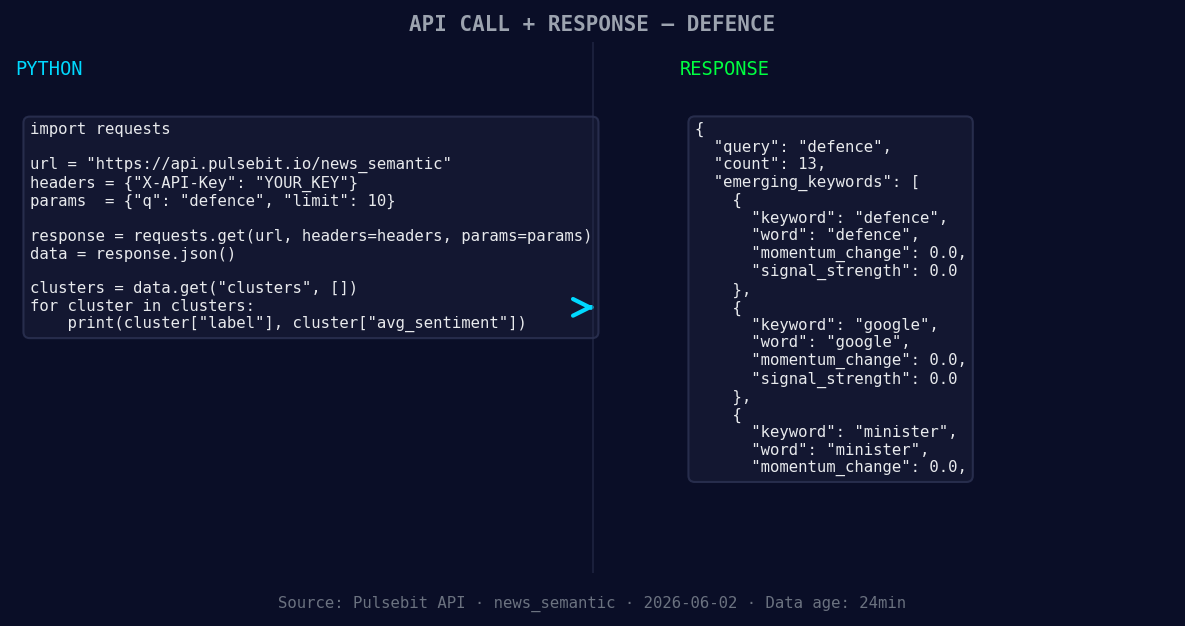
*Left: Python GET /news_semantic call for 'defence'. Right: returned JSON response structure (clusters: 3). Source: Pulsebit /news_semantic.*
data = response.json()
print(data)
Next, we need to evaluate the meta-sentiment of the narrative surrounding the spike. We can run the cluster reason string back through our sentiment endpoint to analyze how the sentiment is framed.
# Define the cluster reason string
cluster_reason = "Clustered by shared themes: israeli, major, defence, france, bans."

# API call to fetch meta-sentiment
meta_sentiment_response = requests.post("https://api.pulsebit.com/sentiment", json={"text": cluster_reason})

meta_sentiment_data = meta_sentiment_response.json()
print(meta_sentiment_data)
By integrating both the geographic origin filter and the meta-sentiment analysis, we can create a robust framework for detecting and responding to sentiment shifts in real time.

Geographic detection output for defence. India leads with 7 articles and sentiment +0.34. Source: Pulsebit /news_recent geographic fields.
Now, let’s explore three specific builds we can implement using this spike pattern:
Spanish Defence Insights: Create a signal that triggers when sentiment reaches a predefined threshold of +0.060 in the defence category. Implement a geographical origin filter to ensure you’re only capturing sources from Spanish media. This will help you stay ahead of shifts that could impact defence markets.
Meta-Sentiment Alerts: Set up an alert system that uses the meta-sentiment loop. Whenever the sentiment score exceeds +0.060 for narratives clustered around themes like “military” and “inquiry,” you can trigger a notification to your team to investigate further. This responsiveness can be crucial in fast-moving situations.
Comparative Analysis Dashboard: Build a dashboard that contrasts emerging themes like "defence" and "google" against mainstream narratives such as "sexual," "violence," and "landmark." This will help you visualize how different topics are trending and whether there’s a divergence in sentiment that may indicate underlying issues or opportunities.
To get started with these capabilities, refer to our documentation at pulsebit.lojenterprise.com/docs. You can copy-paste the above code and run it in under 10 minutes to catch up on these critical insights. Don’t let your pipeline lag behind.


Top comments (0)