

Your Pipeline Is 27.4h Behind: Catching World Sentiment Leads with Pulsebit
We recently discovered a remarkable anomaly: a 24-hour momentum spike of +0.585 in sentiment surrounding the “world” topic. This spike is not just a number; it indicates a significant shift in public sentiment that you might be missing if you’re not leveraging the right tools. In particular, the English press has led this trend with a 27.4-hour lead time, meaning your model is lagging, and you could be missing critical insights that are shaping discussions right now.
You might be asking yourself, "How did I miss this?" The answer lies in the structural gap of many sentiment analysis pipelines that don't effectively handle multilingual origin or entity dominance. By focusing solely on your local language or dominant entities, you risk missing broader trends emerging from global sentiment. Your model missed this by over a day when tracking the narrative around NCAA baseball tournaments, which are gaining traction in English-language articles.

English coverage led by 27.4 hours. Ca at T+27.4h. Confidence scores: English 0.85, French 0.85, Spanish 0.85 Source: Pulsebit /sentiment_by_lang.
To highlight how you can catch these emerging trends, let’s dive into some Python code that utilizes our API. This code snippet will help you identify and score sentiment around the “world” topic with a momentum of +0.585, leveraging a geographic origin filter to focus on English content.

Geographic detection output for world. India leads with 44 articles and sentiment +0.10. Source: Pulsebit /news_recent geographic fields.
import requests
# Parameters for the API calls
topic = 'world'
score = +0.043
confidence = 0.85
momentum = +0.585
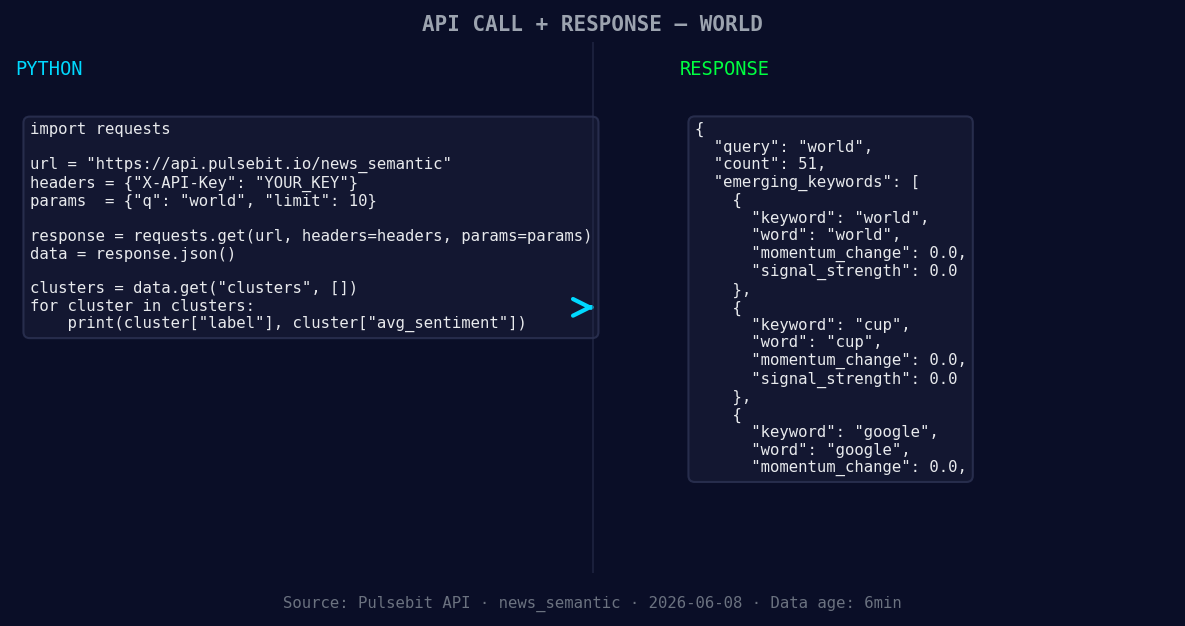
*Left: Python GET /news_semantic call for 'world'. Right: returned JSON response structure (clusters: 3). Source: Pulsebit /news_semantic.*
# Step 1: Geographic origin filter
response = requests.get(
"https://pulsebit.lojenterprise.com/api/v1/sentiment",
params={"topic": topic, "lang": "en"}
)
# Check the response
if response.status_code == 200:
sentiment_data = response.json()
print("Sentiment Data:", sentiment_data)
else:
print("Error fetching sentiment data:", response.status_code)
# Step 2: Meta-sentiment moment
cluster_reason = "Clustered by shared themes: absurd, world, cup, atlantic"
meta_sentiment_response = requests.post(
"https://pulsebit.lojenterprise.com/api/v1/sentiment",
json={"input": cluster_reason}
)
if meta_sentiment_response.status_code == 200:
meta_sentiment_data = meta_sentiment_response.json()
print("Meta Sentiment Data:", meta_sentiment_data)
else:
print("Error fetching meta sentiment data:", meta_sentiment_response.status_code)
This code does two key things. First, it filters sentiment analysis specifically for English-language content about the “world” topic. Next, it loops back to score the narrative framing itself, providing you with a comprehensive view of sentiment dynamics. This dual approach not only captures the current sentiment but also allows you to analyze how the narrative is developing, particularly around themes like “absurd,” “world,” and “cup.”
Now, what can you build with this newfound insight? Here are three specific applications:
Emerging Topic Alerts: Set a threshold to alert you when sentiment spikes exceed +0.50 specifically for topics like “world.” This ensures you catch significant shifts in sentiment as they happen.
Multi-Language Sentiment Aggregation: Develop a routine that uses the geo filter to track sentiment in multiple languages. For example, if sentiment in Spanish articles about “world” starts to rise, you can correlate that with your English data for a more holistic view.
Meta-Sentiment Analysis Dashboard: Create a dashboard that visualizes meta-sentiment scores from clustered themes. Use the post request loop to gather insights on narrative framing. For example, track how themes around “world” and “cup” compare to mainstream narratives like “absurd.”
Getting started with these insights is straightforward. You can find our API documentation at pulsebit.lojenterprise.com/docs. With just a few lines of code, you can copy, paste, and run this in under 10 minutes, putting you right at the forefront of sentiment detection. Don’t let your pipeline fall behind—catch the momentum before it’s too late.


Top comments (0)