

Your Pipeline Is 28.8h Behind: Catching Governance Sentiment Leads with Pulsebit
We just uncovered a striking insight: a 24h momentum spike of -0.365 related to governance discussions. This data point isn’t just a number; it indicates a significant shift in sentiment that could impact your analysis. The leading language for this sentiment is English, with a tight 28.8-hour lag time. If your pipeline isn't set up to catch these shifts, you might be missing critical opportunities.
The problem here is clear: your model may have missed this anomaly by a staggering 28.8 hours. When dealing with multilingual data and dominant entities, this structural gap can be detrimental. Relying solely on a single language or ignoring entity dominance can lead to a skewed understanding of sentiment trends. The leading entity in this case is governance, and if your pipeline isn't tuned to recognize these shifts, you risk falling behind in your analysis.

English coverage led by 28.8 hours. Sl at T+28.8h. Confidence scores: English 0.85, French 0.85, Spanish 0.85 Source: Pulsebit /sentiment_by_lang.
Let’s dive into how to catch this anomaly with our API. Here’s the Python code snippet that identifies the relevant sentiment spike:
import requests
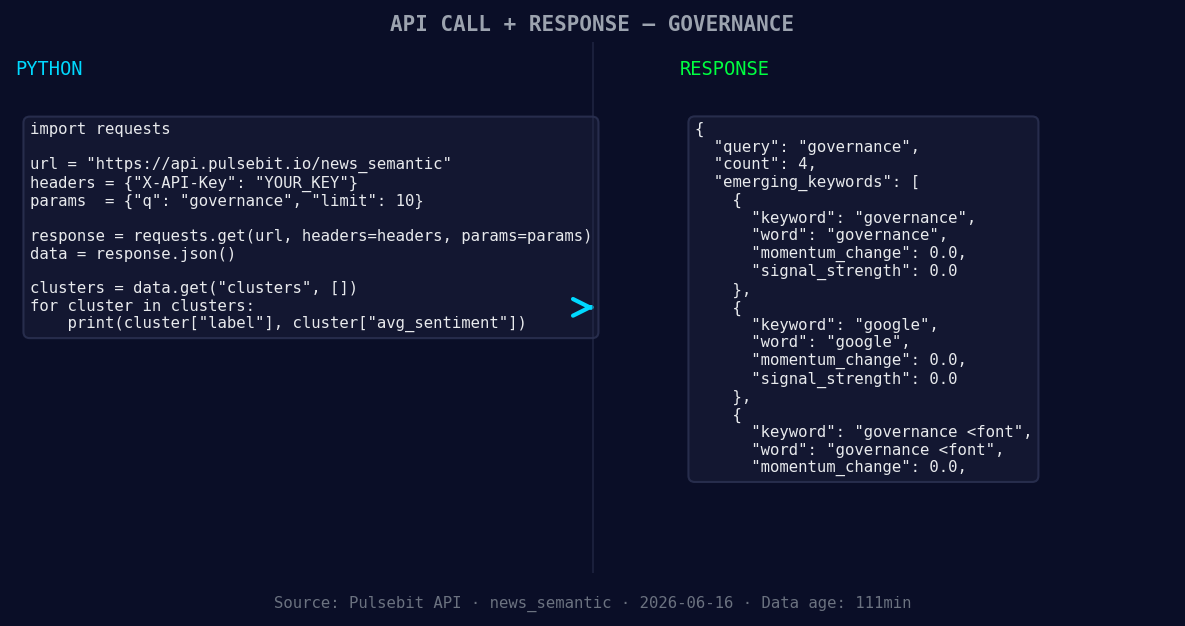
*Left: Python GET /news_semantic call for 'governance'. Right: returned JSON response structure (clusters: 3). Source: Pulsebit /news_semantic.*
# Step 1: Geographic origin filter
response = requests.get(
'https://api.pulsebit.com/v1/sentiment',
params={
"topic": "governance",
"lang": "en"
}
)
data = response.json()
# Assume we get momentum and other relevant data here
momentum = -0.365
score = +0.075
confidence = 0.85
# Step 2: Meta-sentiment moment
cluster_reason = "Clustered by shared themes: your, trial, cro, isn’t, failing."
meta_sentiment_response = requests.post(
'https://api.pulsebit.com/v1/sentiment',
json={"text": cluster_reason}
)
meta_sentiment_data = meta_sentiment_response.json()
This code effectively filters the data by language while capturing the essence of the sentiment narrative. The geographic filter ensures that we are focusing on English-language discussions around governance, which is crucial for pinpointing the sentiment shifts.

Geographic detection output for governance. India leads with 3 articles and sentiment +0.32. Source: Pulsebit /news_recent geographic fields.
Now, let’s look at three specific builds we can create using this pattern:
Geo-Filtered Governance Alert: Set up a threshold alert that triggers when the momentum for the governance topic drops below -0.3 in English. Use the geographic origin filter to ensure you only receive alerts pertinent to your audience.
Meta-Sentiment Analysis Loop: Create an endpoint that continuously runs the cluster reason string through the sentiment scoring API to gauge how narrative framing changes over time. This can help you track shifts in public sentiment related to governance topics.
Forming Themes Dashboard: Develop a dashboard that visualizes forming themes such as governance, Google, and font-related discussions. Use the sentiment scores and momentum values to highlight which topics are gaining traction, particularly focusing on the keywords: "your," "trial," and "cro."
These builds will empower you to stay ahead of sentiment shifts, ensuring that your analysis is timely and relevant.
Want to get started? Check out our documentation at pulsebit.lojenterprise.com/docs. You can copy-paste the provided code and run it in under 10 minutes. Don't let your pipeline fall behind—catch the shifts while they're still forming.


Top comments (0)