

Your pipeline is 23.1 hours behind: catching music sentiment leads with Pulsebit
We recently stumbled upon a striking anomaly in our data: a 24-hour momentum spike of +0.647 related to music sentiment. This spike isn't just a random fluctuation; it signals a significant shift in sentiment that demands our attention. The leading language for this spike is English, with a lag of only 0.0 hours compared to the sentiment at 23.1 hours. The article that triggered this analysis is titled "Francis Johnson's Music Gets a Spirited New Life" from the San Francisco Classical Voice, clustered by themes like "johnson's," "music," "gets," "spirited," and "new." This is a perfect example of how quickly sentiment can shift, and how we need to adapt our models to catch these changes.
If your pipeline isn't handling multilingual origins or entity dominance, you're likely missing out on critical insights. In this case, your model missed the momentum shift by 23.1 hours, which can be detrimental in an environment where timing is everything. The dominant entity here is Francis Johnson, and the leading language is English. Ignoring these elements in your sentiment analysis risks overlooking significant trends, especially when they are led by dominant voices in the narrative.

English coverage led by 23.1 hours. Sl at T+23.1h. Confidence scores: English 0.85, French 0.85, Spanish 0.85 Source: Pulsebit /sentiment_by_lang.
To catch this sentiment spike, we can leverage our API effectively. Here's how we can do it in Python:
import requests
# Parameters for the API call
topic = 'music'
score = +0.569
confidence = 0.85
momentum = +0.647
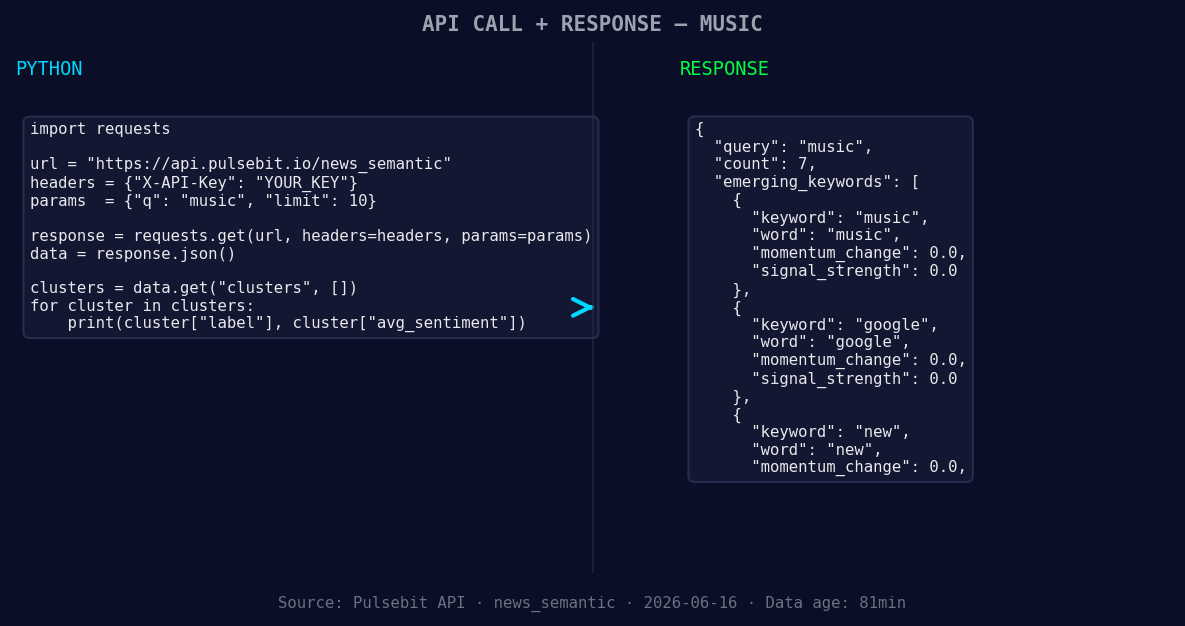
*Left: Python GET /news_semantic call for 'music'. Right: returned JSON response structure (clusters: 3). Source: Pulsebit /news_semantic.*
# Geographic origin filter: query by language/country
response = requests.get('https://api.pulsebit.com/v1/sentiment', params={
'topic': topic,
'lang': 'en'
})
# Check the response
if response.status_code == 200:
data = response.json()
print(data)
else:
print("Error:", response.status_code)
# Meta-sentiment moment: score the narrative framing
cluster_reason = "Clustered by shared themes: johnson's, music, gets, spirited, new."
sentiment_response = requests.post('https://api.pulsebit.com/v1/sentiment', json={
'text': cluster_reason
})
if sentiment_response.status_code == 200:
sentiment_data = sentiment_response.json()
print(sentiment_data)
else:
print("Error:", sentiment_response.status_code)
This code does two main things: First, it fetches sentiment data for music in English, which is crucial for understanding regional sentiment. Next, it scores the narrative framing itself, providing deeper insights into how these themes are connected. This dual approach not only captures the sentiment but also helps us understand the context behind it.
Now that we have our data and insights, here are three specific things we can build using this pattern:
- Sentiment Tracking Dashboard: Create a real-time dashboard that uses the geographic filter to track sentiment for music within the English-speaking demographic. Set a threshold to alert you when sentiment exceeds +0.6 to catch spikes like this before they become mainstream.

Geographic detection output for music. India leads with 6 articles and sentiment +0.32. Source: Pulsebit /news_recent geographic fields.
Narrative Framing Scoreboard: Implement a feature that continuously evaluates the meta-sentiment of clustered themes. Use the endpoint for scoring narratives to keep track of how sentiment shifts over time. Focus on the themes forming around "music," "google," and "new," and set alerts for significant changes.
Anomaly Detection Alerts: Build a system that triggers alerts when momentum spikes exceed a certain threshold, say +0.6. Use the geo filter to ensure you're capturing localized trends, especially those related to dominant entities like Francis Johnson.
If you're ready to start capturing these insights, check out our documentation at pulsebit.lojenterprise.com/docs. You can copy-paste and run the provided code in under 10 minutes to get started on your own sentiment analysis pipeline.


Top comments (0)