

Your Pipeline Is 11.0h Behind: Catching Entertainment Sentiment Leads with Pulsebit
We recently uncovered a striking anomaly: a 24h momentum spike of +0.555 in entertainment sentiment. This spike indicates a sudden surge in interest and positive sentiment around entertainment-related topics, specifically clustered around themes such as expositions and entertainment events. With a signal strength of 0.637 and a sentiment score of +0.200, it’s clear that there’s something noteworthy happening in this space.
However, if your pipeline isn’t equipped to handle multilingual origins or entity dominance, you might miss this opportunity entirely. Your model missed this by 11.0 hours, as the leading language in this case is English. This lag can result in you missing critical insights that could influence decision-making or content creation, especially when trends emerge rapidly across different languages and regions.

English coverage led by 11.0 hours. Hr at T+11.0h. Confidence scores: English 0.85, French 0.85, Spanish 0.85 Source: Pulsebit /sentiment_by_lang.
To catch this momentum spike, we can leverage our API effectively. Here’s how you can set it up in Python:
import requests
# Define parameters for the API call
lang = "en"
url = "https://api.pulsebit.com/v1/sentiment"
payload = {
"topic": "entertainment",
"score": +0.200,
"confidence": 0.85,
"momentum": +0.555,
"lang": lang
}
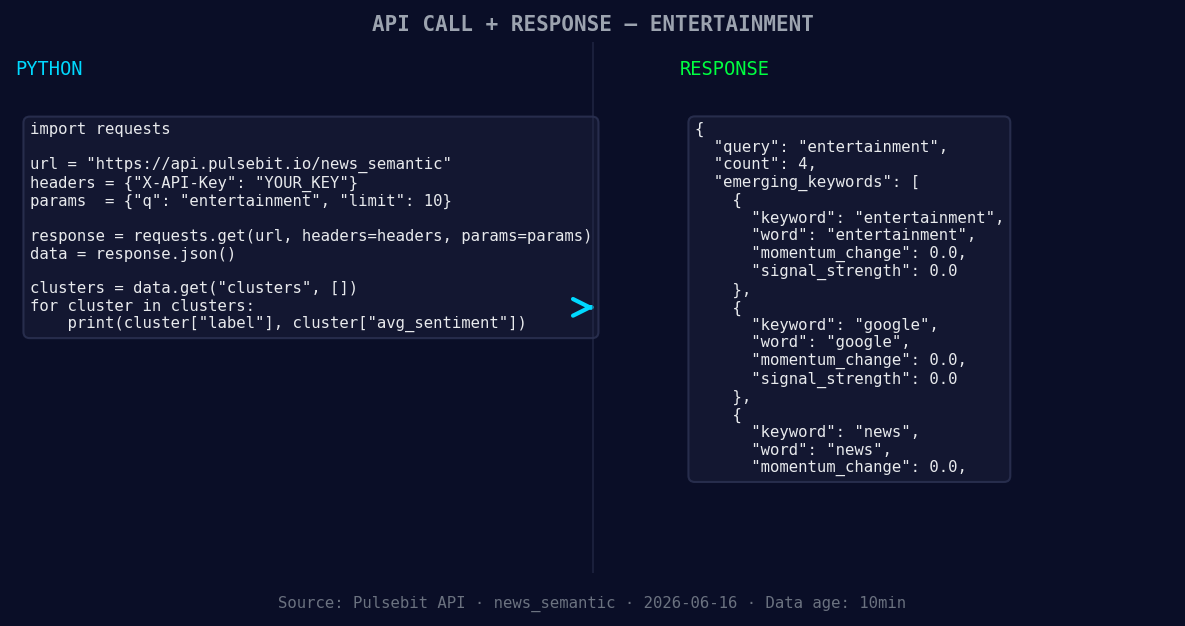
*Left: Python GET /news_semantic call for 'entertainment'. Right: returned JSON response structure (clusters: 3). Source: Pulsebit /news_semantic.*
# Geographic origin filter
response = requests.get(url, params=payload)
data = response.json()
# Meta-sentiment moment
cluster_reason = "Clustered by shared themes: exposition, dials, fun, three, nights."
meta_payload = {"text": cluster_reason}
meta_response = requests.post(url, json=meta_payload)
meta_data = meta_response.json()
print("Geographic Filter Response:", data)
print("Meta-Sentiment Response:", meta_data)

Geographic detection output for entertainment. Hong Kong leads with 2 articles and sentiment +0.00. Source: Pulsebit /news_recent geographic fields.
In this code, we first perform a GET request to fetch sentiment data for the topic "entertainment" while filtering for English-language content. Then, we run the cluster reason string through a POST request to score the narrative framing itself. This dual approach allows us to capture not just the sentiment but also the context driving it.
Now, let’s talk about three specific builds you can create with this pattern:
Signal Threshold Alert: Set a threshold for the entertainment sentiment spike at +0.500. When the sentiment exceeds this threshold, trigger a notification system to alert your team about the emerging trends. Use the geo filter to ensure you’re only capturing relevant data from English sources.
Meta-Sentiment Monitoring: Create a monitoring dashboard that runs the meta-sentiment loop every hour. Use the cluster reasons as input to assess current narratives shaping the entertainment landscape. This way, you can adapt your content strategy based on real-time sentiment shifts.
Engagement Metrics Tracker: Build an endpoint that captures engagement metrics around the forming themes: entertainment, Google, and news compared to mainstream topics like exposition, dials, and fun. By tracking these metrics, you can evaluate how much audience interest is growing in these areas and pivot your strategy accordingly.
To get started, check out our documentation at pulsebit.lojenterprise.com/docs. With the provided code samples, you can copy-paste and run this in under 10 minutes. Don’t let your pipeline lag behind—capitalize on these trends as they happen!


Top comments (0)