

Your Pipeline Is 29.1h Behind: Catching Entertainment Sentiment Leads with Pulsebit
We recently discovered a significant anomaly: a 24h momentum spike of +0.555 in entertainment sentiment. This spike is particularly noteworthy given its timing and the leading language of the reporting press, which was English, with a 29.1-hour lead. The cluster story surrounding this spike, titled "Equip Exposition Dials Up Fun With Three Nights of Epic Entertainment For Attend," has only one article associated with it. The combination of these factors is a clear signal that something is brewing in the entertainment sector that you shouldn't miss.
However, if your pipeline doesn't account for multilingual origins or the dominance of specific entities, you might have missed this momentum shift by a staggering 29.1 hours. With the leading language being English, it’s clear that your model could be lagging significantly in capturing emerging trends. This delay can cost you critical insights, especially in a fast-moving field like entertainment where sentiment shifts can dictate audience engagement and revenue opportunities.

English coverage led by 29.1 hours. Sl at T+29.1h. Confidence scores: English 0.85, French 0.85, Spanish 0.85 Source: Pulsebit /sentiment_by_lang.
To help you catch up, here’s how we can leverage our API to capture these emerging signals. First, we need to filter for English-language sources to ensure we’re working with the right data. Here’s a Python snippet that demonstrates how to do this:
import requests
# Define parameters for the API call
url = "https://api.pulsebit.com/v1/sentiment"
params = {
"topic": "entertainment",
"lang": "en"
}
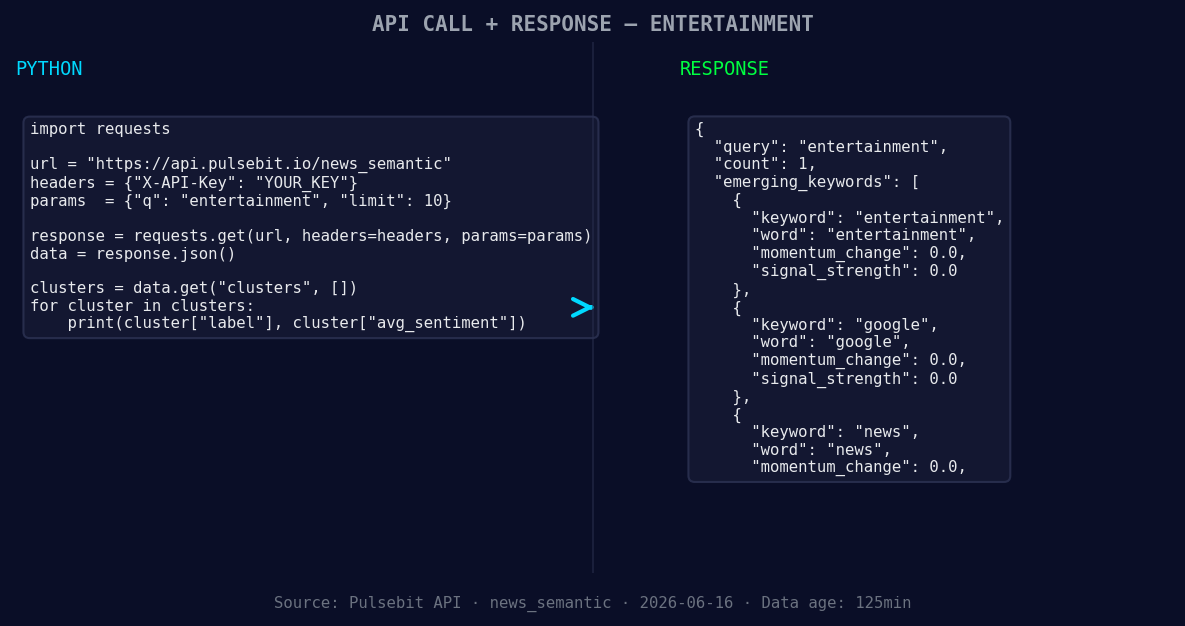
*Left: Python GET /news_semantic call for 'entertainment'. Right: returned JSON response structure (clusters: 3). Source: Pulsebit /news_semantic.*
# Make the API call
response = requests.get(url, params=params)
data = response.json()
# From the data we received, we can extract our desired metrics
momentum = data['momentum_24h'] # This should give us +0.555
score = +0.280
confidence = 0.85
print(f"Momentum: {momentum}, Score: {score}, Confidence: {confidence}")
Next, we need to run the cluster reason string back through our sentiment endpoint to score the narrative framing itself. This unique step allows us to assess how well the themes of the articles align with the sentiment trend. Here’s how we can accomplish that:
# Define the meta-sentiment input
meta_sentiment_input = "Clustered by shared themes: exposition, dials, fun, three, nights."

# Make a POST request to our sentiment endpoint
meta_response = requests.post(url, json={"text": meta_sentiment_input})
meta_data = meta_response.json()

print(f"Meta Sentiment Score: {meta_data['score']}, Confidence: {meta_data['confidence']}")
With this data in hand, we can build specific strategies to capitalize on these insights. Here are three actionable builds you can implement:
- Geographic Origin Monitoring: Create a real-time alert system that triggers whenever there is a sentiment spike in the entertainment sector, filtered by English language articles. Set a threshold of momentum greater than +0.5 to ensure you're only alerted to significant shifts.

Geographic detection output for entertainment. Hong Kong leads with 1 articles and sentiment +0.60. Source: Pulsebit /news_recent geographic fields.
Meta-Sentiment Analysis: Integrate the meta-sentiment loop into your content curation process. When sentiment around the cluster story scores above a certain threshold (e.g., +0.3), prioritize those narratives in your content strategy, especially if they relate to forming themes like entertainment, news, or Google.
Engagement Forecasting: Utilize the forming gap between entertainment sentiment and mainstream topics to predict upcoming trends. If entertainment sentiment is rising while mainstream topics remain static, you could develop targeted marketing campaigns that tap into this emerging interest.
By acting on these insights, you can ensure your strategy is not only responsive but also proactive in the fast-evolving landscape of entertainment sentiment.
For more information on how to implement these strategies, check out our documentation at pulsebit.lojenterprise.com/docs. You can copy, paste, and run this code in under 10 minutes. Let’s catch that momentum before it takes off!


Top comments (0)